
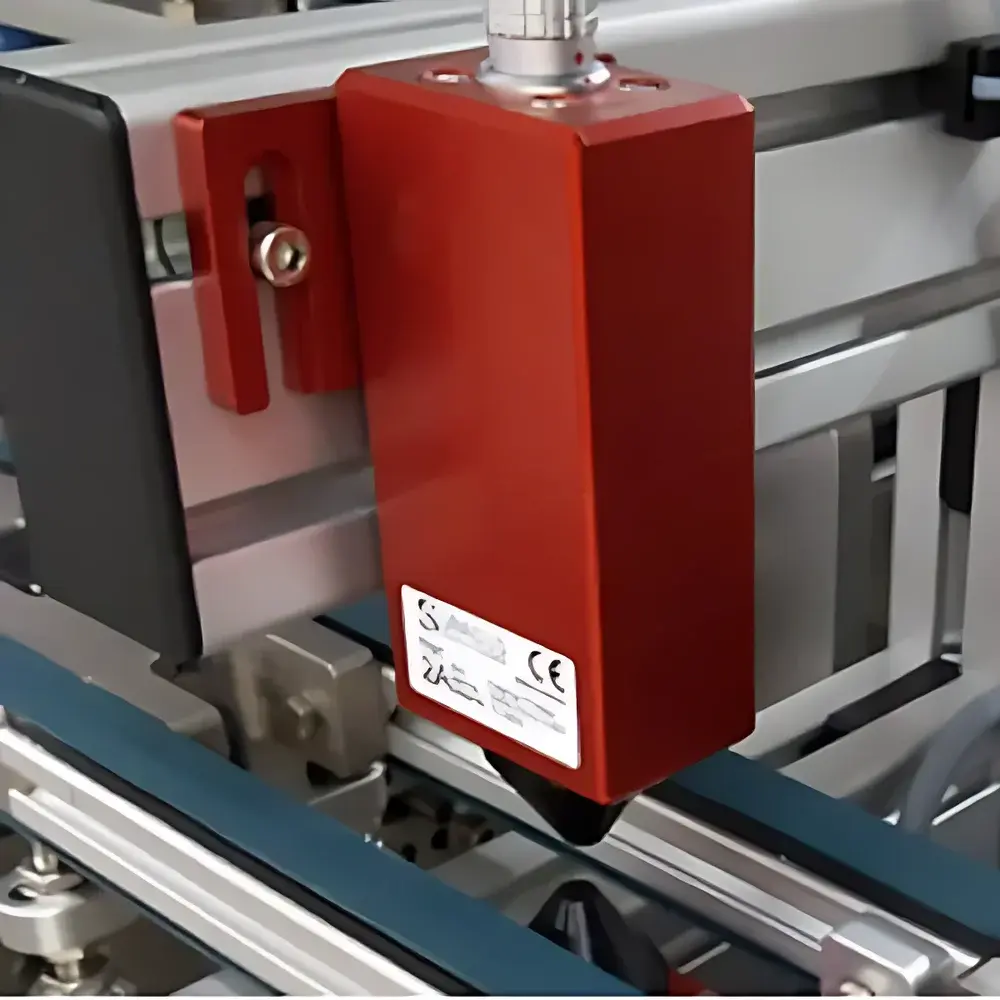
SURAGUS EddyCus TF Inline Non-Contact Sheet Resistance Monitor
| Brand | SURAGUS |
|---|---|
| Model | EddyCus TF Inline |
| Measurement Principle | Eddy Current |
| Sampling Rate | Up to 1000 Hz |
| Sheet Resistance Range | 0.1 mΩ/sq – 1 kΩ/sq |
| Metal Layer Thickness Range | 2 nm – 2 mm (material-dependent) |
| Resistivity Range | 0.1 mΩ·cm – 1 Ω·cm |
| Dielectric Moisture Detection | Yes |
| Substrate Compatibility | Glass, Foil, Paper, Silicon Wafers, Polymers, Ceramics |
| Operating Environment | Ambient or Vacuum |
| Standoff Distance | Up to 60 mm |
| Channel Capacity | 1–99 independent measurement channels |
| Software Interface | OPC UA, TCP/IP, analog/digital I/O |
| Compliance | Compatible with FDA 21 CFR Part 11 (audit trail via EC Control), GLP/GMP process logging |
Overview
The SURAGUS EddyCus TF Inline Non-Contact Sheet Resistance Monitor is an industrial-grade eddy current-based metrology system engineered for real-time, non-destructive characterization of conductive thin films during high-speed roll-to-roll, wafer-level, or sheet-fed manufacturing processes. Unlike contact-based four-point probe methods, this system operates on the principle of electromagnetic induction: a high-frequency alternating magnetic field generated by the sensor induces eddy currents in the conductive layer; the resulting perturbation in the sensor’s impedance is quantitatively correlated to sheet resistance (Rs), film thickness, and material conductivity—without physical contact or electrical connection. This physics-based approach ensures long-term stability, immunity to surface contamination, and compatibility with dynamic production environments where substrates travel at speeds exceeding 10 m/min. The system is specifically designed for integration into vacuum deposition lines (e.g., sputtering, evaporation, ALD), wet coating processes (slot-die, spray, gravure), thermal treatment (annealing, sintering), and post-processing steps (etching, cleaning, oxidation), delivering traceable, repeatable data directly to MES or SCADA platforms.
Key Features
- Non-contact operation with standoff distance up to 60 mm—enabling measurement over encapsulated layers, fragile substrates, or through protective windows
- High-speed sampling at up to 1000 measurements per second, synchronized to line speed via encoder input or external trigger
- Multi-channel architecture supporting 1–99 independently configurable sensors per system, facilitating cross-web profiling or multi-zone monitoring
- Temperature-compensated electronics ensuring measurement stability across ambient fluctuations (±0.05 %/°C typical drift compensation)
- Robust mechanical design rated for continuous operation in cleanroom ISO Class 5–8 environments and vacuum chambers down to 10−6 mbar
- Edge-sensitive geometry allowing reliable Rs acquisition within 3 mm of substrate edge—critical for narrow-margin flexible electronics and photovoltaic ribbons
Sample Compatibility & Compliance
The EddyCus TF Inline supports a broad spectrum of conductive and semi-conductive thin-film systems deposited on non-magnetic, non-ferrous substrates including soda-lime glass, PET/PEN foils, silicon wafers (up to 300 mm), aluminum foil, ceramic tiles, and cellulose-based papers. It characterizes not only metallic layers (Cu, Al, Ag, ITO, NiCr) but also doped metal oxides, conductive polymers (PEDOT:PSS), and carbon-based films (graphene, CNT networks). All measurements comply with ASTM F84-22 (Standard Test Method for Sheet Resistance of Semiconductor Materials Using a Collinear Four-Point Probe) *by correlation*, and raw impedance data meets traceability requirements under ISO/IEC 17025 for accredited calibration laboratories. When deployed with EC Control software, the system supports audit-trail-enabled data logging aligned with FDA 21 CFR Part 11 and EU Annex 11 for regulated pharmaceutical and medical device manufacturing environments.
Software & Data Management
The system interfaces natively with industrial automation protocols including OPC UA, Modbus TCP, and EtherNet/IP, enabling direct integration into Siemens PCS7, Rockwell FactoryTalk, or Beckhoff TwinCAT control architectures. SURAGUS provides two complementary software layers: (1) the real-time EC Control suite—delivering live visualization, statistical process control (SPC) charts (X-bar/R, Cpk), alarm thresholds, and CSV/SQL export with timestamped metadata; and (2) the EC Analyze post-processing toolkit, supporting batch trend analysis, spatial mapping (Rs uniformity heatmaps), and correlation modeling between sheet resistance and secondary parameters (e.g., annealing temperature, deposition power). All data archives include full sensor diagnostics, environmental logs (temperature, pressure), and user-accessible calibration certificates.
Applications
This monitor is deployed across semiconductor front-end processing (metal stack qualification on 200/300 mm wafers), flat-panel display manufacturing (ITO uniformity on Gen 8+ glass), photovoltaic production (Ag grid sintering validation on PERC cells), flexible printed electronics (conductive ink drying and curing verification), and advanced packaging (RDL and redistribution layer resistivity monitoring). It further supports R&D applications such as in-situ optimization of sputter target utilization, plasma-enhanced CVD parameter tuning, and electrochemical deposition bath stability assessment. In battery manufacturing, it verifies current collector coating integrity pre-calendering and detects micro-cracks in cathode/anode layers after slurry drying.
FAQ
Does the system require recalibration when switching between different substrate materials?
No—calibration is material-specific but stored in sensor firmware; users select pre-loaded profiles (e.g., “Al on PET”, “Cu on SiO₂”) without hardware adjustment.
Can it measure through insulating layers such as SiO₂ or polymer encapsulation?
Yes—provided the total dielectric thickness is ≤100 µm and the underlying conductor remains electromagnetically coupled to the sensor field.
Is vacuum-compatible cabling and feedthrough included in the standard delivery?
Vacuum-rated coaxial cabling and CF-40 or KF-25 feedthroughs are available as optional accessories, qualified to UHV standards.
How is measurement uncertainty quantified and validated?
Each system ships with NIST-traceable calibration reports; uncertainty budgets (k=2) are provided per application matrix, covering repeatability, temperature drift, and standoff variation.
What level of technical support is offered for MES integration?
SURAGUS provides protocol-specific integration guides, test scripts, and on-site commissioning support—including validation documentation (IQ/OQ) for GxP-regulated facilities.




