
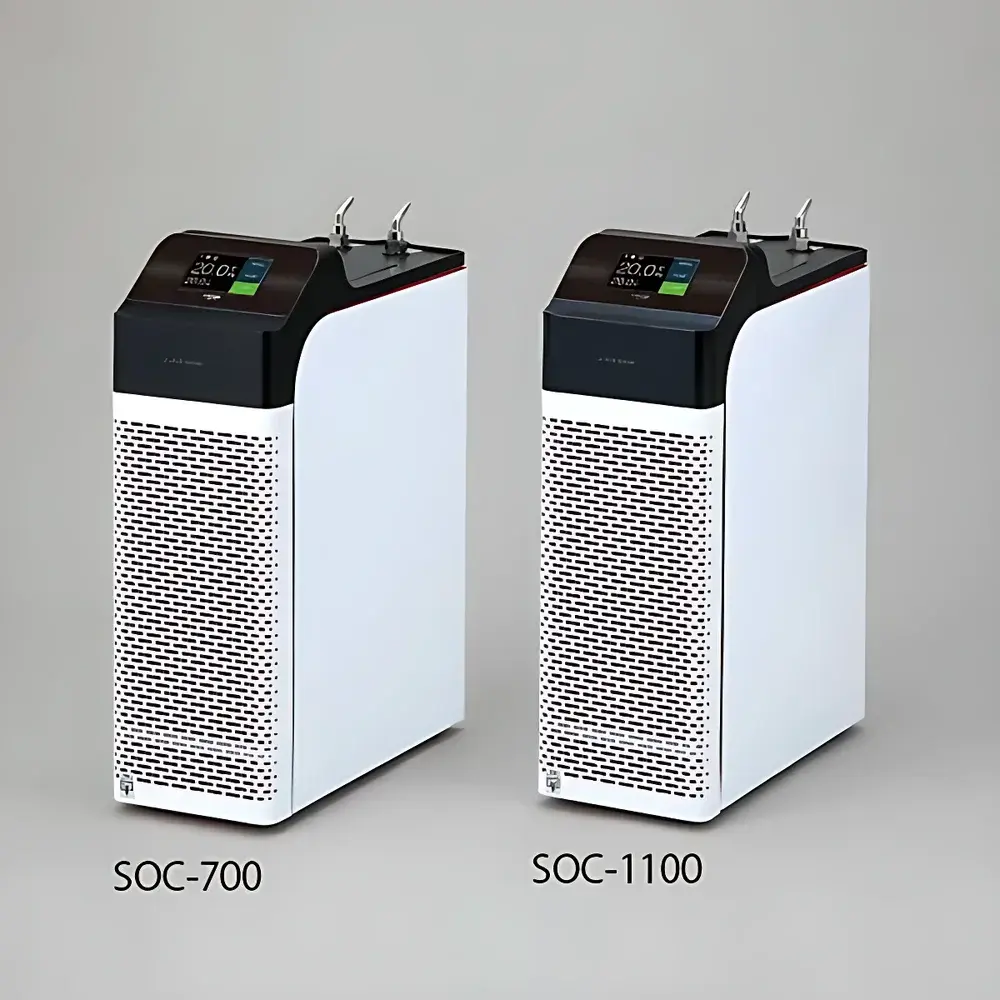
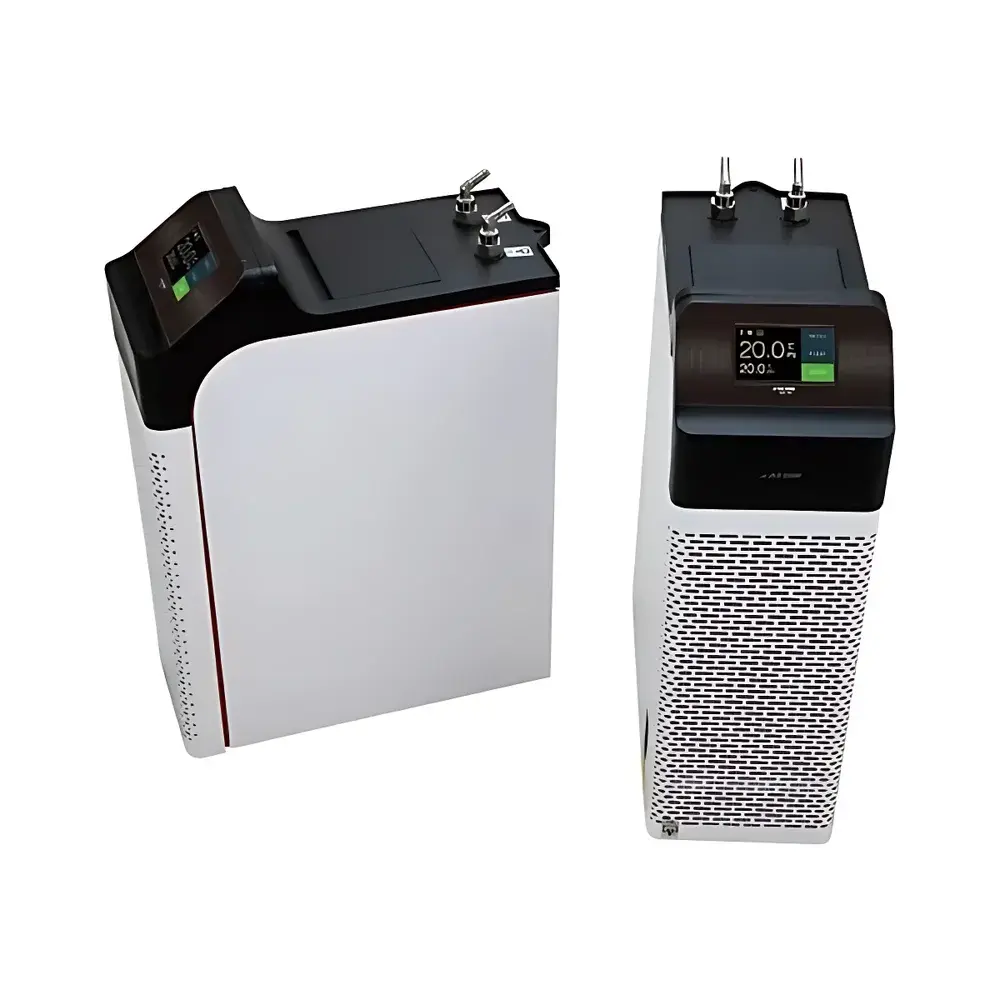
AS ONE SOC-700 / SOC-1100 Circulating Chiller
| Brand | AS ONE |
|---|---|
| Origin | Shanghai, China |
| Manufacturer Type | Direct Manufacturer |
| Product Category | Domestic |
| Model | C4-2732-01 (SOC-700) / C4-2732-02 (SOC-1100) |
| Instrument Type | Integrated Circulating Chiller |
| Cooling Method | Air-Cooled |
| Temperature Control Range | −15 °C to +30 °C (SOC-700) |
| Refrigeration Capacity | 460 W at ΔT = 10 °C (SOC-700) |
| Temperature Stability | ±1.0 °C |
| Circulation Flow Rate | 12 L/min (SOC-700) |
| Max Head | 8 m (SOC-700) |
| Reservoir Volume | 5.0 L (liquid volume ~4.2 L) |
| Working Mode | Air-Cooled, Closed-Loop Circulation |
| Refrigerant | R-134a |
| Heat Exchanger Material | Brazed Plate Type, SUS316L/SUS304 |
| Reservoir Material | SUS304 |
| External Nozzle | Metal, OD 10 mm (compatible with tubing ID φ8–9 mm) |
| Dimensions (W×D×H) | 212 × 482 × 637 mm |
| Net Weight | 30 kg (SOC-700) |
| Ambient Operating Temperature | 5–30 °C |
| Power Supply | AC 220 V, 50/60 Hz |
| Safety Protections | Leakage Current Protection, Overcurrent Circuit Breaker, Compressor Delay Timer, Low-Water-Level Sensor, Compressor Overload Relay, Upper/Lower Temperature Limit Alarms |
Overview
The AS ONE SOC-700 and SOC-1100 are precision-engineered, air-cooled circulating chillers designed for stable thermal management of laboratory equipment requiring consistent low-temperature coolant delivery. These units operate on a closed-loop refrigeration cycle using environmentally compliant R-134a refrigerant and employ hot-gas bypass control—a proven method for fine-grained temperature regulation without compressor cycling. Unlike water-cooled systems, the air-cooled architecture eliminates dependency on facility cooling water infrastructure, enabling flexible placement in standard laboratory environments where ambient temperature remains within 5–30 °C. The chiller’s primary application is supporting rotary evaporators, condensers, spectrophotometer cells, and other heat-sensitive analytical instruments that demand precise, continuous coolant supply between −20 °C and +30 °C. Both models feature stainless steel (SUS304) reservoirs and brazed plate heat exchangers constructed from corrosion-resistant SUS316L and SUS304—critical for long-term compatibility with aqueous and glycol-based coolants (e.g., 30–50% ethylene glycol/water mixtures). Pure water is explicitly excluded due to risk of microbial growth and freezing-induced system damage.
Key Features
- Intuitive 45°-tilted touchscreen interface with 0.1 °C resolution for temperature setpoint entry and real-time digital display
- Hot-gas bypass temperature control architecture ensuring high reproducibility and reduced thermal overshoot during load transients
- Dual-stage safety system including compressor overload relay, refrigerant circuit delay timer, and dual-limit temperature alarms (configurable upper/lower thresholds)
- Magnetically secured front-panel filter access for rapid maintenance without tools
- Integrated condensate drainage channel to prevent moisture accumulation in enclosed lab cabinets or under-bench installations
- Robust mechanical design with vibration-damped compressor mounting and reinforced metal external nozzles (OD 10 mm) compatible with standard φ8–9 mm tubing
- Compact footprint (212 × 482 × 637 mm) optimized for benchtop or floor-standing deployment adjacent to rotary evaporators or reaction calorimeters
Sample Compatibility & Compliance
These chillers are validated for use with deionized water–ethylene glycol mixtures (recommended concentration: 30–50% v/v), which provide freeze protection down to −25 °C while maintaining acceptable viscosity and thermal conductivity. Operation with pure water is prohibited per manufacturer specification due to microbiological proliferation risks and potential ice formation below 0 °C in low-flow conditions. The stainless steel wetted components (SUS304 reservoir, SUS316L/SUS304 brazed heat exchanger) conform to ASTM A240 and ISO 8501-1 surface preparation standards for corrosion resistance in mildly aggressive coolant media. While not certified to UL 61010-1 or IEC 61000-6-3 by default, the units incorporate leakage current protection and overcurrent circuit breakers aligned with general-purpose laboratory electrical safety expectations. For GLP/GMP-regulated environments, optional audit-trail-capable data loggers (sold separately) may be integrated via RS-485 or analog output modules—though native firmware does not support FDA 21 CFR Part 11 electronic signature compliance.
Software & Data Management
The SOC-700 and SOC-1100 operate as standalone instruments with no embedded PC-based software or network connectivity. All operational parameters—including setpoint, actual bath temperature, pump status, and alarm history—are accessible exclusively through the front-panel touchscreen. Real-time temperature logging is not natively supported; however, the units provide analog voltage outputs (0–5 V or 4–20 mA, configurable via service menu) for integration with external data acquisition systems (e.g., LabVIEW, DeltaV, or custom SCADA platforms). Alarm events—including low coolant level, temperature deviation beyond ±3 °C, compressor fault, or ambient overheating—are stored in non-volatile memory with timestamping (resolution: 1 minute) and retrievable via diagnostic mode. Firmware updates require AS ONE-certified service technicians and proprietary USB programming tools—not end-user modifiable.
Applications
- Rotary evaporation: Maintaining condenser coil temperatures at −10 °C to −15 °C for efficient solvent recovery of heat-labile compounds
- Reactor jacket cooling: Stabilizing exothermic Grignard or lithiation reactions in 1–5 L glass reactors with ±1.0 °C thermal uniformity
- Spectroscopic cell cooling: Preventing thermal drift in UV-Vis cuvettes or FTIR transmission cells during extended acquisition sequences
- HPLC column oven pre-cooling: Conditioning mobile phase prior to injection to minimize baseline noise from thermal expansion
- Calorimetry support: Providing constant-temperature coolant to isothermal titration calorimeters (ITC) or differential scanning calorimeters (DSC) auxiliary systems
FAQ
Can the SOC-700/SOC-1100 be used with pure deionized water?
No. Pure water is strictly prohibited due to microbiological growth, corrosion acceleration, and freezing-related mechanical stress. Only aqueous ethylene glycol solutions (30–50% v/v) are approved.
What is the minimum ambient temperature required for reliable operation?
The unit must be operated in environments between 5 °C and 30 °C. Below 5 °C, refrigerant pressure drops may impair compressor efficiency and trigger low-pressure lockout.
Is remote monitoring or control possible out of the box?
No native Ethernet, Wi-Fi, or USB device-mode control is included. Remote supervision requires external DAQ hardware interfacing with the analog output signals.
How often should the inlet filter be cleaned?
Under normal laboratory conditions using filtered glycol coolant, inspect and clean the magnetic front filter every 3 months or after 500 operating hours—whichever occurs first.
Does the chiller support heating functions?
Neither model includes electric heating elements. Temperature control is limited to active refrigeration within the specified range (−20 °C to +30 °C).
Related Products



