
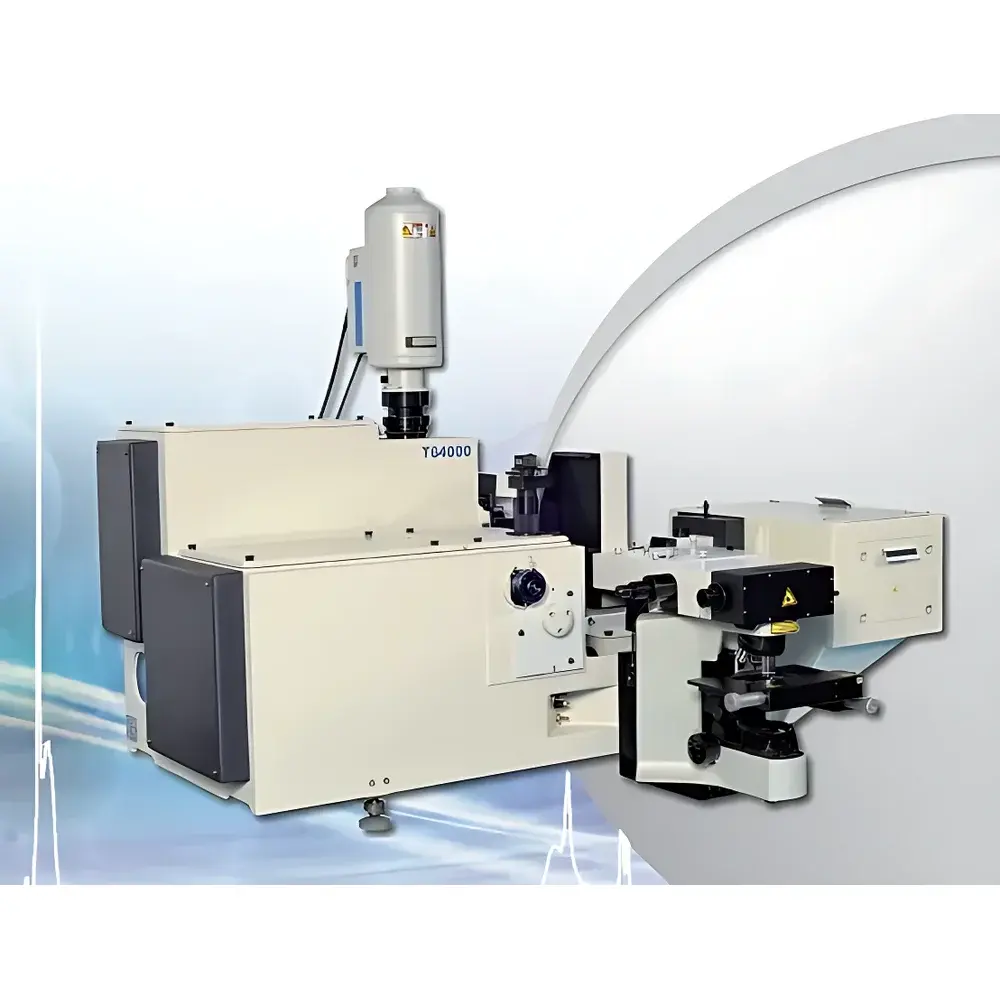
HORIBA T64000 Triple-Stage Raman Spectrometer
| Brand | HORIBA |
|---|---|
| Origin | France |
| Model | T64000 |
| Instrument Type | Confocal Micro-Raman Spectrometer |
| Spectral Resolution (Additive Mode) | 0.15 cm⁻¹ |
| Low-Wavenumber Limit (Subtractive Mode) | 5 cm⁻¹ |
| Focal Length (Single Stage) | 640 mm |
| Total Focal Length (Triple Additive) | 3 × 640 mm |
| Excitation Range | UV–VIS–NIR |
| Detector | Research-Grade Air-Cooled Large-Format CCD |
| Optical Output | Flat-Field Spectral Dispersion |
| Laser Power Control | Multi-Step Attenuation Wheel |
| Configuration Options | Confocal Microscopy & Macro Sample Chamber |
| Polarization Compatibility | Full-Line (Excitation, Raman, White Light) |
| Optional Detectors | Secondary Output Port for PL or NIR Raman |
Overview
The HORIBA T64000 is a research-grade triple-stage Raman spectrometer engineered for ultra-high spectral fidelity in demanding analytical and materials science applications. Based on the principle of grating-based dispersive spectroscopy with cascaded monochromator architecture, the T64000 employs three serially coupled 640 mm focal length spectrometers to achieve exceptional wavelength separation capability. Its modular optical design supports three operational modes: subtractive (for ultra-low wavenumber detection), additive (for maximum resolution), and single-stage (for high-throughput screening). This architecture enables rigorous discrimination of closely spaced Raman bands—critical for phonon mode analysis in 2D materials, stress/strain mapping in semiconductors, and isotopic fingerprinting in pharmaceutical polymorphs. The system integrates seamlessly with inverted or upright research microscopes, delivering diffraction-limited spatial resolution (< 0.5 µm with 532 nm excitation) while maintaining full confocality across UV, visible, and NIR excitation wavelengths.
Key Features
- Triple-stage optical configuration with selectable subtractive, additive, and single-stage operation modes
- Spectral resolution down to 0.15 cm⁻¹ in additive mode—validated per ISO 17025-compliant calibration protocols
- Low-wavenumber detection limit of 5 cm⁻¹ in subtractive mode, enabling characterization of lattice vibrations, interlayer shear modes, and acoustic phonons
- Flat-field spectral output optimized for large-format, back-illuminated CCD detectors (e.g., 2048 × 512 pixels, 13.5 µm pitch)
- UV–VIS–NIR excitation compatibility (244 nm to 1064 nm) via interchangeable laser modules and broadband dichroic optics
- Motorized, multi-position filter turret supporting edge filters, notch filters, and holographic rejection filters
- Integrated multi-step neutral density wheel for precise laser power attenuation (OD 0.1 to OD 6.0), essential for photolabile sample integrity
- Dual-output port architecture: primary port for Raman detection; secondary port configurable for photoluminescence (PL), time-resolved measurements, or NIR-excited Raman
Sample Compatibility & Compliance
The T64000 accommodates diverse sample geometries through interchangeable optical paths: a high-magnification confocal microscope module (with motorized XYZ stage and auto-focus) and a macro sample chamber supporting irregular, temperature-controlled, or fiber-coupled specimens. It complies with ISO/IEC 17025 requirements for spectral instrument validation and supports GLP/GMP workflows via optional audit-trail-enabled software modules. All polarization accessories—including motorized half-wave plates, polarizing beam splitters, and rotating analyzer stages—are traceably calibrated against NIST-traceable standards. Thermal stages (−190 °C to +600 °C), electrochemical cells, and gas-tight environmental chambers are mechanically and optically aligned to maintain alignment stability under thermal cycling per ASTM E2847 guidelines.
Software & Data Management
Controlled by HORIBA’s LabSpec 6 platform, the T64000 supports fully automated acquisition, real-time spectral processing, and multidimensional hyperspectral imaging (up to 1024 × 1024 pixel maps). The software implements ICH Q5E-compliant baseline correction algorithms, multivariate curve resolution (MCR-ALS), and peak fitting using Voigt or pseudo-Voigt line shapes with constrained physical parameters. Raw data are stored in vendor-neutral HDF5 format with embedded metadata (excitation wavelength, grating position, slit width, integration time, detector temperature), ensuring FAIR (Findable, Accessible, Interoperable, Reusable) data principles. Optional 21 CFR Part 11 compliance package provides electronic signatures, role-based access control, and immutable audit trails for regulated environments.
Applications
- Characterization of layered materials (graphene, MoS₂, h-BN) including layer count, stacking order, strain, and doping via low-frequency interlayer modes
- Polymorph identification and quantitative phase analysis in active pharmaceutical ingredients (APIs), aligned with USP and Ph. Eur. 2.2.48
- In situ catalysis studies under reactive gas atmospheres using fiber-optic probes and heating stages
- Failure analysis of microelectronic devices via stress mapping across Si/SiO₂ interfaces
- Art conservation science: non-invasive pigment identification and degradation product detection in historical manuscripts and paintings
- Carbon nanomaterial quality assessment (D/G ratio, defect density, tube chirality distribution)
FAQ
What excitation wavelengths are supported without hardware modification?
The T64000 accepts standard DPSS and diode lasers from 244 nm to 1064 nm; switching between wavelengths requires only filter and grating changes—not optical realignment.
Can the system perform simultaneous Stokes and anti-Stokes acquisition?
Yes—using the dual-output port configuration with synchronized dual detectors, enabling direct temperature mapping without thermal calibration curves.
Is the 0.15 cm⁻¹ resolution achievable across the full spectral range?
Resolution is specified at 532 nm excitation; variation across the range follows grating dispersion laws and is documented in the factory calibration certificate.
How is stray light suppressed in low-wavenumber measurements?
Stray light rejection exceeds OD 8.0 via triple-stage subtraction, optimized baffling, and Rayleigh rejection optics validated per ISO 17025 procedures.
Does the system support time-resolved Raman measurements?
With optional pulsed laser integration and gated ICCD or SPAD detector modules, lifetime-resolved Raman spectroscopy is fully supported.
Related Products




