
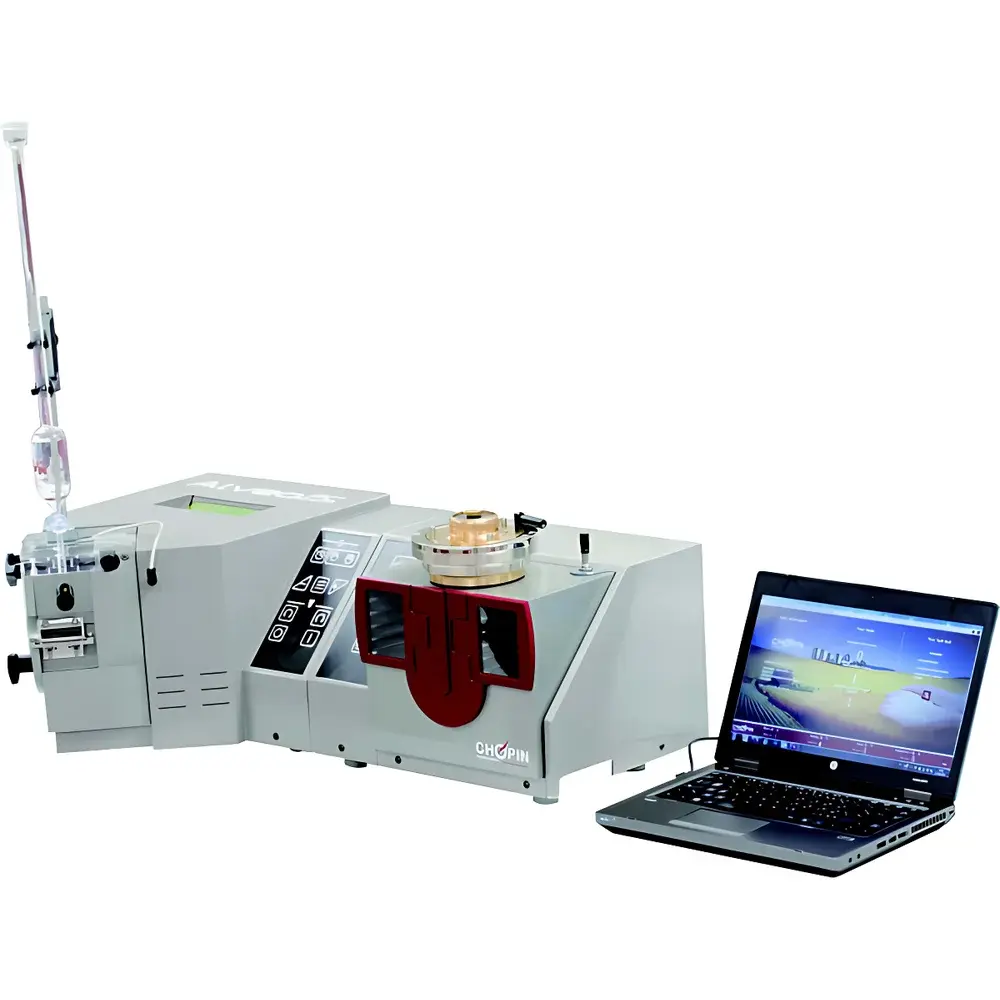
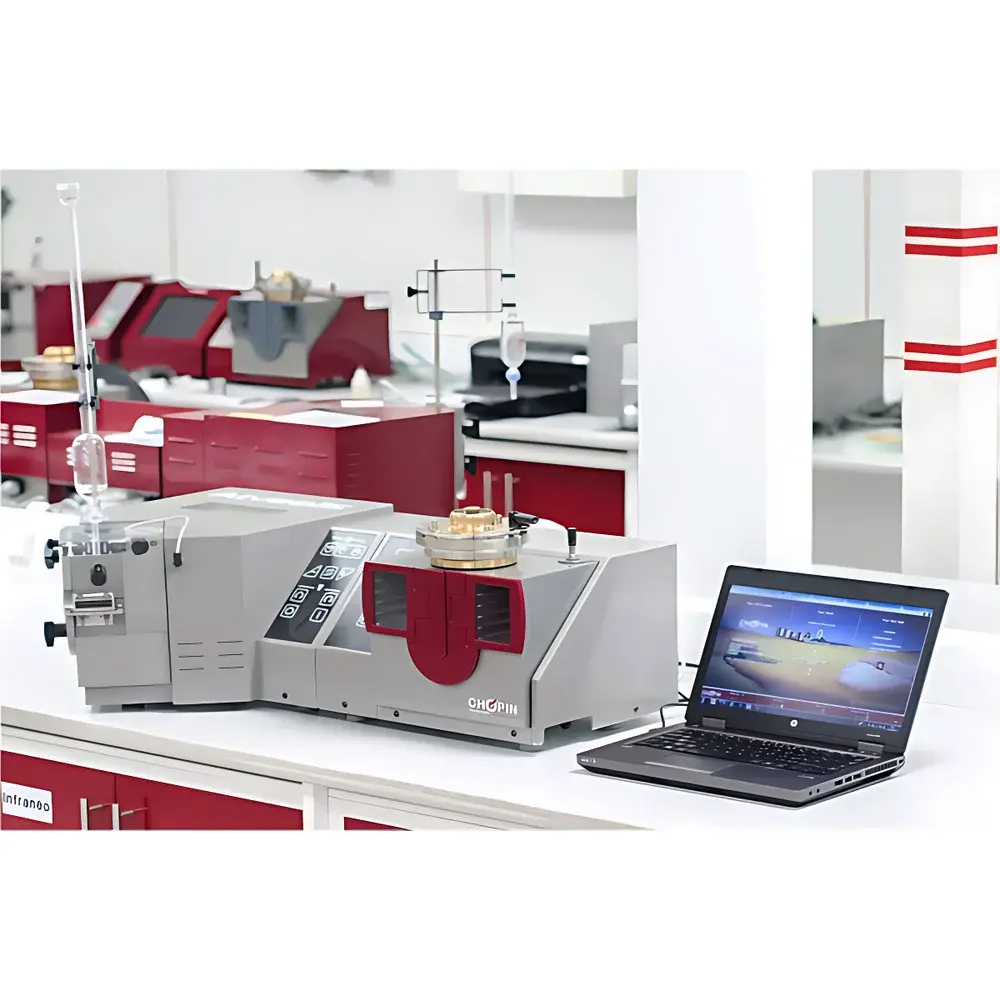
KPM CHOPIN AlveoPC Computerized Extensibility and Gluten Strength Analyzer
| Brand | KPM CHOPIN |
|---|---|
| Origin | France |
| Model | AlveoPC |
| Compliance | AACC 54-30.02, ICC 121, NF EN ISO 27971, GB/T 14614.4 |
| Application Domain | Wheat breeding, flour milling, grain procurement, food processing, official quality inspection |
Overview
The KPM CHOPIN AlveoPC is a computer-controlled alveograph system engineered for standardized, reproducible assessment of wheat flour and dough rheological properties—specifically gluten strength, extensibility, elasticity, and baking potential. Operating on the fundamental principle of uniaxial gas-induced deformation, the instrument replicates the natural leavening process: a standardized dough disc is pneumatically inflated under controlled pressure until rupture, generating a characteristic pressure–volume curve. This dynamic expansion profile is intrinsically linked to the viscoelastic behavior of gluten networks under CO₂ stress—a critical determinant of bread volume, crumb structure, and processing tolerance. Unlike empirical texture or mixing tests, the AlveoPC delivers dimensionally consistent, physics-based parameters rooted in classical rheology and widely accepted across global cereal science laboratories.
Key Features
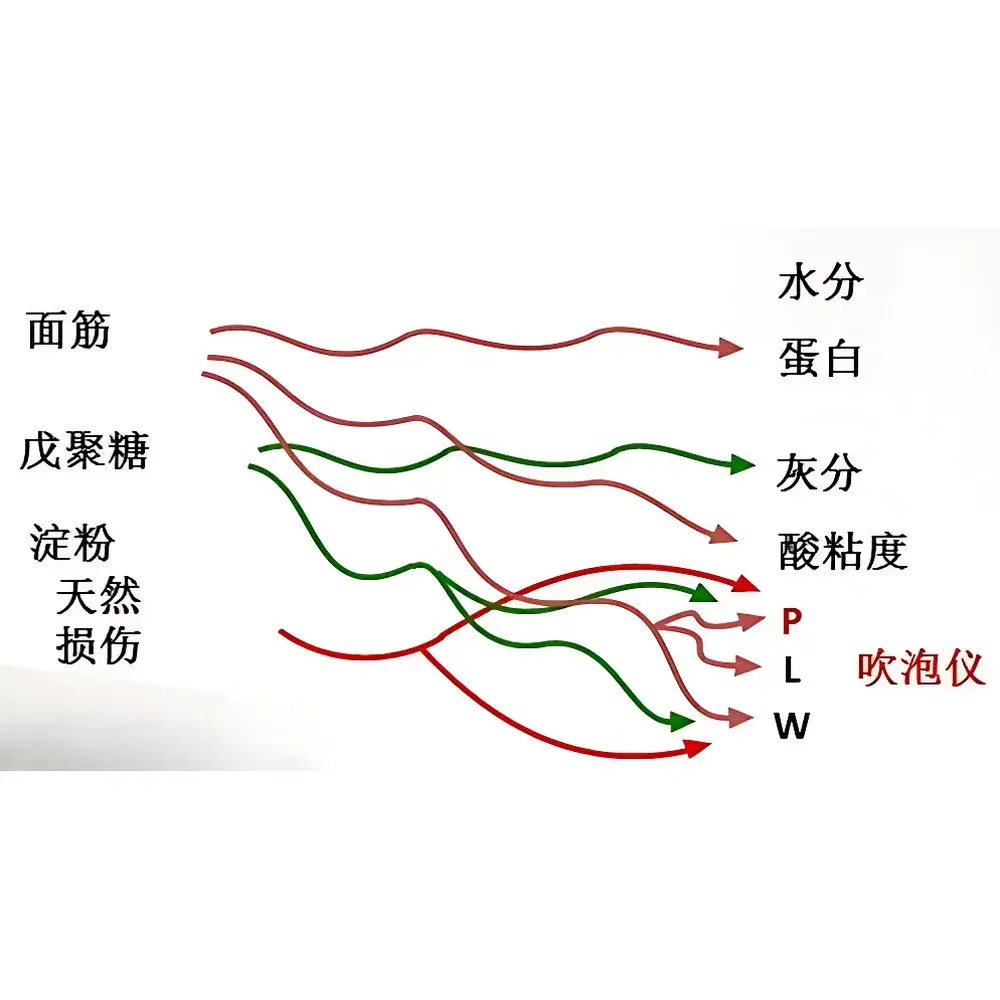
- Computer-integrated real-time acquisition and analysis of inflation curves with automatic P (tenacity), L (extensibility), Ie (elasticity index), and W (baking strength) calculation per ISO 27971 and AACC 54-30.02 protocols
- Precision pneumatic control system ensuring stable, repeatable inflation pressure ramp (0–100 hPa range) and volumetric flow regulation
- Digital optical displacement sensor array for high-resolution tracking of bubble geometry during inflation, enabling true 3D deformation mapping
- Integrated climate-controlled chamber (22 ± 0.5 °C, 65 ± 2 % RH) compliant with ICC 121 conditioning requirements for dough sample equilibration
- Automated dough sheet extrusion module with calibrated thickness (1.0 ± 0.02 mm) and diameter (50.0 ± 0.1 mm) consistency
- Modular hardware architecture supporting firmware updates and calibration traceability to NIST-traceable pressure and dimensional standards
Sample Compatibility & Compliance
The AlveoPC accepts standard 250 g flour samples conditioned per ICC 121 or AACC 26-15A; dough preparation follows strict hydration protocols (e.g., constant hydration or absorption-adjusted “constant water” mode). It supports wholemeal, refined, and fortified flours—including durum semolina for pasta applications—and accommodates modified flours treated with enzymes, oxidants, or hydrocolloids. All reported parameters comply with internationally harmonized definitions: P (in hPa) reflects resistance to extension at peak pressure; L (in mm) quantifies total bubble elongation prior to rupture; Ie = (P/L) × 100 expresses relative elastic recovery capacity; W (in 10⁻⁴ J) integrates the area under the inflation curve as a measure of total energy absorption—directly correlating with loaf volume in pan bread trials. The system meets GLP documentation requirements and supports audit-ready electronic records aligned with FDA 21 CFR Part 11 principles when deployed with validated software configurations.
Software & Data Management
The AlveoPC runs on Windows-based AlveoSoft v5.x, featuring ISO/IEC 17025-aligned data integrity controls including user-level access permissions, electronic signatures, version-controlled method templates, and immutable audit trails for all parameter recalculations. Raw pressure–volume datasets are stored in HDF5 format with embedded metadata (operator ID, ambient conditions, calibration timestamps). Statistical modules support batch comparison (ANOVA, PCA), trend monitoring across harvest years, and correlation analysis against farinograph, mixolab, or RVA data. Export options include CSV, PDF reports compliant with ISO/IEC 17025 clause 7.8.2, and direct integration into LIMS via ODBC drivers.
Applications
- Wheat breeding programs: High-throughput screening of F₃–F₅ progeny for gluten strength–extensibility balance under varying nitrogen regimes
- Mill quality assurance: Real-time classification of incoming wheat lots and blended flours for end-use suitability (bread, biscuit, noodle)
- R&D of enzymatic additives: Quantifying protease-induced reductions in P and W, or transglutaminase-mediated increases in Ie
- Official grain inspection: Certified testing per national standards (e.g., GB/T 14614.4 in China, NF EN ISO 27971 in EU)
- Academic research: Mechanistic studies linking HMW-glutenin subunit composition to Ie and W values using SDS-PAGE coupled with alveographic profiling
FAQ
What does the W value represent, and how is it calculated?
The W value (in 10⁻⁴ J) is the integral of the pressure–volume curve generated during inflation. It reflects the total mechanical work required to expand and rupture the dough film, serving as a composite indicator of gluten network integrity and baking performance.
Can the AlveoPC be used for gluten-free or low-gluten formulations?
No—the instrument is specifically validated for wheat-based systems with functional gluten networks. Non-wheat matrices lack the viscoelastic response necessary for meaningful P, L, and W interpretation.
Is routine calibration required, and what standards are used?
Yes: daily zero-pressure verification and quarterly full-range calibration using certified pressure transducers and dimensional gauges traceable to national metrology institutes (e.g., LNE, France).
How does the AlveoPC differ from the older Alveolab or manual alveographs?
The AlveoPC replaces analog manometers and manual curve tracing with digital sensors, automated inflation control, and algorithmic parameter extraction—reducing inter-operator variability and enabling compliance with modern data integrity regulations.
Does the system support multi-language UI and report generation?
Yes: AlveoSoft supports English, French, German, Spanish, Chinese, and Russian interfaces; PDF reports auto-generate in the selected language with localized unit formatting and regulatory footnote templates.






