
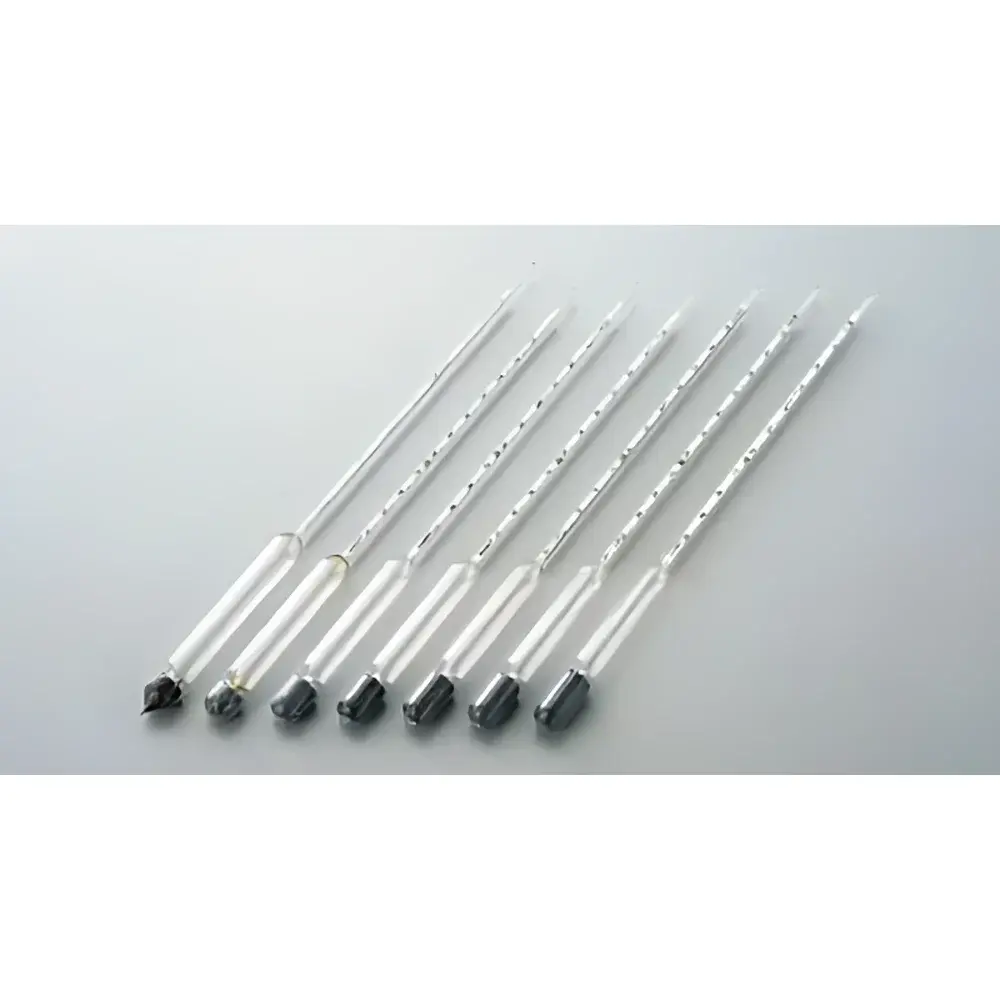
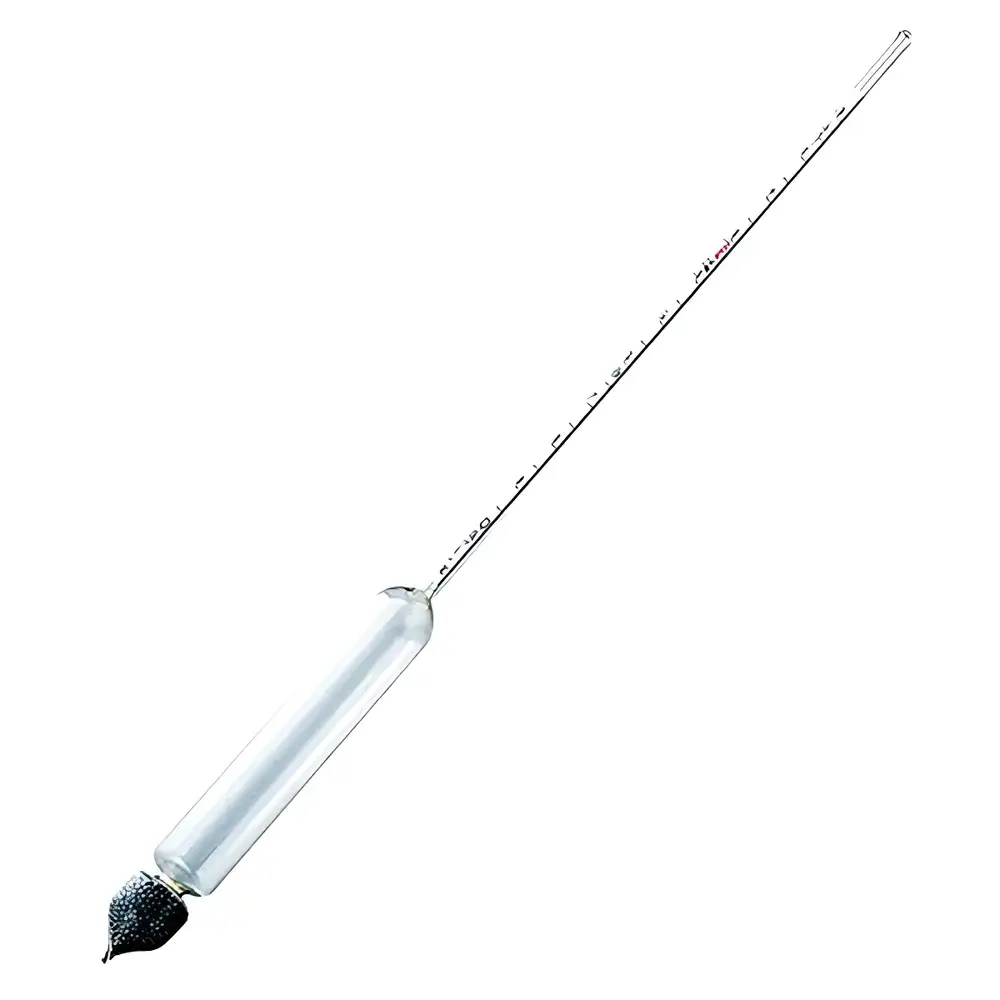
AS ONE JC-9320 10-Scale Baumé Hydrometer
| Brand | AS ONE |
|---|---|
| Origin | Japan |
| Manufacturer | Nihon Keiryoki Co., Ltd. |
| Model | 1-6205-01 |
| Scale Range | 0–10°Bé |
| Minimum Graduation | 0.1 °Bé |
| Total Length | 300 mm |
| Material | Borosilicate Glass |
Overview
The AS ONE JC-9320 10-Scale Baumé Hydrometer is a precision-calibrated, laboratory-grade specific gravity measuring instrument engineered for rapid, reliable density assessment of aqueous solutions in quality control, chemical manufacturing, electroplating, and food & beverage processing environments. Based on the classical Baumé scale—a temperature-compensated empirical scale widely adopted in industrial fluid analysis—the JC-9320 operates on Archimedes’ principle: buoyant force exerted on the hydrometer equals the weight of displaced liquid, allowing direct readout of solution concentration or density relative to water at 15.6°C (60°F). This model conforms to JIS Z 8010 (Japanese Industrial Standard for Hydrometers) and is officially verified by Japan’s National Metrology Institute (NMI-J), bearing an indelible calibration mark confirming traceability to national standards. Designed for single-point immersion measurement, it delivers consistent, operator-independent results without electronic components or power requirements—ideal for routine field or benchtop use where robustness and metrological integrity are prioritized over digital automation.
Key Features
- Calibrated scale range from 0 to 10° Baumé, optimized for low-density aqueous electrolytes, sugar syrups, brines, and cleaning solutions
- Precision etched graduations at 0.1°Bé intervals, enabling visual interpolation to ±0.05°Bé under optimal lighting and parallax-free viewing conditions
- 300 mm total length with weighted bulb and calibrated stem—engineered for stable vertical floatation in standard 100 mL cylindrical glass cylinders (ID ≥ 35 mm)
- Manufactured from high-purity borosilicate glass (equivalent to Pyrex®), ensuring thermal stability (±0.1°C coefficient of expansion), chemical resistance to acids, alkalis, and organic solvents, and long-term dimensional retention
- Permanently marked with official Japanese calibration stamp (Shinsho Mark), indicating compliance with JIS Z 8010 Type B specifications for general-purpose hydrometers
- No battery, firmware, or software dependency—fully mechanical operation ensures zero drift, no recalibration cycles, and unrestricted use in explosion-proof or EMI-sensitive zones
Sample Compatibility & Compliance
The JC-9320 is intended for use with homogeneous, non-viscous, non-suspended liquid samples at equilibrium temperature (standard reference: 15.6°C). It is incompatible with highly viscous fluids (>50 mPa·s), suspensions, emulsions, or volatile solvents that may attack glass surfaces (e.g., concentrated hydrofluoric acid or hot alkaline peroxides). For regulatory alignment, its calibration methodology adheres to ISO 387:2021 (Glass hydrometers — Specifications) and supports traceable documentation required under GLP (Good Laboratory Practice) and GMP (Good Manufacturing Practice) frameworks. While not FDA 21 CFR Part 11 compliant (as it generates no electronic records), its physical calibration certificate satisfies audit requirements for manual QC checks in ISO 9001-certified facilities and USP referenced density verification protocols.
Software & Data Management
This is a purely analog, hand-held instrument with no embedded electronics, connectivity interfaces, or data logging capability. Measurement values are recorded manually into laboratory notebooks, LIMS spreadsheets, or paper-based SOP checklists. Users requiring digital integration may pair the JC-9320 with third-party image-based reading systems (e.g., calibrated USB microscopes + OCR software), though such configurations fall outside AS ONE’s validation scope. No proprietary drivers, firmware updates, or cloud services apply. Calibration documentation—including certificate number, date of verification, and accredited lab ID—is supplied with each unit and archived per JIS Z 8000-2:2019 guidelines.
Applications
- Routine verification of plating bath densities (e.g., copper sulfate, nickel sulfamate) in PCB and metal finishing lines
- Concentration monitoring of sodium hydroxide, sodium carbonate, or nitric acid solutions in semiconductor wet benches
- Quality assurance of sucrose, glucose, or invert sugar syrups during confectionery and beverage production
- Field testing of antifreeze coolant mixtures (ethylene glycol/water) in automotive maintenance
- Educational demonstration of density–concentration relationships in university chemistry laboratories
- Pre-screening of wastewater salinity prior to conductivity or ICP-MS analysis
FAQ
What is the reference temperature for the JC-9320 scale calibration?
The scale is calibrated at 15.6°C (60°F), per JIS Z 8010. Measurements taken at other temperatures require correction using published Baumé–temperature compensation tables.
Can this hydrometer be used for alcohol solutions?
No—Baumé scales are defined for aqueous solutions only. Ethanol–water mixtures require alcoholmeter-specific calibration (e.g., Gay-Lussac or %ABV scales) and are outside the JC-9320’s design scope.
Is recalibration possible after purchase?
Recalibration is not user-performed. Units must be returned to an ISO/IEC 17025-accredited calibration laboratory authorized by Japan’s Ministry of Economy, Trade and Industry (METI) for re-verification.
Does the “10-scale” designation indicate resolution or range?
It denotes the full graduated range: 0 to 10° Baumé—not resolution. Minimum readable increment remains 0.1°Bé, as engraved on the stem.
How does the Japanese calibration mark differ from CE or NIST-traceable marks?
The Shinsho Mark certifies conformity to JIS Z 8010 under Japan’s Measurement Act and is issued by designated verification bodies (e.g., JCSS labs). It is legally equivalent to NIST-traceable calibration within Japan but requires separate equivalence assessment for EU or U.S. regulatory acceptance.
Related Products



