
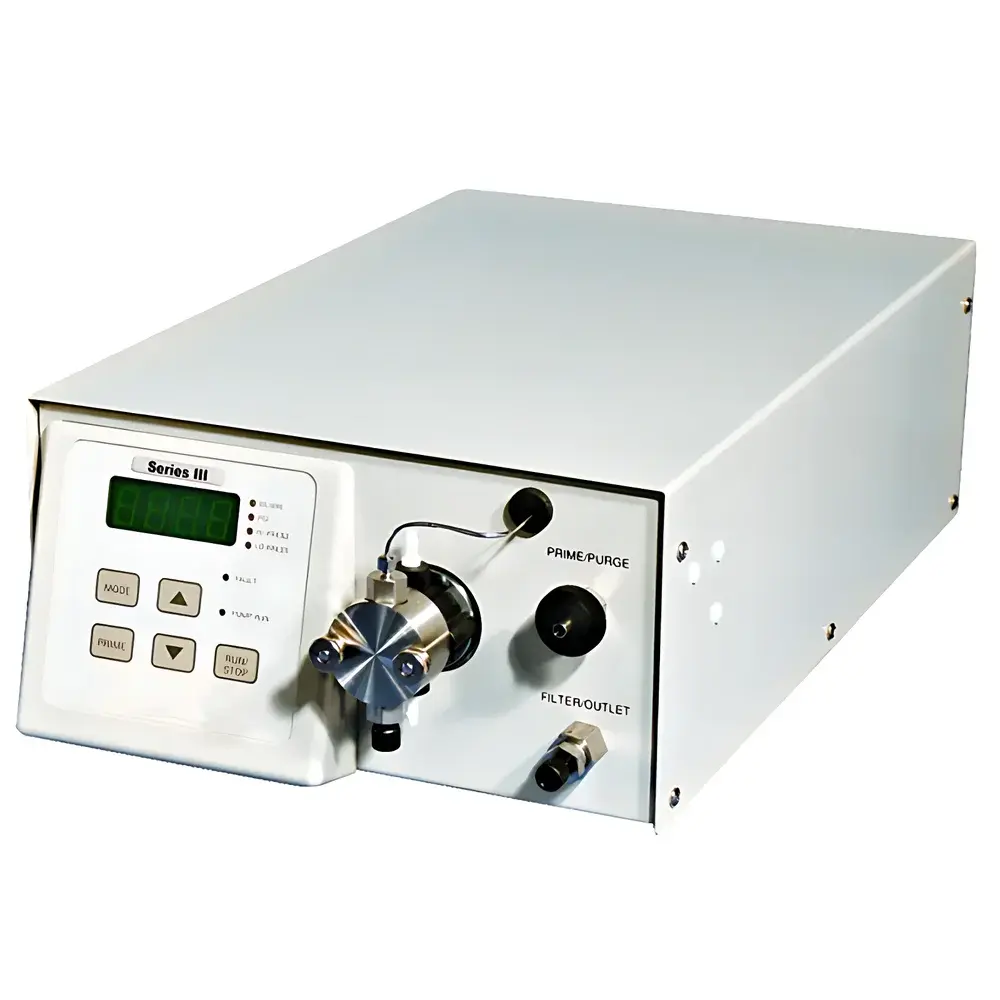
SSI Series III Constant Flow Piston Pump
| Brand | SSI |
|---|---|
| Origin | Imported |
| Model | Series III |
| Flow Rate | 0.001–40 mL/min (selectable ranges) |
| Maximum Pressure | 6000 psi (stainless steel), 5000 psi (PEEK), 1500 psi (low-pressure configuration) |
| Accuracy | ±2% |
| Flow Precision | 0.2% RSD |
| Display | LED (flow rate and pressure, high/low pressure limits) |
| Pulse Damping | Integrated diaphragm-type pulsation dampener |
| Priming | Internal fast-fill cam mechanism |
| Control | Digital logic circuitry with stepper motor drive |
| Pressure Sensing | Built-in transducer |
| Self-Cleaning | On-line pump head auto-flush function |
| Remote Interface | RS232, frequency input, analog voltage input |
| Wetted Materials | PEEK or 316L stainless steel |
| Dimensions | 140 H × 254 W × 432 D mm |
| Weight | 11 kg |
| Power Supply | 115 V / 230 V, 50 / 60 Hz |
Overview
The SSI Series III Constant Flow Piston Pump is a precision-engineered high-pressure liquid delivery system designed for demanding laboratory applications requiring stable, pulse-free flow across a wide dynamic range. Based on proven positive displacement piston architecture, the Series III employs dual ceramic-coated stainless-steel plungers operating in parallel mode to achieve exceptional volumetric accuracy and long-term stability. Its hydraulic design incorporates a low-volume diaphragm-type pulsation dampener and an internal fast-fill cam mechanism—both contributing to baseline noise reduction and minimized flow ripple (<0.2% RSD under typical operating conditions). Unlike peristaltic or syringe-based alternatives, the Series III delivers true constant-flow behavior under variable backpressure, making it particularly suitable for high-resolution chromatography, kinetic reaction monitoring, and controlled reagent infusion where flow integrity directly impacts data fidelity.
Key Features
- High-precision stepper motor control coupled with digital logic circuitry enables programmable flow rates from 0.001 to 40 mL/min across three calibrated ranges—each optimized for resolution and linearity.
- Integrated pressure transducer provides real-time feedback; pressure values (0–6000 psi max) and user-defined high/low limits are displayed on a dedicated LED interface.
- On-line self-cleaning capability allows automated flush cycles without disassembly—reducing downtime and minimizing risk of cross-contamination in multi-sample workflows.
- Modular pump head design supports rapid field replacement; wetted components are available in chemically resistant PEEK or 316L stainless steel to accommodate aggressive solvents, acids, bases, and biocompatible buffers.
- Front-panel controls include five dedicated function keys for intuitive adjustment of flow setpoint, pressure limits, start/stop, quick flush, and parameter selection—enabling standalone operation without external software.
- Built-in bypass valve and configurable remote I/O (RS232, 0–5 V analog, TTL frequency input) support integration into automated platforms, gradient systems, or process control environments compliant with GLP/GMP documentation requirements.
Sample Compatibility & Compliance
The Series III accommodates a broad spectrum of liquid media, including aqueous buffers, organic solvents (acetonitrile, methanol, THF), corrosive reagents (e.g., TFA, HCl), and viscous solutions up to 20 cP. Its material options meet USP Class VI and FDA-compliant biocompatibility standards when configured with PEEK fluid paths. The pump’s mechanical design conforms to IEC 61010-1 safety requirements for laboratory equipment. While not certified for use in explosive atmospheres or as a medical device, its pressure containment architecture complies with ASME B31.3 process piping guidelines for non-fired pressure components. For regulated environments, audit-trail-capable data logging (via RS232) supports 21 CFR Part 11 readiness when paired with validated host software.
Software & Data Management
Though fully functional in stand-alone mode, the Series III supports bidirectional communication via RS232 serial protocol. Compatible ASCII command sets allow integration with LabVIEW, MATLAB, Python-based control frameworks, or commercial chromatography data systems (CDS). Logged parameters—including timestamped flow rate, actual pressure, alarm status, and flush cycle history—can be exported for traceability. When deployed in validated workflows, the pump’s deterministic response time (<100 ms to step-change commands) and repeatable setpoint recovery facilitate IQ/OQ documentation per ISO/IEC 17025 and ASTM E2500-18 guidance.
Applications
- HPLC and UHPLC solvent delivery in analytical and preparative configurations
- Controlled reagent addition in continuous-flow synthesis and microreactor studies
- Calibration and verification of flow meters and mass flow controllers
- Long-duration kinetic assays requiring uninterrupted flow over 72+ hours
- Teaching laboratories demonstrating fluid dynamics, pump mechanics, and system backpressure effects
- Environmental testing setups involving leachate extraction or column breakthrough analysis
FAQ
What flow rate ranges are factory-calibrated on the Series III?
Three selectable ranges are supported: 0.001–5 mL/min, 0.01–10 mL/min, and 0.1–40 mL/min. Each range is independently calibrated and verified per ISO 4064-2 metrological standards.
Can the pump operate continuously at maximum pressure?
Yes—rated for continuous duty at 6000 psi with stainless-steel fluid path; thermal management and plunger seal design ensure >10,000-hour MTBF under sustained load.
Is gradient formation possible with a single Series III unit?
No—gradient capability requires two or more synchronized pumps with proportioning valves; however, the Series III’s RS232 interface enables master-slave coordination in multi-pump configurations.
How often does the pump head require maintenance?
Under normal use with filtered solvents, the pump head requires inspection every 6 months; seal replacement intervals exceed 2,000 operational hours.
Does the Series III support password-protected parameter locking?
Not natively—the front panel permits full access; however, external host software can enforce role-based access control during remote operation.



