
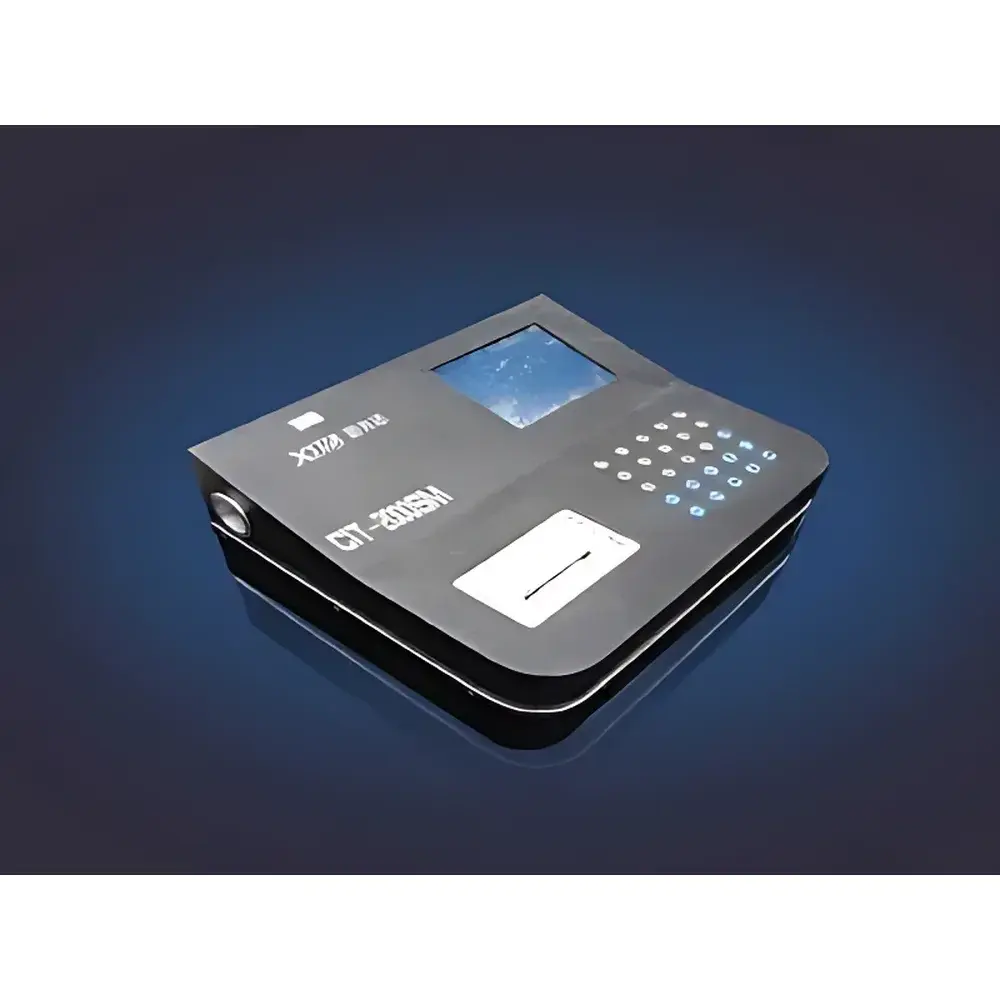
Sichuan Xinxianda CIT-2000SMP Portable Energy Dispersive X-Ray Fluorescence Spectrometer
| Brand | Sichuan Xinxianda |
|---|---|
| Origin | Sichuan, China |
| Model | CIT-2000SMP |
| Detector Type | Proportional Counter |
| Excitation Source | ²³⁸Pu Radioisotope |
| Energy Resolution | 15–20% (at 5.9 keV) |
| Detection Limit | 10⁻³ µg/g |
| Measurement Time | 0.5–5 min per sample |
| Operating Temperature | 0–50 °C |
| Power Consumption | ≤5 W |
| Weight | 3 kg |
| Dimensions | 30 × 20 × 13 cm |
| Elemental Range | Ca, Fe, Ti, Mn, Cu, Pb, Zn, Ni, Sn, Bi, Mo |
| Multichannel Analyzer | 512-channel |
| Sample Form | Solid (bulk or powder) |
| Compliance | CE-marked for field-deployable instrumentation |
| Software Interface | Standalone microcontroller with LCD display and onboard data storage |
Overview
The Sichuan Xinxianda CIT-2000SMP is a field-deployable, microprocessor-controlled Energy Dispersive X-Ray Fluorescence (ED-XRF) spectrometer engineered for rapid, on-site elemental analysis of geological, metallurgical, and industrial materials. Unlike benchtop wavelength-dispersive systems, the CIT-2000SMP employs a compact ²³⁸Pu radioisotope excitation source coupled with a gas-filled proportional counter detector—enabling direct measurement of characteristic K- and L-shell X-ray emissions without requiring high-voltage X-ray tubes or cryogenic cooling. Its design adheres to fundamental ED-XRF principles: incident photons eject inner-shell electrons from sample atoms; subsequent electron transitions generate element-specific fluorescent X-rays, which are resolved by pulse-height analysis across a 512-channel multichannel analyzer (MCA). The instrument delivers quantitative results via linear regression calibration against reference standards, supporting up to six simultaneous elements per measurement cycle. Intended for operation in remote or resource-constrained environments—including open-pit mines, exploration drill sites, smelter feed yards, and QC laboratories—the CIT-2000SMP prioritizes ruggedness, low power draw (<5 W), and immediate spectral visualization on its integrated LCD interface.
Key Features
- Radioisotope-based excitation using ²³⁸Pu (half-life: 87.7 years), eliminating dependency on external power for X-ray generation
- Proportional counter detector optimized for mid-Z element sensitivity (Ca to Mo), with typical energy resolution of 15–20% FWHM at Mn Kα (5.9 keV)
- Onboard 512-channel MCA with real-time full-spectrum display and automatic peak identification
- Dedicated microcontroller architecture with embedded firmware—no PC required for basic operation
- Integrated 6×6 membrane keypad and monochrome LCD screen for direct parameter input, spectrum viewing, and result readout
- Non-destructive analysis of heterogeneous solids: unprepared rock chips, crushed ore, metal alloys, and powdered pellets
- Calibration flexibility: user-definable multi-element regression models stored locally; supports matrix-matched standardization for geological and metallurgical matrices
- Thermal stability maintained across 0–50 °C ambient range, with temperature coefficient ≤0.0004 °C⁻¹ for count-rate drift compensation
Sample Compatibility & Compliance
The CIT-2000SMP accommodates irregularly shaped bulk samples (up to 5 cm diameter) and pressed powders without vacuum or helium purge—ideal for field geology and process control where sample preparation infrastructure is unavailable. It complies with IEC 61000-6-3 (EMC emission limits) and IEC 61000-6-2 (immunity to industrial electromagnetic noise), ensuring reliable performance near heavy machinery or RF sources. While not certified to ISO/IEC 17025 for accredited testing, its analytical protocol aligns with ASTM D6317–22 (Standard Guide for XRF Analysis of Metals and Alloys) and USGS Open-File Report 2006–1198 for portable XRF validation in geochemical surveys. Instrument stability (0.008 RSD over 8-hour operation, excluding statistical counting uncertainty) meets routine QA/QC requirements for grade control in mining operations under GLP-aligned workflows.
Software & Data Management
Operation is fully self-contained: spectra, calibrated concentrations, and acquisition metadata (time stamp, integration time, detector voltage) are stored internally in non-volatile memory. Optional data export is supported via RS-232 serial interface to external laptops or desktop workstations for advanced spectral deconvolution (e.g., peak fitting with Gaussian-Lorentzian hybrids) or database integration. Firmware supports up to 20 independent calibration sets—each configurable with unique element lists, interference corrections, and detection limit thresholds. Audit trails are limited to timestamped measurement logs; the system does not implement FDA 21 CFR Part 11 electronic signature or audit trail functionality, as it operates outside regulated GMP environments.
Applications
- Rapid lithogeochemical screening during reconnaissance mapping and trench sampling
- In-situ assay of drill core and chip trays for Cu, Pb, Zn, and Au pathfinder elements (e.g., As, Sb)
- Grade control at mine faces and stockpile blending points in base metal and iron ore operations
- Scrap metal sorting and alloy verification at recycling facilities
- Quality assurance of sinter feed, concentrate shipments, and slag composition in smelting plants
- Environmental site assessment for heavy metal contamination (Pb, Cr, Ni) in soils and sediments
FAQ
Does the CIT-2000SMP require annual calibration certification?
No formal certification is mandated; however, users should verify daily with a stable check standard (e.g., NIST SRM 278) to confirm detector gain stability and peak position reproducibility.
Can it detect light elements below calcium (e.g., Mg, Al, Si)?
No—its ²³⁸Pu source emits primarily 13–17 keV photons, and the proportional counter lacks sufficient transmission efficiency and resolution for Kα lines of elements with Z < 20.
Is radiation shielding integrated into the housing?
Yes—the instrument meets IAEA RS-G-1.9 requirements for exempt device classification; dose rate at 10 cm from the collimated beam port is <0.1 µSv/h during operation.
What maintenance is required beyond battery replacement?
The sealed proportional counter has no consumables; periodic cleaning of the sample window (beryllium foil) with ethanol-dampened lint-free swabs is recommended every 200 measurements.
Can measurement data be exported to LIMS platforms?
Raw ASCII spectra and CSV-formatted concentration reports can be transferred via serial link; custom parsing scripts are required for LIMS ingestion due to absence of ASTM E1392 or ASTM E1527 data schema support.





