
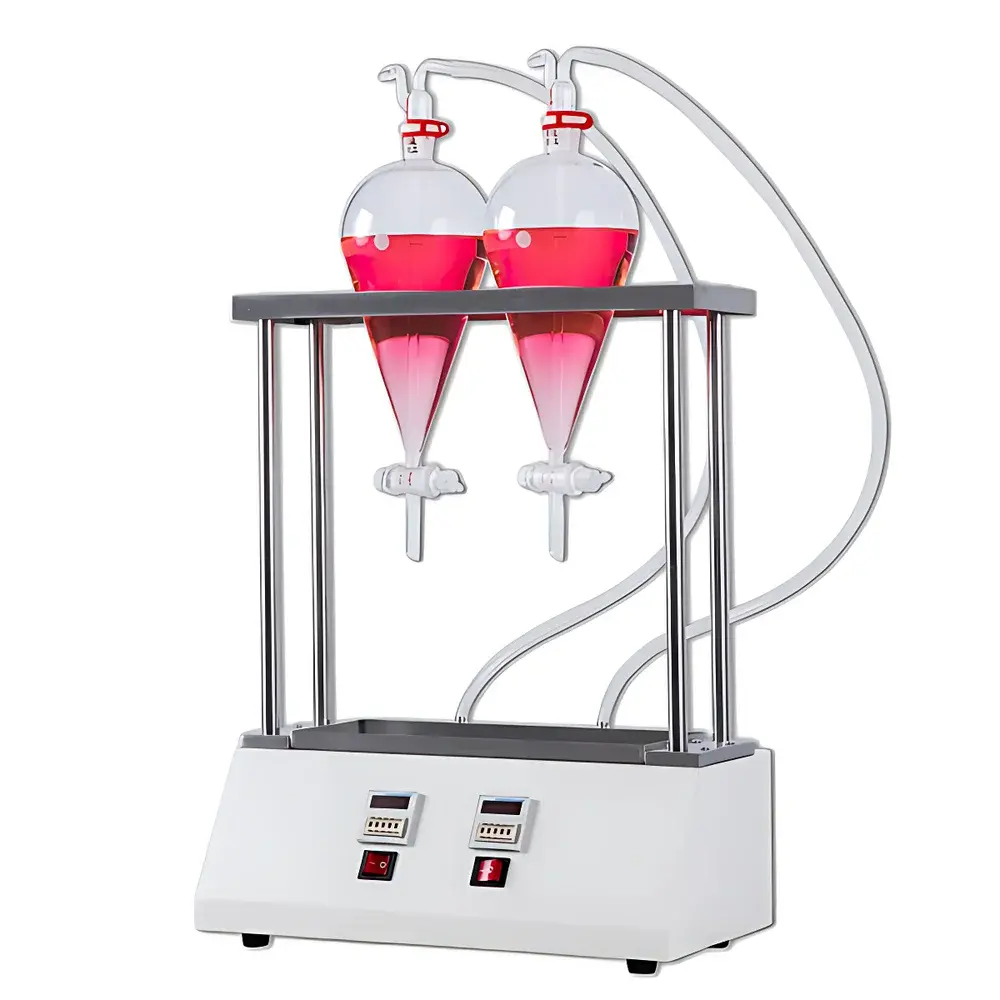
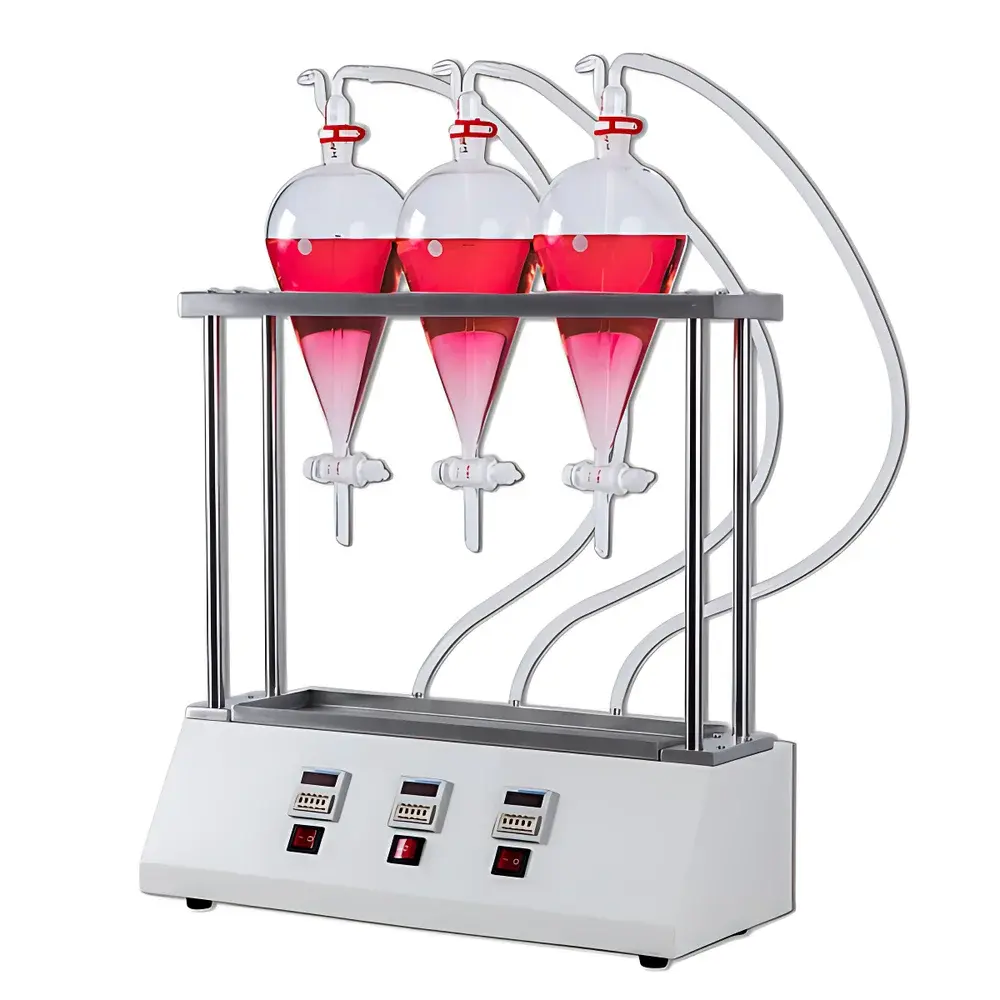
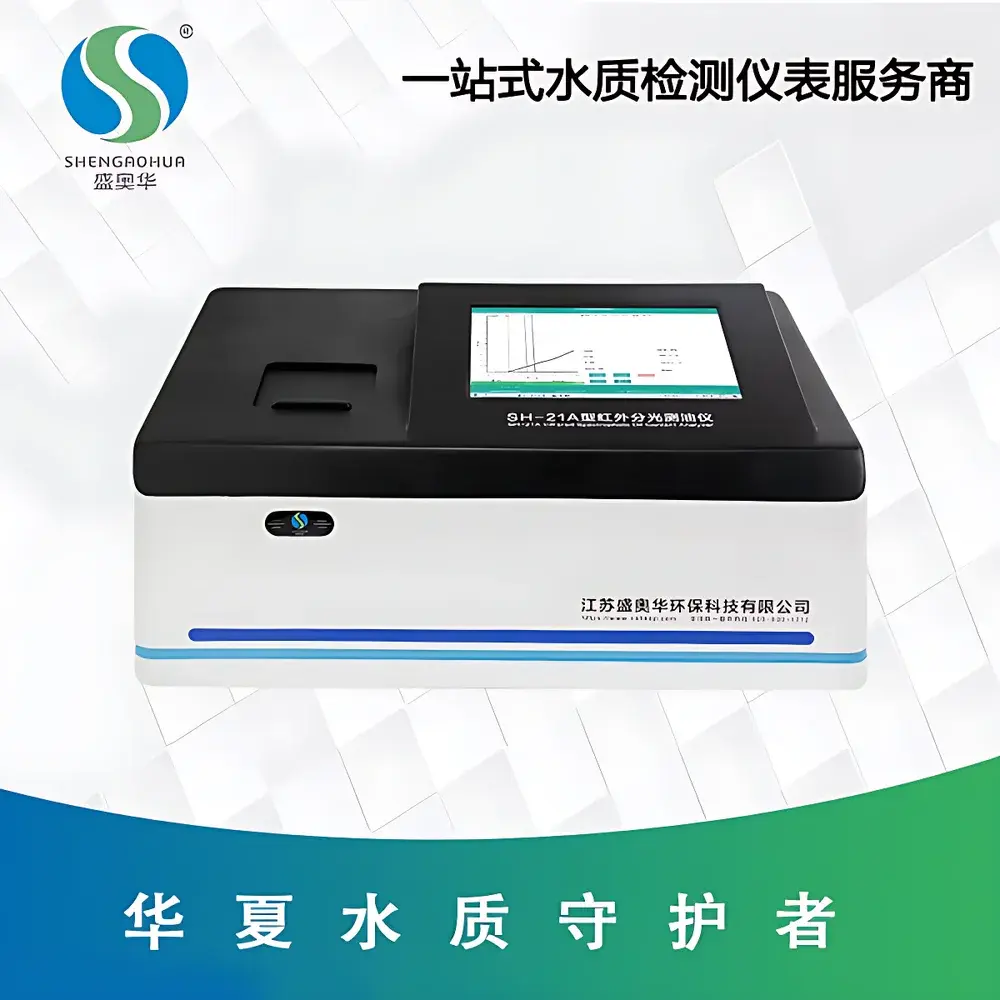
ShengAohua SH-21A Infrared Oil Content Analyzer
| Brand | ShengAohua |
|---|---|
| Origin | Jiangsu, China |
| Manufacturer Type | Direct Manufacturer |
| Product Category | Domestic |
| Model | SH-21A |
| Instrument Type | Laboratory Benchtop Analyzer |
| Measurement Principle | Infrared Spectrophotometry (FTIR-based Dispersive Detection) |
| Measurement Range | 0–120.00 mg/L (as oil in water) |
| Detection Limit | 0.001 mg/L (instrument detection limit, water sample basis) |
| Accuracy | ±1.5% |
| Wavenumber Range | 3400–2400 cm⁻¹ (2941–4167 nm) |
| Wavenumber Accuracy & Repeatability | ±0.5 cm⁻¹ |
| Baseline Drift | <0.005 AU/60 min |
| Linearity (R²) | >0.999 |
| Repeatability (RSD) | ≤0.6% at 30–40 mg/L oil standard (n=11) |
| Absorbance Range | 0.0000–3.0000 AU (T = 100%–1%) |
| Scan Speed | Full-spectrum scan in 30 s |
| Light Source | German-imported infrared tungsten-halogen lamp (lifetime ≥50,000 h) |
| Optical Path | Integrated optical-mechanical-electrical architecture with mechanical chopper for zero-point auto-adjustment |
| Solvent Compatibility | Tetrachloroethylene (C₂Cl₄), S-316, 1,1,2-trichloro-1,2,2-trifluoroethane, and other non-carbon-chlorinated solvents |
| Sample Cell | 4 cm pathlength quartz cuvette |
| Operating Environment | 15–30 °C, 20–80% RH (non-condensing) |
| Power Supply | (220 ± 22) V AC, (50 ± 1) Hz, 50 W |
| Dimensions | 480 × 340 × 160 mm |
| Net Weight | 12 kg |
Overview
The ShengAohua SH-21A Infrared Oil Content Analyzer is a laboratory-grade benchtop instrument engineered for precise quantification of total petroleum hydrocarbons (TPH) and mineral oil content in aqueous, gaseous, and solid-phase environmental matrices. It operates on the principle of dispersive infrared spectrophotometry—specifically calibrated to the C–H stretching absorption bands at 2930 cm⁻¹ (CH₂ asymmetric stretch), 2960 cm⁻¹ (CH₃ asymmetric stretch), and 3030 cm⁻¹ (aromatic C–H stretch)—in accordance with standardized methodologies defined in China’s national standards GB 16488–1996 and HJ 637–2018. The analyzer employs a high-stability, long-life German infrared tungsten-halogen source coupled with a mechanically chopped optical system to suppress baseline drift and ensure signal integrity over extended measurement cycles. Its fully integrated opto-mechanical-electronic architecture eliminates external alignment dependencies, delivering robust reproducibility and operational stability in routine QC and regulatory compliance workflows.
Key Features
- Embedded 10.8-inch Windows 10 tablet with full-HD touchscreen interface—no external PC required
- Dual-mode spectral analysis: full-spectrum scanning (30 s) and rapid non-dispersive mode (2 s) for high-throughput screening
- Automated wavenumber calibration at 2930, 2960, and 3030 cm⁻¹ for samples ≥30 mg/L—eliminating manual peak positioning errors
- Pre-installed oil analysis software with spectral visualization, interference identification, data archiving, statistical reporting (mean, SD, RSD), and GLP-compliant audit trail generation
- Optimized optical path design with 4 cm quartz cuvette compatibility and selectable solvent support (tetrachloroethylene, S-316, or 1,1,2-trichloro-1,2,2-trifluoroethane)
- Baseline stability <0.005 AU/60 min via real-time mechanical chopper zero-point correction
- Linear dynamic range up to 120.00 mg/L (as oil in water); instrument detection limit ≤0.001 mg/L (water sample basis)
- Wavenumber accuracy ±0.5 cm⁻¹ and repeatability validated per ISO 17025 traceable protocols
Sample Compatibility & Compliance
The SH-21A supports quantitative oil analysis across diverse environmental media: surface water, groundwater, industrial wastewater, flue gas condensates (via impinger collection), soil/sediment extracts, and food-grade process residues. Sample preparation follows standardized liquid–liquid extraction using tetrachloroethylene or equivalent IR-transparent solvents, followed by dehydration with anhydrous sodium sulfate. The instrument complies with methodological requirements for regulatory monitoring under China’s Environmental Monitoring Technical Specifications and aligns with international best practices for hydrocarbon quantification—including ASTM D7066 (for TPH in water) and ISO 9377-2 (petroleum hydrocarbons in water). While not FDA 21 CFR Part 11 certified out-of-the-box, its software architecture supports configurable user access controls, electronic signature prompts, and immutable data logging—enabling customization for GLP/GMP environments upon validation.
Software & Data Management
The embedded Windows 10 platform runs proprietary oil analysis software featuring dual-algorithm processing: one optimized for tetrachloroethylene-based extractions (per HJ 637–2018), and another adaptable to alternative solvents such as S-316. All spectra are stored in vendor-neutral .csv and .spc formats, supporting third-party spectral libraries and post-acquisition reprocessing. The software automatically calculates total oil concentration using built-in calibration curves (0–100 mg/L reference standards), applies matrix correction factors, and generates printable reports compliant with internal QA/QC templates. Audit trails record operator ID, timestamp, method version, raw absorbance values, and calibration history—facilitating traceability during regulatory inspections or laboratory accreditation audits (e.g., CNAS, CMA).
Applications
- Regulatory compliance testing for effluent discharge permits (e.g., municipal WWTPs, petrochemical refineries)
- Groundwater plume characterization at contaminated sites (e.g., leaking USTs, pipeline corridors)
- Process water monitoring in power generation (cooling tower makeup), steel manufacturing (rolling mill emulsions), and food processing (wastewater grease load)
- Research-grade quantification of oil–water partitioning behavior and biodegradation kinetics
- Field-deployable lab verification for mobile environmental labs and emergency response units
- Educational use in university environmental engineering and analytical chemistry curricula
FAQ
What extraction solvents are compatible with the SH-21A?
Tetrachloroethylene (C₂Cl₄) is the primary solvent specified in HJ 637–2018. Alternative IR-transparent solvents—including S-316 and 1,1,2-trichloro-1,2,2-trifluoroethane—are supported via user-defined calibration protocols.
Is the instrument suitable for measuring oil in air or soil samples?
Yes—when paired with standardized collection methods: impinger trapping for airborne oil aerosols, and Soxhlet or ultrasonic extraction for solid matrices. Quantification assumes proper solvent recovery and cleanup prior to IR measurement.
Does the SH-21A meet international standards such as ISO or ASTM?
Its measurement principle and performance specifications align with ISO 9377-2 and ASTM D7066 for petroleum hydrocarbon determination in water. Full conformance requires site-specific method validation per ISO/IEC 17025.
Can raw spectral data be exported for external analysis?
Yes—absorbance spectra are exportable in ASCII (.csv) and JCAMP-DX (.spc) formats, enabling integration with chemometric tools or spectral databases.
What maintenance is required for long-term reliability?
Annual optical alignment verification and lamp intensity calibration are recommended. The halogen source has a rated lifetime exceeding 50,000 hours; no routine lamp replacement is anticipated within normal lab usage cycles.
Related Products







