
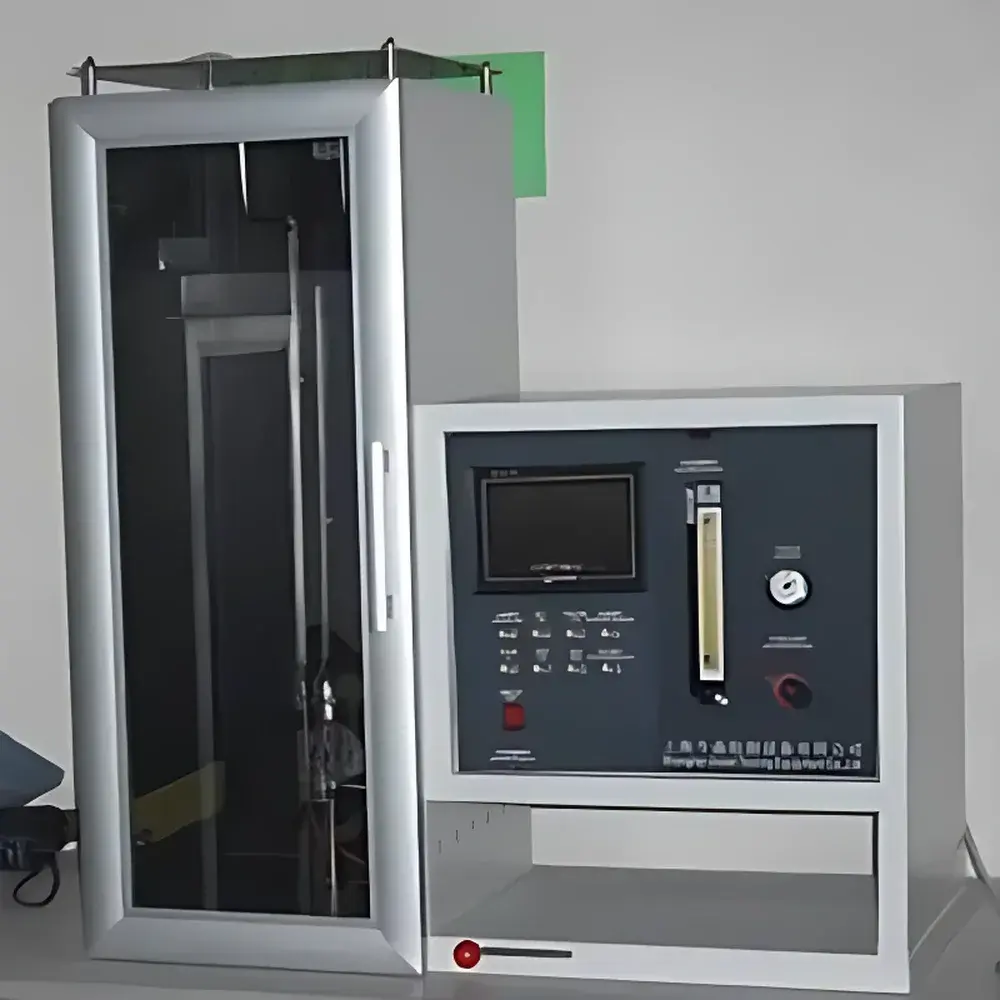
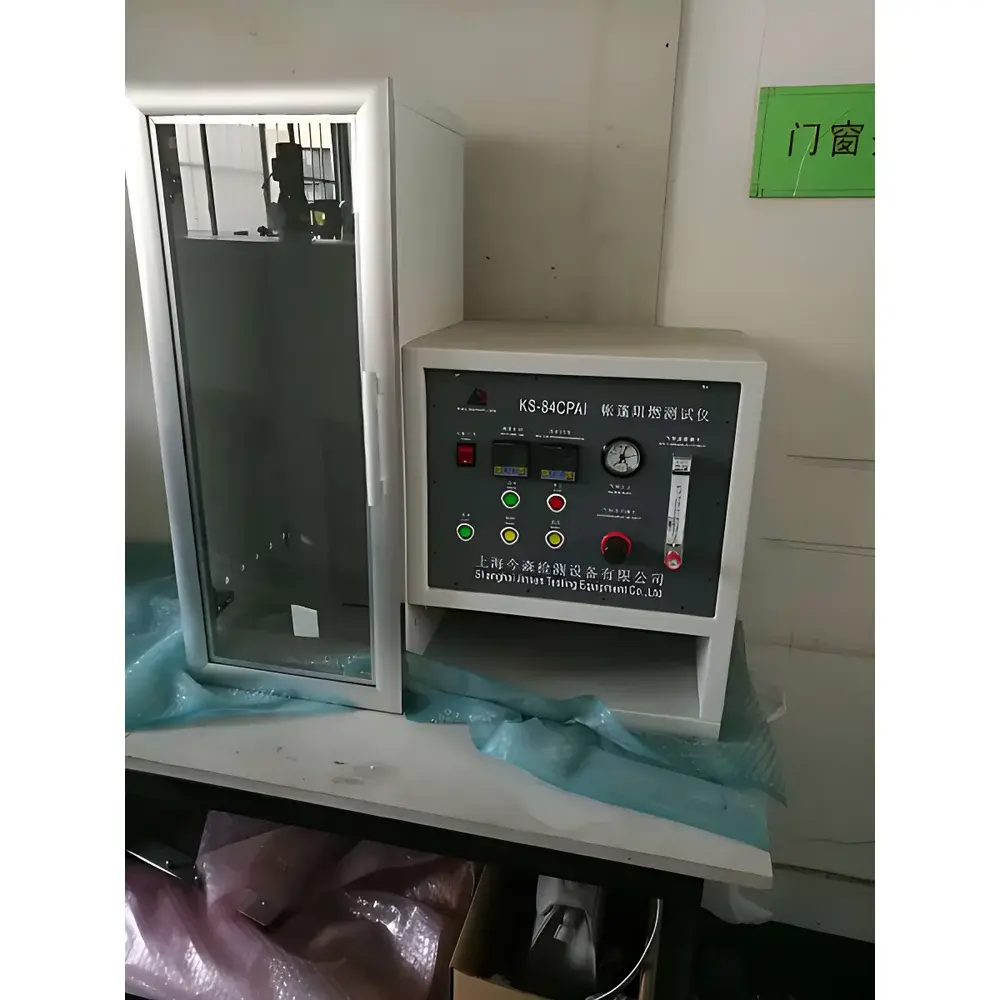
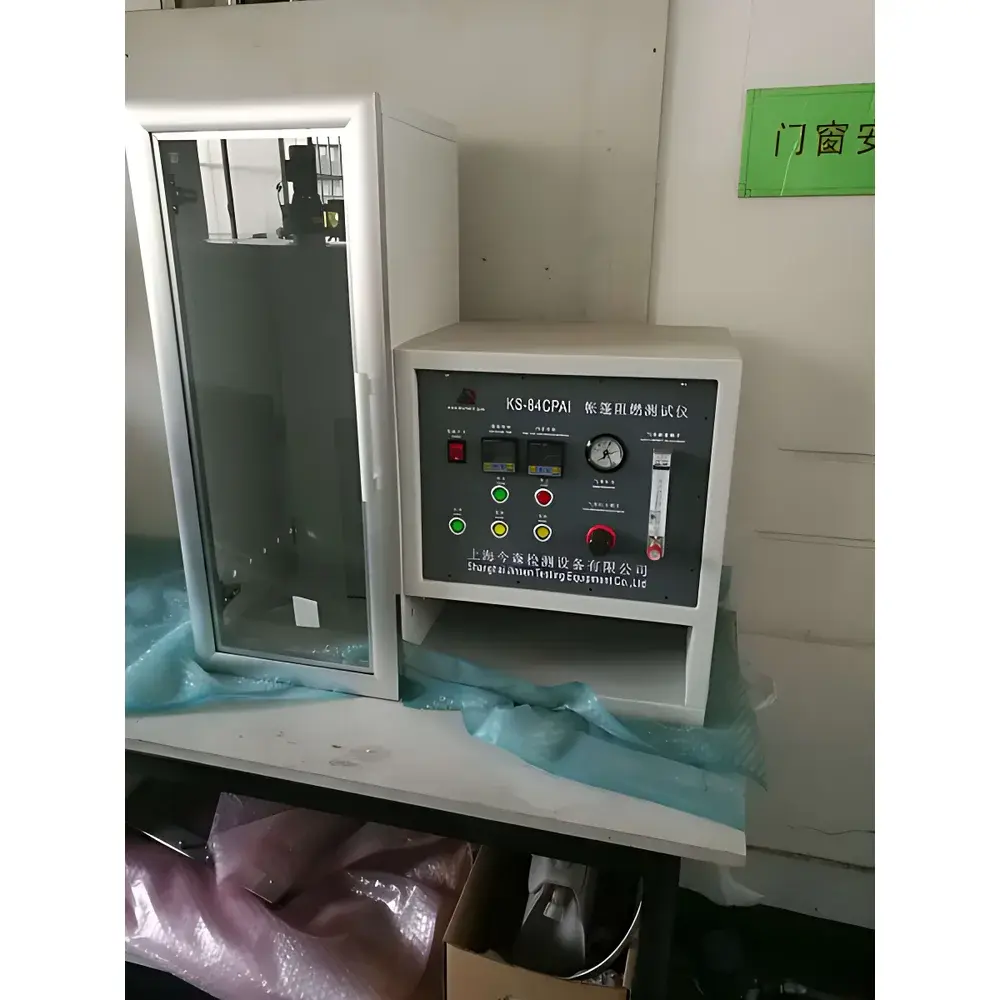
KS-8333BS Vertical Burning Tester for Rigid Foam Plastics
| Brand | INSMENT (Shanghai Jinsen) |
|---|---|
| Origin | Shanghai, China |
| Model | KS-8333BS |
| Flame Height (inner blue cone) | 25–30 mm (adjustable) |
| Gas Flow Rate | 0–1000 mL/min (adjustable) |
| Flame Temperature Range | 100–1000 °C (Bunsen burner, imported from Hamburg, USA) |
| Control System | Microprocessor-based with automatic ignition and timing |
| Temperature Display | Imported digital temperature indicator |
| Fuel Gas Purity | ≥95% propane or natural gas |
| Power Supply | AC 220 V ±10 V, 50 Hz |
| Operating Ambient Temperature | 10–35 °C |
| Relative Humidity | ≤75% |
Overview
The KS-8333BS Vertical Burning Tester for Rigid Foam Plastics is a precision-engineered instrument designed to evaluate the flammability behavior of rigid polymeric foam materials under standardized vertical orientation conditions. It operates on the principle of controlled open-flame exposure—applying a defined Bunsen burner flame to the bottom edge of a vertically clamped specimen for a specified duration—and quantifies key fire response parameters including afterflame time, afterglow time, and extent of flaming combustion or char propagation. The system adheres strictly to the test methodology outlined in GB/T 8333–2008, China’s national standard for vertical burning tests of rigid foams, and is fully compatible with ASTM D3014–04a, the widely recognized U.S. standard for evaluating the flame resistance of cellular plastics used in building and transportation applications. Its design emphasizes repeatability, operator safety, and regulatory traceability—critical requirements for laboratories engaged in material qualification, product development, and compliance verification for construction, automotive, and rail sectors.
Key Features
- Imported high-precision Hamburg-manufactured Bunsen burner with thermally stable ceramic nozzle, enabling accurate flame geometry and reproducible thermal flux delivery across the 100–1000 °C operating range.
- Adjustable inner blue flame height (25–30 mm), calibrated per ASTM D3014 and GB/T 8333 specifications to ensure consistent ignition source geometry and heat transfer profile.
- Digital mass-flow controlled gas delivery system (0–1000 mL/min range) with real-time monitoring, supporting both propane and natural gas (≥95% purity) as fuel sources.
- Integrated microprocessor controller featuring programmable ignition sequence, dual independent timers (for flame application and post-ignition observation), and automatic shutdown logic upon test completion.
- High-resolution digital temperature indicator with NIST-traceable calibration capability, facilitating continuous monitoring of burner tip temperature during operation.
- Robust stainless-steel test chamber with transparent borosilicate viewing window, ventilation interlock, and flame-retardant interior lining to meet laboratory safety protocols.
Sample Compatibility & Compliance
The KS-8333BS accommodates standard test specimens measuring 250 mm × 20 mm × 10 mm (L × W × H), cut from rigid foam panels—including polyurethane (PUR), phenolic (PF), polyisocyanurate (PIR), and expanded polystyrene (EPS)—with surface density up to 300 kg/m³. Specimen mounting fixtures conform to dimensional tolerances specified in both GB/T 8333–2008 and ASTM D3014–04a. The instrument supports full documentation workflows aligned with GLP (Good Laboratory Practice) and ISO/IEC 17025 requirements, including timestamped event logging (ignition, flame-off, extinguishment), operator ID input, and non-volatile storage of test metadata. While not certified to UL 94 or IEC 60695-11-10 by default, its physical configuration and operational parameters are directly comparable to apparatus used in those standards’ vertical burn procedures.
Software & Data Management
The KS-8333BS operates via embedded firmware with no external PC dependency; however, optional RS-232 or USB-C interface enables direct data export to LIMS or QA/QC databases. All test records—including flame-on duration, afterflame time (t₁), afterglow time (t₂), specimen damage length, and pass/fail status per GB/T 8333 criteria—are stored in internal memory with date/time stamping and user authentication. Audit trail functionality complies with FDA 21 CFR Part 11 expectations when paired with validated third-party data acquisition software. Exported CSV files contain column headers compliant with ASTM E141 standard reporting conventions for fire test data.
Applications
- Quality control of rigid foam insulation boards prior to release for construction or cold-chain logistics applications.
- Comparative evaluation of flame-retardant additive efficacy (e.g., phosphorus-, bromine-, or nitrogen-based systems) in polymeric foam formulations.
- Regulatory submission support for CE marking (EN 13501-1), CCC certification (China Compulsory Certification), and railway rolling stock fire safety approvals (EN 45545-2).
- R&D screening of next-generation bio-based foams and nanocomposite-enhanced cellular materials under standardized thermal insult conditions.
- Internal validation of material substitution proposals where fire performance equivalence must be demonstrated against legacy products.
FAQ
What standards does the KS-8333BS explicitly support?
It is configured and verified for GB/T 8333–2008 and ASTM D3014–04a. Calibration certificates and installation qualification (IQ) documents are provided upon request.
Can the instrument be used with butane or mixed hydrocarbon gases?
No—only ≥95% pure propane or natural gas is permitted to maintain flame stability, repeatability, and conformance with standard-defined thermal output.
Is third-party calibration available?
Yes. INSMENT partners with CNAS-accredited metrology labs in Shanghai and Guangzhou for annual calibration services, including flame geometry verification and flowmeter traceability to SI units.
Does the system include smoke density or CO measurement capabilities?
No. The KS-8333BS is a dedicated vertical burn apparatus; complementary instruments such as cone calorimeters (ASTM E1354) or Fourier-transform infrared (FTIR) gas analyzers are required for combustion gas analysis.
What maintenance intervals are recommended?
Burner nozzle inspection and cleaning every 50 test cycles; flowmeter recalibration annually or after any gas line modification; firmware updates issued biannually via secure download portal.



