
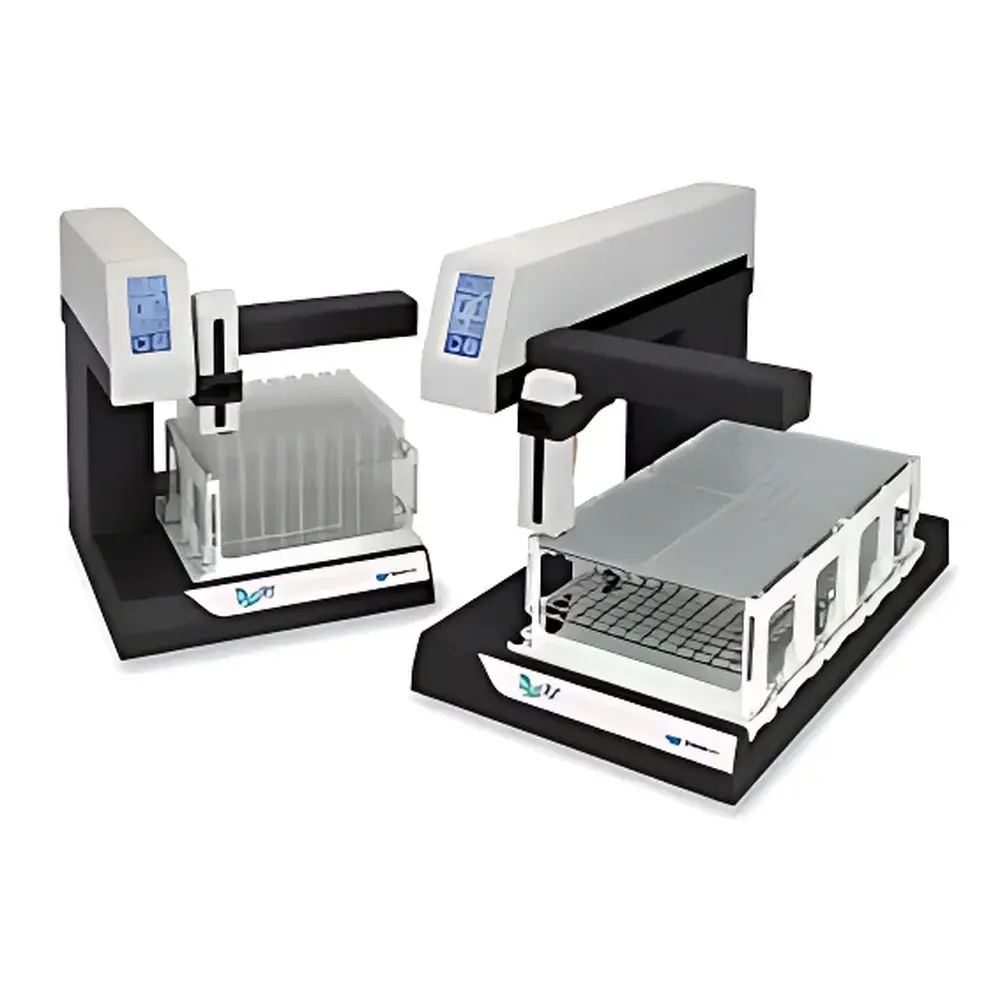
CoMetro R1/R2 Fraction Collector
| Brand | CoMetro |
|---|---|
| Origin | Imported |
| Manufacturer Type | Authorized Distributor |
| Instrument Type | Mixed-Mode Fraction Collector |
| Collection Mode | Drop Counting, Time-Based, Volume-Based, Peak-Triggered |
| Max Flow Rate | 100 mL/min |
| Dimensions (R1) | 31 × 33 × 35.5 cm |
| Dimensions (R2) | 31 × 53 × 38 cm |
| Weight (R1, excl. rack) | 7.7 kg |
| Weight (R2, excl. rack) | 10.6 kg |
| Power Supply | 115 VAC or 230 VAC, 50/60 Hz |
| Tube Capacity Options | 144 × 12/13 mm, 100 × 16 mm, 72 × 18 mm, 36 × 25 mm, 60 × 1.5 mL microcentrifuge tubes, 36 × 50 mL centrifuge tubes, 96-well plate support |
| Standard Configuration (R1) | Main unit, switching valve, one 13-mm tube rack |
| Standard Configuration (R2) | Main unit, switching valve, two 13-mm tube racks |
Overview
The CoMetro R1/R2 Fraction Collector is a programmable, mixed-mode fraction collection system engineered for integration with preparative liquid chromatography (prep-LC), gravity-fed column chromatography, and fast protein liquid chromatography (FPLC) platforms. It operates on a dual-principle collection architecture—supporting drop-counting, time-based, volumetric, and peak-triggered fractionation—enabling precise synchronization with UV/Vis, conductivity, or pH detectors via analog or digital TTL trigger inputs. Designed for laboratory environments requiring high reproducibility in sample recovery and minimal carryover, the R1/R2 employs a robust peristaltic-compatible fluid path with chemically resistant PTFE and polypropylene wetted materials. Its low-noise stepper-motor-driven tube carousel and rapid valve actuation (< 200 ms switching time) ensure consistent retention of labile compounds and maintain integrity during sequential collection across up to 144 fractions.
Key Features
- Mixed-mode collection logic: configurable by drop count (user-defined drop volume calibration), elapsed time (1 s–99 h 59 min resolution), delivered volume (via integrated flow pulse counting or external flowmeter input), or real-time peak detection (TTL/analog signal threshold triggering)
- Modular tube rack system: supports interchangeable carriers for 1.5 mL microcentrifuge tubes, 13–25 mm diameter glass or plastic test tubes, 50 mL centrifuge tubes, and standard 96-well microplates—enabling method flexibility without hardware modification
- Compact dual-form factor: R1 (single-rack configuration) and R2 (dual-rack configuration) accommodate varying throughput needs while maintaining footprint efficiency; both models feature tool-free rack insertion and tactile alignment guides
- Embedded safety architecture: includes leak-detection circuitry at the valve manifold, grounded chassis design compliant with IEC 61010-1, and automatic flow-stop on power interruption or tube overflow detection
- Low-maintenance electromechanical design: brushless stepper motors, sealed solenoid valves rated for >1 million cycles, and absence of lubricated gear trains reduce long-term calibration drift and service intervals
Sample Compatibility & Compliance
The R1/R2 is compatible with aqueous, organic, and mixed-solvent mobile phases commonly used in reversed-phase, ion-exchange, size-exclusion, and affinity chromatography. All fluid-contact surfaces meet USP Class VI biocompatibility standards. The system complies with CE marking requirements under the EU Machinery Directive 2006/42/EC and Low Voltage Directive 2014/35/EU. When operated with validated methods and audit-trail-enabled software (see Software & Data Management), it supports GLP and GMP workflows aligned with FDA 21 CFR Part 11 expectations for electronic records and signatures—particularly when paired with third-party chromatography data systems (CDS) that provide full traceability of collection events, timestamps, and operator IDs.
Software & Data Management
The R1/R2 operates standalone via front-panel keypad navigation with LCD display, storing up to 20 user-defined methods—including collection thresholds, delay times, pause conditions, and post-collection actions (e.g., valve park position, alarm activation). Optional USB-to-serial interface enables bidirectional communication with Windows-based CDS platforms (e.g., Chromeleon, Empower, OpenLAB) for synchronized method loading, real-time status monitoring, and export of collection logs in CSV format. All method parameters, execution history, and error codes are timestamped and retained in non-volatile memory—even during power loss—ensuring full traceability for regulatory review.
Applications
- Purification of natural products and synthetic intermediates in pharmaceutical process development
- Isolation of monoclonal antibody fragments following Protein A chromatography
- Collection of discrete elution windows in gradient HPLC for subsequent NMR or MS analysis
- Automated fractionation in flash chromatography for library synthesis and metabolite profiling
- Time-resolved sampling in continuous-flow reaction monitoring setups
FAQ
What types of detectors can trigger peak-based collection?
The R1/R2 accepts TTL-level (0–5 V) or analog (0–10 V) output signals from UV/Vis absorbance, conductivity, refractive index, or fluorescence detectors. Threshold and slope-based peak detection algorithms are configurable via front panel or host software.
Is the system compatible with high-pressure prep-LC systems?
Yes—the R1/R2 is designed for post-column, low-backpressure operation (max inlet pressure: 0.5 bar). For systems exceeding this, an optional pressure-relief tee or flow splitter must be installed upstream to protect the collection valve manifold.
Can collection methods be exported and shared between instruments?
Method files (.CMF) generated via the optional PC utility are portable across R1/R2 units of the same firmware revision. Each file includes checksum verification to prevent unintended parameter corruption.
Does the R1/R2 support 21 CFR Part 11 compliance out of the box?
Standalone operation does not include electronic signature or role-based access control. However, when integrated with validated third-party CDS software that implements audit trails, electronic signatures, and user authentication, the R1/R2 satisfies data integrity requirements as a peripheral device.
What maintenance is required for long-term reliability?
No routine lubrication or recalibration is needed. Recommended quarterly inspection includes visual check of tubing integrity, cleaning of tube rack contacts, and verification of valve seal integrity using water-drop consistency test (supplied in manual).




