
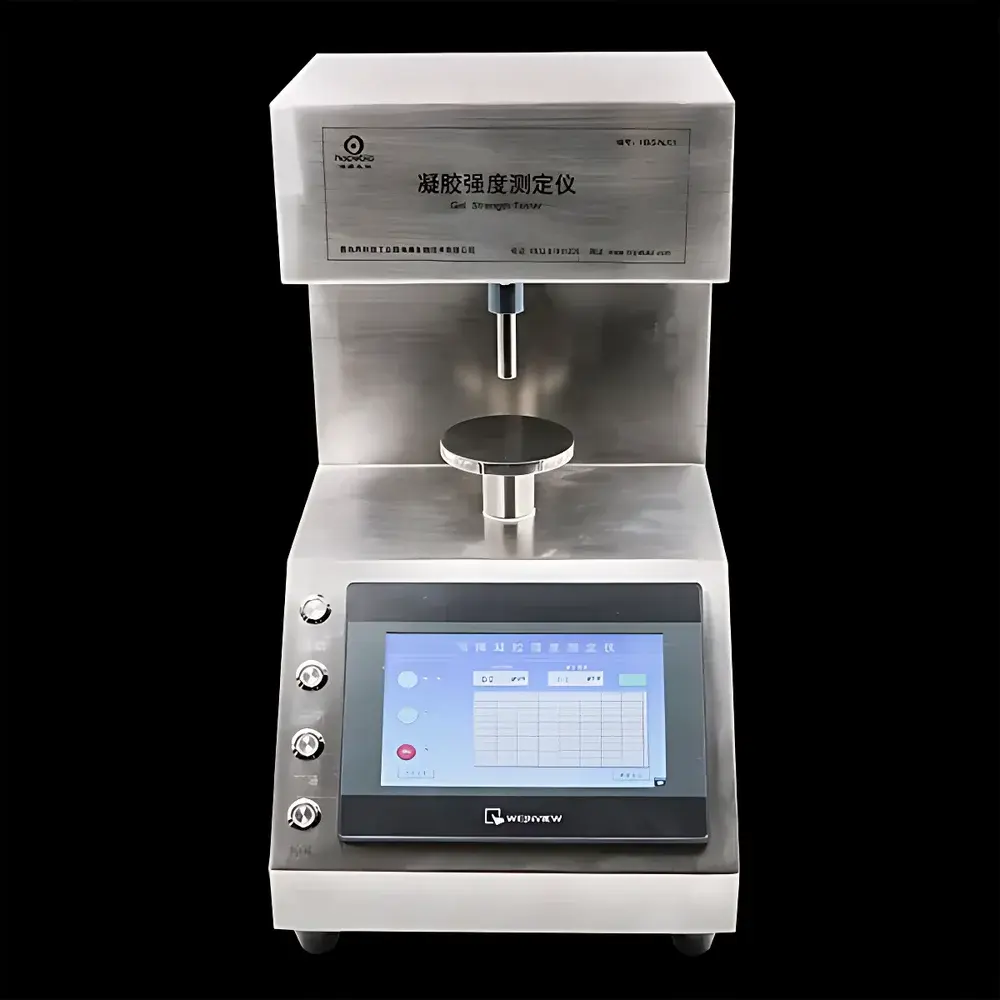
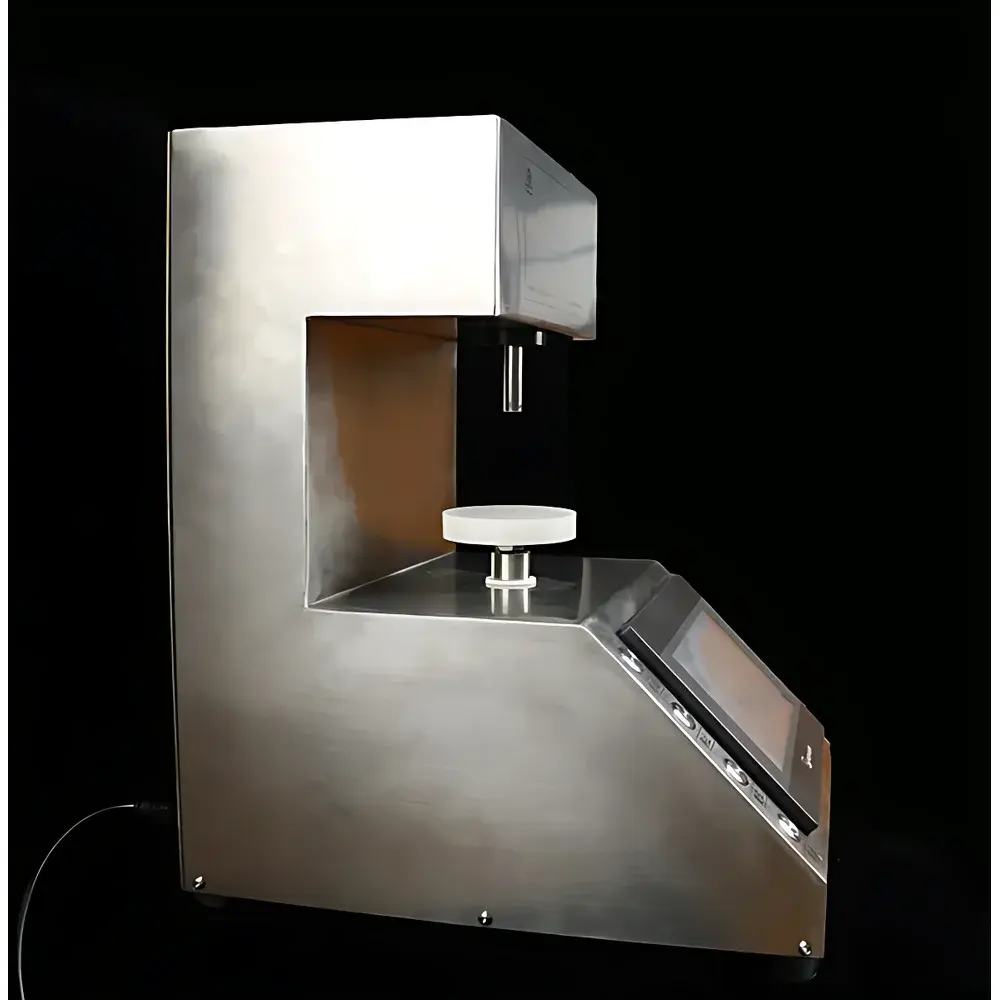
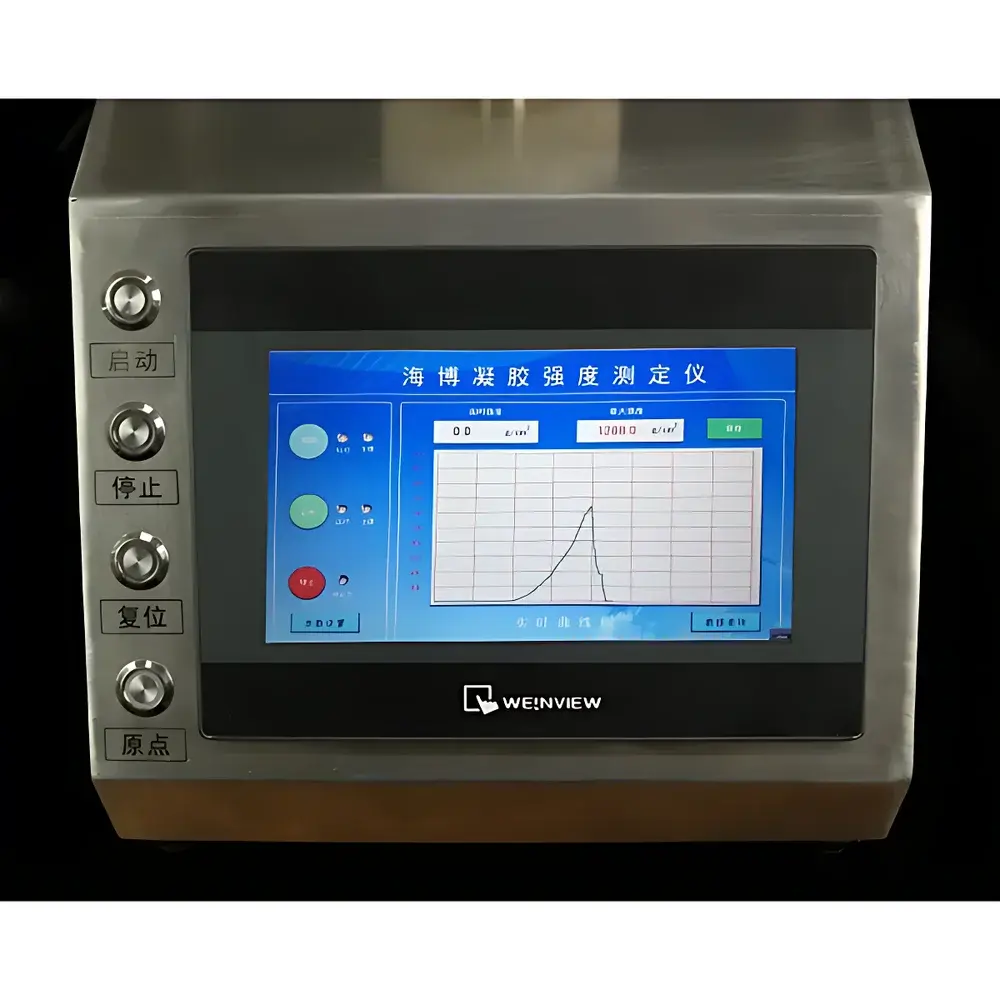
Hopebiol HBS-NJ01 Gel Strength Tester
| Brand | Hopebiol |
|---|---|
| Origin | Shandong, China |
| Manufacturer Type | Authorized Distributor |
| Country of Origin | China |
| Model | HBS-NJ01 |
| Voltage | 220 V AC |
| Current Rating | 1 A |
| Weight | 10 kg |
| Dimensions (W×D×H) | 350 × 250 × 435 mm |
| Touchscreen | 7-inch TFT LCD |
| Operating Temperature | 10–40 °C |
| Relative Humidity | <90% RH |
| Force Measurement Range | 0–3000 g/cm² |
| Resolution | 0.1 g |
| Probe Diameter | 11.28 mm (cross-sectional area: 1 cm²) |
| Penetration Speed | Adjustable, default 1.0 mm/s |
| Retraction Speed & Distance | Adjustable |
| Penetration Depth Range | 0.01–40 mm |
| Data Storage Capacity | 36 test records |
| Construction | Full stainless-steel enclosure |
| Control System | PLC-based embedded controller |
Overview
The Hopebiol HBS-NJ01 Gel Strength Tester is a precision-controlled mechanical penetrometer engineered for standardized quantitative assessment of gel rigidity in hydrocolloid systems. It operates on the principle of controlled axial compression using a calibrated cylindrical probe (11.28 mm diameter, 1 cm² cross-section) driven at programmable linear velocity into a pre-equilibrated gel surface. The instrument measures the maximum resisting force (in grams per square centimeter) required to achieve a defined penetration depth—directly corresponding to gel strength as defined in ISO 9665 (Adhesives — Animal glues — Method of sampling and testing), GB 28304–2012 (Curdlan gel strength determination), and GB 6783–2013 (Gelatin bloom strength). Designed for routine quality control and R&D laboratories in food, pharmaceutical, and biomaterial sectors, the HBS-NJ01 delivers high reproducibility under GLP-aligned operational conditions without requiring operator calibration or manual interpolation.
Key Features
- High-resolution load cell with 0.1 g resolution and full-scale range of 0–3000 g/cm², traceable to national metrological standards
- Programmable penetration parameters: descent speed (0.1–5.0 mm/s), retraction speed, and penetration depth (0.01–40 mm), enabling method harmonization across labs
- PLC-based real-time control architecture with deterministic response timing, minimizing hysteresis and drift during dynamic loading
- 7-inch industrial-grade touchscreen interface supporting bilingual (English/Chinese) menu navigation, intuitive parameter entry, and live force–displacement curve visualization
- Full stainless-steel housing (AISI 304) compliant with ISO 14644-1 Class 8 cleanroom-compatible environments and resistant to aqueous hydrocolloid residue
- Onboard data storage for up to 36 complete test records—including timestamp, probe speed, depth, peak force, and curve metadata—with CSV export via USB port
- Auto-zero function triggered only when platform load is ≤60 g, ensuring baseline integrity prior to sample placement
Sample Compatibility & Compliance
The HBS-NJ01 is validated for use with thermoreversible and thermoirreversible gels including agar, carrageenan, pectin, alginates, locust bean gum, xanthan gum, gelatin, guar gum, konjac glucomannan, curdlan, superabsorbent polymers (SAPs), and synthetic hydrogels. Sample preparation must adhere to specified thermal equilibration protocols: gels shall be solidified ≥90 minutes at 10–25 °C; refrigerated plates (2–8 °C) must be acclimatized to ambient temperature prior to testing. The instrument meets mechanical and procedural requirements of ISO 9665 Annex B (penetrometer specifications), GB/T 6783–2013 Clause 5.3 (bloom meter compliance), and GB/T 28304–2012 Section 4.2 (standardized probe geometry and speed). While not certified to FDA 21 CFR Part 11, its audit-ready data logging supports GMP-aligned documentation practices when paired with validated SOPs.
Software & Data Management
The embedded firmware provides real-time plotting of force (g) versus displacement (mm), with automatic detection and annotation of peak force—the primary gel strength metric. Each test record stores raw time-series data points at ≥100 Hz sampling rate, enabling post-acquisition analysis of viscoelastic recovery kinetics. Data export is restricted to USB mass-storage mode (no network connectivity), preserving data integrity in regulated environments. All saved records include immutable metadata: test ID, date/time stamp, operator ID (manually entered), probe speed, target depth, and environmental condition flags (temperature/humidity warnings if outside 10–40 °C / <90% RH). Internal memory is volatile; users are advised to perform daily backups to external media to comply with ALCOA+ data retention principles.
Applications
- Batch release testing of commercial gelatin and carrageenan grades against USP/NF monographs
- Formulation optimization of plant-based meat analogs and dairy-free desserts where texture profile correlates with probe resistance
- Stability monitoring of pH- or ion-sensitive hydrogels during accelerated shelf-life studies
- Comparative evaluation of enzymatic vs. thermal gelation kinetics in collagen-derived biomaterials
- Validation of polymer crosslinking density in wound-healing hydrogels per ASTM F2535–21 guidelines
- Teaching laboratory implementation for undergraduate rheology and food physics curricula
FAQ
What is the minimum recommended gel thickness for accurate measurement?
The sample height must exceed the selected penetration depth by ≥2 mm to prevent bottom-effect interference. For standard 1 cm² probe tests at 4 mm depth, gels should be ≥6 mm thick.
Can the HBS-NJ01 be used for non-hydrocolloid materials such as silicone elastomers?
No. Its force range and probe geometry are optimized for soft, hydrated gels (0.5–3000 g/cm²). Materials exceeding 3000 g/cm² or exhibiting high elastic recovery may damage the sensor or yield non-compliant readings.
Is calibration certificate included with shipment?
A factory calibration report (traceable to CNAS-accredited reference standards) is provided. Field recalibration requires certified dead-weight kits and is recommended annually or after impact events.
Does the instrument support automated sequence testing for multiple samples?
No. Each test requires manual sample placement and initiation. However, the rapid 30-second cycle time (including retraction and display refresh) enables high-throughput manual operation.
How does ambient vibration affect measurement accuracy?
Vibration >0.5 g RMS at 10–100 Hz introduces noise in force signal acquisition. Installation on a granite slab or anti-vibration table is mandatory in shared lab spaces or near centrifuges/pumps.



