
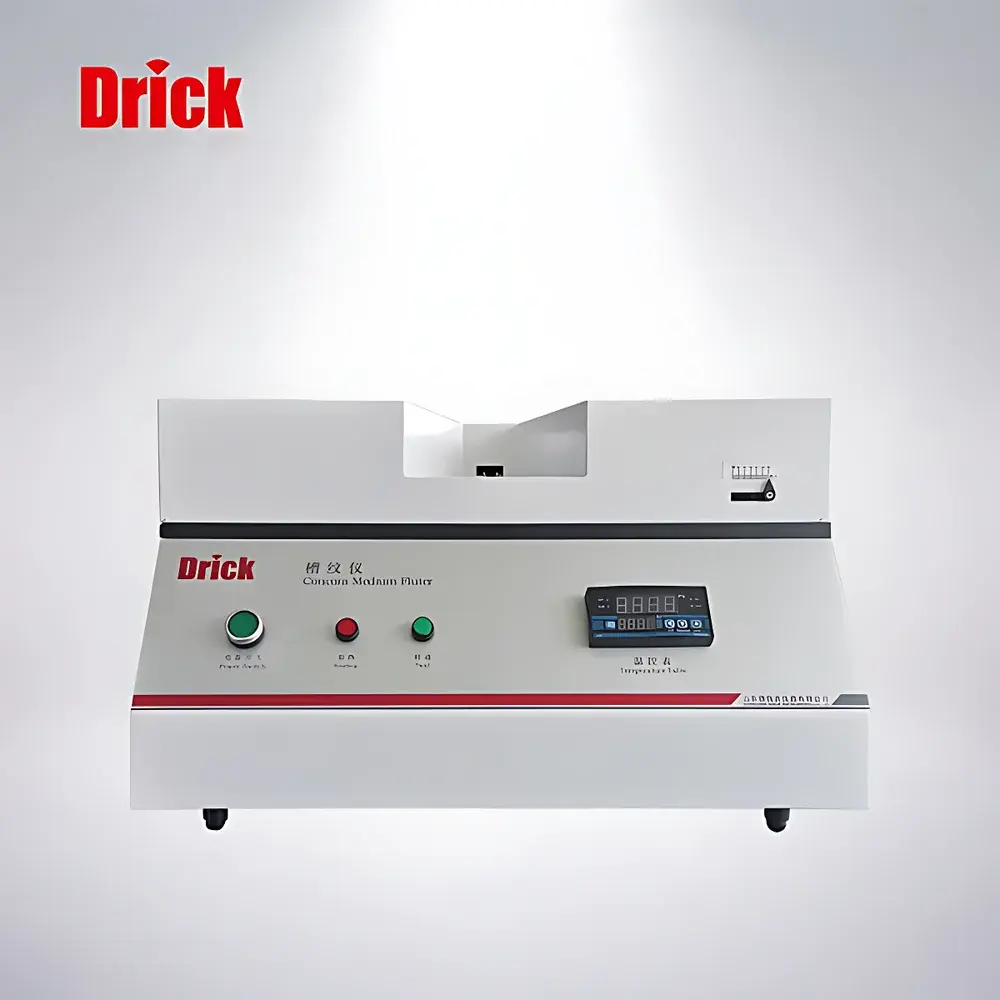
Drick DRK113E-1 Corrugating Flute Former for Corrugating Medium
| Key | Brand: Drick |
|---|---|
| Origin | Shandong, China |
| Manufacturer Type | Direct Manufacturer |
| Country of Origin | China |
| Model | DRK113E-1 |
| Operating Speed | 4.5 rpm |
| Temperature Display Resolution | 1 °C |
| Temperature Measurement Accuracy | Class 0.5 |
| Adjustable Temperature Range | Ambient to 200 °C |
| Adjustable Pressure Range | 49–108 N |
| Standard Operating Temperature | 175 °C |
| Spring Tension | 100 N |
| Dimensions (L×W×H) | 564 × 377 × 330 mm |
| Power Supply | AC 220 V ±5%, 50 Hz |
Overview
The Drick DRK113E-1 Corrugating Flute Former is a precision laboratory instrument engineered for the standardized corrugation of corrugating medium (also known as fluting medium or linerboard core paper) under controlled thermal and mechanical conditions. It replicates the industrial flute-forming process at bench scale—generating consistent, repeatable flute geometry (e.g., A-, B-, C-, or E-flute profiles) in accordance with internationally recognized test standards. The device operates on the principle of controlled heat-assisted deformation: heated copper flute rolls apply calibrated pressure and rotational shear to the paper sample, inducing permanent creasing and elastic-plastic deformation along defined sinusoidal or trapezoidal waveforms. This pre-formed specimen is then transferred to a compression tester for subsequent Corrugated Medium Test (CMT) or Corrugated Crush Test (CCT), where flat crush resistance (CMT) or edge crush resistance (CCT) is quantified per ASTM D6320, ISO 7263, GB/T 2679.6, QB 1061, and TAPPI T809.
Key Features
- High-stability PID temperature controller with auto-tuning capability and real-time thermal compensation—ensures stable setpoint maintenance within ±1 °C across extended operation cycles.
- Copper alloy flute rolls manufactured to ISO 2768-mK tolerances; optimized for high thermal mass, uniform surface heat distribution, and long-term wear resistance under cyclic loading.
- Digital dual-display interface showing both setpoint and actual roll surface temperature (resolution: 1 °C; accuracy: Class 0.5 per IEC 60751).
- Adjustable mechanical pressure system (49–108 N range) with calibrated spring tension (100 N nominal) and overload protection to prevent specimen over-compression or roll damage.
- Fixed rotational speed of 4.5 rpm ensures consistent dwell time and deformation kinetics—critical for inter-laboratory reproducibility.
- Integrated overtemperature cutoff circuitry and non-volatile parameter memory (retains settings after power interruption).
Sample Compatibility & Compliance
The DRK113E-1 accommodates standard test specimens measuring 152 mm × 152 mm (6″ × 6″) or 25.4 mm × 100 mm (1″ × 4″), compatible with all common fluting grades (kraft, semi-chemical, recycled fiber blends) ranging from 80–200 g/m² basis weight. All operational parameters—including temperature ramp profiles, dwell duration, and pressure application sequence—are aligned with the procedural requirements of ISO 7263:2016 (“Corrugated fibreboard — Determination of flute profile”), GB/T 2679.6–2022 (“Paper and board — Determination of compressive strength of corrugating medium”), QB 1061–2021 (“Technical specification for corrugating medium”), and TAPPI T809 om-22 (“Flute Profile and Crush Resistance of Corrugating Medium”). The instrument supports GLP-compliant documentation when paired with validated data acquisition systems.
Software & Data Management
While the DRK113E-1 operates as a standalone electromechanical unit without embedded firmware or touchscreen UI, its analog outputs (temperature and pressure signals) are compatible with third-party DAQ systems supporting 0–10 V or 4–20 mA input channels. When integrated into a full test workflow—including a certified compression tester (e.g., MTS Insight, Instron 3300, or Zwick Roell Z2.5) and compliant software such as Bluehill Universal or TestXpert III—the system enables full audit trail generation, electronic signature support, and 21 CFR Part 11–compliant data archiving. Calibration certificates for temperature sensors and load cells are traceable to NIM (National Institute of Metrology, China) or equivalent national metrology institutes.
Applications
- Preparation of standardized fluted specimens for CMT (flat crush) and CCT (edge crush) testing in QC laboratories of paper mills and packaging converters.
- R&D evaluation of new pulp formulations, sizing agents, or wet-end additives affecting flute stability and crush resistance.
- Interlaboratory round-robin studies requiring strict adherence to ISO 7263-defined flute geometry parameters (flute height, pitch, wall angle).
- Validation of production-line corrugator performance by benchmarking lab-formed flutes against field samples.
- Supporting certification audits under ISO 9001, ISO 17025, and FSC Chain-of-Custody requirements through documented, repeatable sample conditioning protocols.
FAQ
What standards does the DRK113E-1 comply with for flute formation?
It conforms to ISO 7263:2016, GB/T 2679.6–2022, QB 1061–2021, and TAPPI T809 om-22 for geometric and procedural fidelity during laboratory corrugation.
Is the temperature control system validated for GMP environments?
Yes—the Class 0.5 temperature sensor, PID algorithm with auto-tuning, and non-volatile memory meet baseline requirements for equipment qualification (IQ/OQ) under Annex 11 and ISO/IEC 17025 clause 6.4.6.
Can the DRK113E-1 produce E-flute or micro-flute profiles?
It is configured for standard A-, B-, and C-flute geometries per ISO 7263; E-flute requires optional narrow-pitch roll sets, available upon request with recalibration documentation.
What maintenance is required for the copper flute rolls?
Monthly visual inspection for surface scoring or oxidation; light polishing with non-abrasive copper cleaner if discoloration occurs; annual verification of roll parallelism and thermal uniformity using calibrated IR thermography.
Does Drick provide calibration services or accredited certificates?
Yes—factory calibration reports (traceable to NIM) are included; on-site calibration and IQ/OQ protocol support are available under service contract.





