
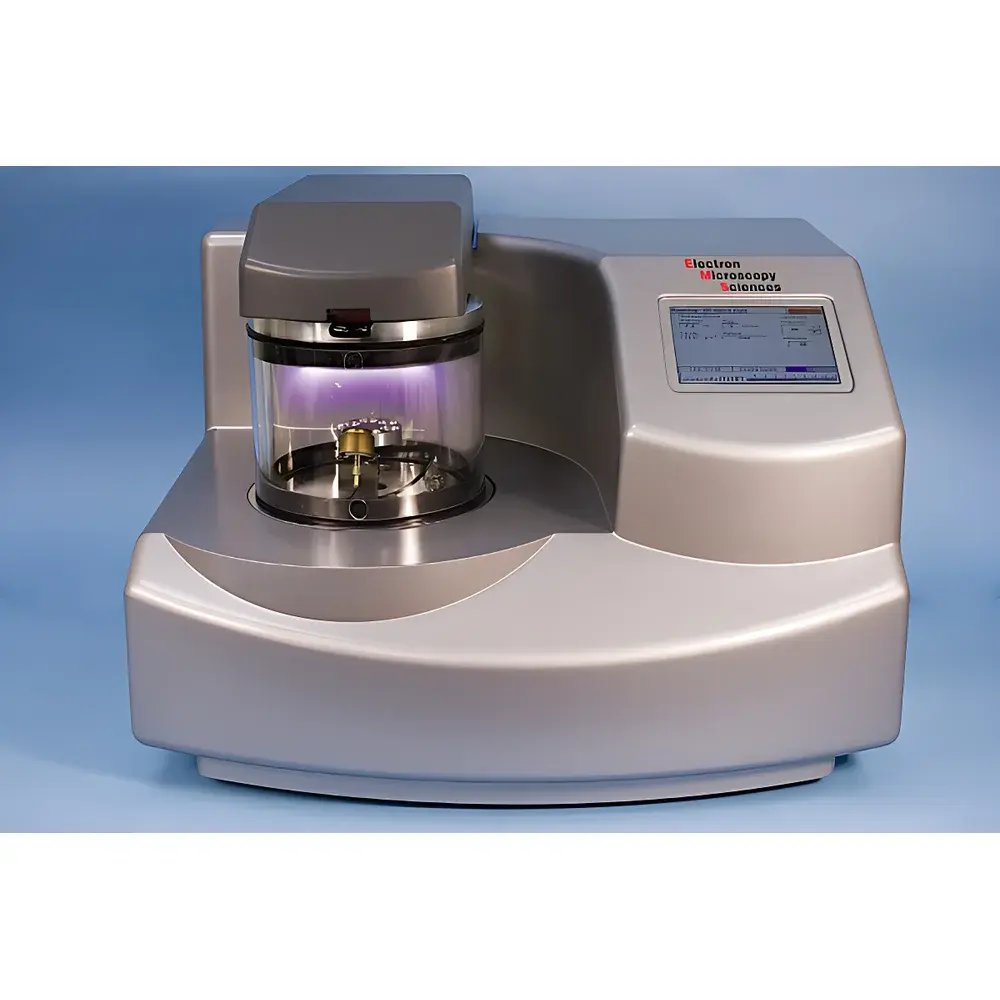
EMS Q150R ES High-Vacuum Ion Sputter Coater
| Brand | EMS/Electron Microscopy Sciences |
|---|---|
| Origin | USA |
| Model | Q150R ES |
| Pumping System | Rotary Vane Mechanical Pump |
| Chamber Diameter | 165 mm (6.5") |
| Coating Modes | Dual-Mode (RF/DC Ion Sputtering + Carbon Evaporation) |
| Compatible Targets | Au, Pt, Pd, Ag, Cr, W, Cu, C (filament or rod) |
| Optional Accessories | Glow Discharge Unit, Quartz Crystal Thickness Monitor, Motorized Tilt/Rotate Stage |
| Control Interface | Full-Color Touchscreen with Preset Protocol Storage |
| Vacuum Base Pressure | ≤5 × 10⁻² mbar (typical with clean, dry system) |
| Max Sputtering Time | 60 min continuous without venting |
Overview
The EMS Q150R ES is a dual-mode, compact high-vacuum coater engineered for precision sample preparation in electron microscopy laboratories. It integrates DC/RF ion sputter deposition and resistive carbon evaporation within a single 165 mm diameter chamber, eliminating the need for separate dedicated instruments. The system operates under a robust mechanical vacuum architecture—achieving base pressures ≤5 × 10⁻² mbar—optimized for reproducible conductive coating of non-conductive specimens prior to SEM, FESEM, and EDS/EBSD analysis. Unlike diffusion-pumped systems, the Q150R ES relies on a sealed rotary vane pump, reducing maintenance overhead while maintaining sufficient vacuum integrity for high-fidelity metal and carbon film formation. Its modular insert-head design enables rapid reconfiguration between sputtering (e.g., Au/Pt for topographic contrast enhancement) and carbon evaporation (e.g., ultra-thin C films for EDS quantification and TEM grid support), all governed by deterministic process logic rather than manual tuning.
Key Features
- Dual-function architecture: Integrated sputter head (Au, Pt, Pd, Ag, Cr, W, Cu) and carbon evaporation head (C filament or rod) mounted in a single chamber
- Intelligent head recognition: Automatic detection of installed insert type triggers corresponding parameter presets and safety interlocks
- Full-color touchscreen interface: Pre-programmable protocols with up to 20 user-defined methods; real-time display of pressure, current, time, and power
- Glow discharge compatibility (optional): Enables surface functionalization (e.g., hydrophobic-to-hydrophilic conversion) for improved resin infiltration or colloidal stability
- Extended sputter duration: Up to 60 minutes of uninterrupted deposition without breaking vacuum—critical for thick-film applications such as electrode fabrication or wear-resistant coatings
- Motorized stage options: Tilt-and-rotate configurations ensure uniform coverage across irregular or high-aspect-ratio samples
- Quartz crystal thickness monitor (QCM) ready: Optional integration supports closed-loop thickness control compliant with ASTM E1577 and ISO 18503 standards
Sample Compatibility & Compliance
The Q150R ES accommodates standard SEM stubs (up to 50 mm), multi-well specimen holders, TEM grids, and custom substrates via interchangeable stage inserts—including planetary rotation, tilt, and cryo-compatible variants. All coatings meet routine requirements for secondary electron yield optimization in high-resolution SEM imaging and low-noise X-ray signal collection in EDS mapping. Carbon films deposited using the resistive evaporation mode comply with USP recommendations for conductive backing layers in elemental microanalysis. The system’s vacuum integrity and process repeatability support GLP-compliant documentation workflows when paired with optional audit-trail-enabled software modules. No internal oil contamination occurs due to the dry-running mechanical pump configuration—ensuring compatibility with sensitive biological or polymer samples.
Software & Data Management
Embedded firmware provides deterministic protocol execution with timestamped logs of vacuum history, current ramp profiles, deposition time, and final pressure values. Each saved method includes metadata fields for operator ID, sample ID, and application context (e.g., “FESEM-Au-sputter-for-nanoparticle-imaging”). Exportable CSV logs facilitate traceability in regulated environments adhering to FDA 21 CFR Part 11 principles—particularly when combined with networked PC-based data archiving. Firmware updates are delivered via USB stick with cryptographic signature verification to maintain system integrity. No cloud connectivity or telemetry is enabled by default; all data remains local unless explicitly exported.
Applications
- SEM sample preparation: Conductive Au/Pt sputtering for charge dissipation on ceramics, polymers, and biological tissues
- EDS/EBSD optimization: Ultra-thin carbon films minimizing X-ray absorption and diffraction artifacts
- TEM grid coating: Uniform C films for electron-transparent support and beam stability during Cs-corrected imaging
- Electrode fabrication: Controlled Cr or W sputtering for microelectrode arrays used in electrochemical sensing
- Surface modification: Glow discharge treatment of PDMS or PET substrates prior to cell culture or inkjet printing
- Thin-film research: Reproducible deposition of noble metals for plasmonic or catalytic studies under controlled vacuum conditions
FAQ
What vacuum level does the Q150R ES achieve, and how is it measured?
Base pressure is monitored continuously via a Pirani gauge calibrated to NIST-traceable standards; typical performance reaches ≤5 × 10⁻² mbar after pump-down with a clean, dry chamber.
Can I use both sputtering and carbon evaporation in one session without venting?
Yes—the dual-insert design allows sequential or independent operation without breaking vacuum, provided the chamber remains below 1 × 10⁻¹ mbar during head swaps.
Is the glow discharge option compatible with carbon-coated samples?
Glow discharge is only recommended on bare substrates or metal-coated surfaces; applying it post-carbon evaporation may oxidize or etch the C layer.
How does the Q150R ES ensure coating uniformity across complex geometries?
Uniformity is achieved through synchronized stage rotation and optimized target-to-substrate geometry (fixed 45° angle); optional motorized tilt enhances edge coverage for cross-sectioned specimens.
Does the system support regulatory compliance for pharmaceutical or clinical labs?
While not FDA-cleared as a medical device, its deterministic protocols, audit-ready logs, and adherence to ASTM/ISO thin-film metrology guidelines support validation under GMP/GLP frameworks when documented per institutional SOPs.



