
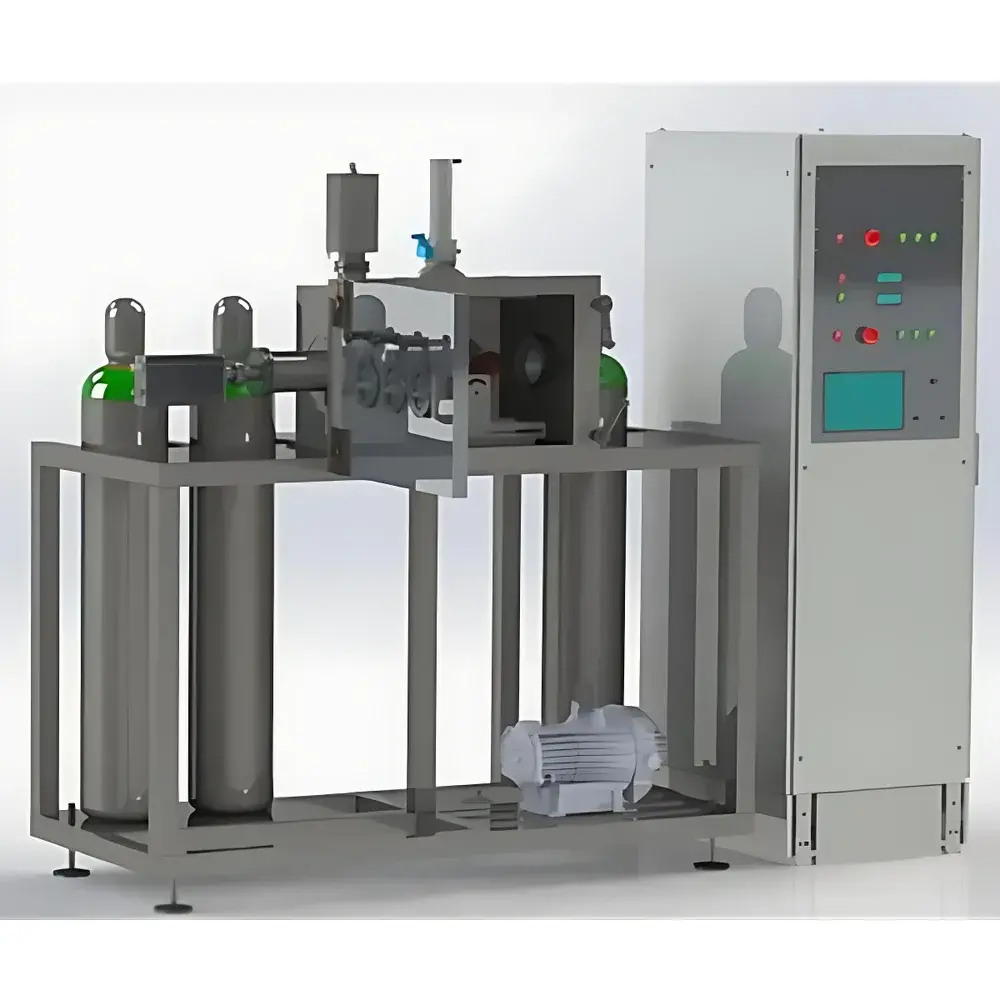
Noivion AtOx Pulsed Discharge Atomic Oxygen Generator
| Brand | Noivion |
|---|---|
| Origin | Czech Republic |
| Model | AtOx |
| Operating Principle | Pulsed high-voltage dielectric barrier discharge (DBD) in pure oxygen gas |
| Max Pulse Voltage | ≤25 kV |
| Pulse Width | <1 µs |
| Adjustable Pulse Frequency | 1–100 Hz |
| Typical Atomic Oxygen Flux Range | 5–6 × 10¹⁵ atoms/(s·cm²) |
| Estimated AO Kinetic Energy | 1–5 eV (corresponding to 4–8 km/s) |
| Compliance | ASTM E2089, QJ 20422-2-2016 |
Overview
The Noivion AtOx Pulsed Discharge Atomic Oxygen Generator is a precision-engineered laboratory instrument designed to replicate the atomic oxygen (AtOx) environment encountered by spacecraft operating in Low Earth Orbit (LEO). Unlike continuous-flow thermal or RF plasma sources, the AtOx system employs a patented pulsed dielectric barrier discharge (DBD) technique—triggered between coaxial electrodes—to generate short-duration, high-energy oxygen plasma pulses. This method enables controlled dissociation of molecular oxygen (O₂) into ground-state atomic oxygen (O(³P)) with tunable flux and kinetic energy, closely matching the 4–5 eV impact energy and 5–6 × 10¹⁵ atoms/(s·cm²) fluence typical of LEO conditions (altitude: 200–700 km). The generator operates under high vacuum-compatible conditions (base pressure <1 × 10⁻⁵ mbar), supporting integration into existing space simulation chambers or custom test rigs. Its core function is not gas production per se, but rather the reproducible, metrologically traceable delivery of reactive atomic oxygen species for quantitative material erosion studies—making it an essential tool for ground-based space environmental simulation.
Key Features
- Pulsed DBD architecture with adjustable voltage (up to 25 kV), pulse width (<1 µs), and repetition frequency (1–100 Hz) for precise control over atomic oxygen flux and energy distribution.
- Electrode configuration optimized for uniform plasma jet formation and minimal electrode sputtering—ensuring long-term operational stability and reduced contamination risk.
- Real-time monitoring interface for discharge current, voltage waveform, and chamber pressure—enabling correlation of electrical parameters with measured AtOx flux via calibrated Kapton HN erosion rate standards.
- Modular design compatible with standard UHV flanges (CF-63/CF-100) and integrated differential pumping stages to maintain background vacuum integrity during operation.
- No consumables required beyond high-purity O₂ feed gas (≥99.999%); no catalysts, filaments, or radioactive sources involved—supporting GLP-compliant, low-maintenance operation.
Sample Compatibility & Compliance
The AtOx generator supports exposure testing of flat or curved specimens up to Ø100 mm, including polymeric films (e.g., Kapton HN, Teflon FEP), metallic coatings (Al, Ag, ITO), ceramic matrix composites (CMCs), and advanced hybrid laminates. Specimen holders are thermally anchored to minimize localized heating during prolonged irradiation. All exposure protocols adhere strictly to ASTM E2089 “Standard Practice for Ground Laboratory Atomic Oxygen Interaction Evaluation of Spacecraft Materials” and Chinese aerospace standard QJ 20422-2-2016 “Environmental Test Methods for Spacecraft Components.” System validation includes periodic flux calibration using certified Kapton HN reference samples, with erosion depth measured via profilometry or mass loss quantified on microgram-resolution balances. Full audit trails—including timestamped parameter logs, operator ID, and calibration certificate references—are retained to satisfy ISO/IEC 17025 and FDA 21 CFR Part 11 requirements for regulated research environments.
Software & Data Management
The AtOx Control Suite (v3.2+) provides deterministic pulse sequencing, synchronized data acquisition from external sensors (quartz crystal microbalances, residual gas analyzers, optical emission spectrometers), and automated report generation compliant with ASTM E2089 Annex A2. Raw discharge waveforms are stored in HDF5 format with embedded metadata (pulse count, cumulative fluence, chamber pressure, gas flow rate). The software supports user-defined exposure profiles—including stepped fluence ramps, duty-cycle modulation, and multi-segment irradiation sequences—and exports tabulated results in CSV and XML formats for integration into institutional LIMS or MATLAB/Python analysis pipelines. Audit logs record all parameter changes, user logins, and calibration events with SHA-256 hashing for tamper-evident integrity verification.
Applications
- Spacecraft Material Qualification: Quantifying erosion yields (cm³/J or atoms removed per incident atom) of thermal control coatings, structural adhesives, and optical filters under representative LEO AtOx fluxes.
- Accelerated Aging Studies: Correlating laboratory-scale AtOx exposure with orbital lifetime predictions via fluence-to-time scaling based on NASA MSFC atomic oxygen models.
- Surface Chemistry Investigation: Coupling AtOx irradiation with in situ XPS or FTIR to characterize oxidation state evolution, carbonyl formation, and cross-linking density in polymer substrates.
- New Material Development: Screening silicon carbide-reinforced polyimides, atomic-layer-deposited Al₂O₃ barriers, and graphene-doped epoxies for enhanced AtOx resistance.
- Instrument Calibration: Serving as a primary source for calibrating space-qualified atomic oxygen detectors aboard CubeSats and small satellites.
FAQ
What vacuum level is required for optimal AtOx generation?
The system achieves stable atomic oxygen production at chamber pressures between 1 × 10⁻⁴ and 5 × 10⁻³ mbar. For maximum dissociation efficiency and minimal three-body recombination, operation at ~1 × 10⁻³ mbar is recommended.
Can the AtOx generator be integrated with existing thermal cycling or UV exposure systems?
Yes—the modular flange interface and Ethernet-based control protocol enable synchronization with commercial thermal vacuum chambers and UV lamp arrays via TTL triggers and shared PLC logic.
Is Kapton HN the only certified reference material for flux calibration?
Kapton HN is the primary ASTM E2089 reference; however, certified polycarbonate and silver-coated quartz standards are also supported upon request for specialized applications.
Does the system require special shielding or radiation safety certification?
No ionizing radiation is produced. The 25 kV pulses are fully enclosed within grounded metal housings meeting IEC 61000-6-3 EMC immunity standards. Standard lab high-voltage safety protocols apply.
How frequently must the electrodes be cleaned or replaced?
Under typical usage (≤500 hours/year), electrode maintenance is required every 1,200–1,500 operational hours. Cleaning follows a documented procedure using ultra-pure isopropanol and nitrogen purge—no replacement parts needed within first 3 years of warranty coverage.



