
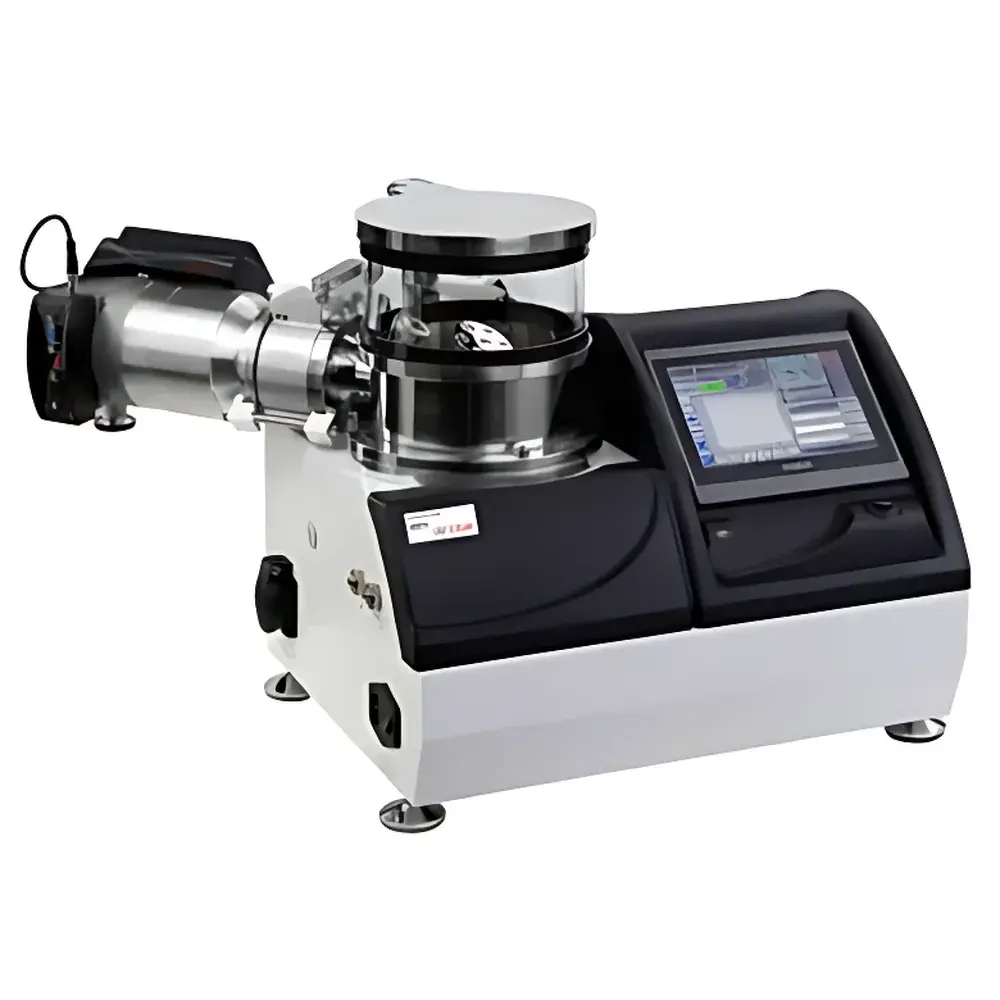
Vac Coat DSR/DST Series Ion Sputter Coater for Electron Microscopy Sample Preparation
| Brand | Vac Coat |
|---|---|
| Origin | United Kingdom |
| Model | DSR/DST |
| Control Method | Fully Automatic |
| Chamber Dimensions | 170–300 mm (diameter) |
| Sputtering Gas | Argon or Compressed Air |
| Application | Conductive Coating for SEM, TEM, EBSD, and EDS Sample Preparation |
| Compliance | Designed for GLP/GMP-aligned labs |
Overview
The Vac Coat DSR/DST Series Ion Sputter Coater is a precision-engineered physical vapor deposition (PVD) system designed specifically for the preparation of conductive thin films on non-conductive or beam-sensitive specimens prior to electron microscopy analysis. Operating on the principle of DC magnetron sputtering, the instrument utilizes a high-purity argon plasma (or compressed air for cost-sensitive workflows) to eject atoms from a metallic or carbon target—typically gold, platinum, palladium, or graphite—onto the sample surface. This process yields ultra-thin (1–10 nm), highly uniform, and low-grain-size conductive coatings essential for minimizing charging artifacts, enhancing secondary electron yield, and preserving fine topographic detail during high-resolution scanning electron microscopy (SEM), transmission electron microscopy (TEM), electron backscatter diffraction (EBSD), and energy-dispersive X-ray spectroscopy (EDS). The DSR/DST platform integrates vacuum science heritage from Cambridge and Oxford engineering teams, reflecting over three decades of iterative refinement in PVD chamber design, plasma stability control, and reproducible film nucleation.
Key Features
- Fully automatic operation with programmable sputtering time, current, and vacuum ramp profiles—enabling unattended batch processing and inter-laboratory method transfer.
- Modular chamber architecture accommodating sample diameters from 170 mm to 300 mm, supporting standard SEM stubs, multi-well TEM grids, and custom substrates up to Ø300 mm.
- Integrated high-stability DC magnetron source with water-cooled target assembly, engineered for consistent power delivery and minimal thermal drift during extended deposition cycles.
- Robust stainless-steel vacuum chamber with viton O-ring seals and a two-stage pumping system (rotary vane + turbomolecular pump), achieving base pressures ≤5 × 10⁻³ Pa prior to sputtering initiation.
- Real-time pressure monitoring and arc suppression circuitry to prevent target arcing and ensure coating integrity—critical for ultra-low-kV SEM imaging and EBSD pattern indexing.
- CE-marked construction compliant with IEC 61000-6-2 (EMC immunity) and IEC 61000-6-4 (EMC emission) standards for safe integration into regulated laboratory environments.
Sample Compatibility & Compliance
The DSR/DST coater accommodates a broad range of electron microscopy substrates, including but not limited to silicon wafers, glass slides, polymer films, biological tissue sections, ceramic particulates, and fractured metallurgical cross-sections. Its low-energy sputtering regime minimizes substrate heating and ion bombardment damage—making it suitable for beam-sensitive organic, hydrated, or nanostructured samples. All operational parameters—including sputter time, current setpoint, and gas flow—are logged with timestamp and user ID, supporting audit readiness under GLP and GMP frameworks. While not FDA 21 CFR Part 11–certified out-of-the-box, the system’s data export capability (CSV/ASCII) enables integration with validated LIMS or ELN platforms meeting regulatory traceability requirements per ISO/IEC 17025 and ASTM E2897–22 (Standard Guide for SEM Sample Preparation).
Software & Data Management
The coater operates via an embedded microcontroller interface with intuitive rotary encoder navigation and OLED display. No external PC is required for routine operation; however, optional RS-232 or USB-C connectivity supports remote parameter logging and firmware updates. Process metadata—including chamber pressure history, sputter current waveform snapshots, and end-point vacuum readings—is stored onboard for ≥1,000 runs and exportable for QA documentation. The system does not include proprietary cloud services or subscription-based software; all configuration files remain fully accessible and editable in plain-text format, facilitating internal SOP customization and validation protocol alignment.
Applications
- Routine gold/palladium coating of insulating geological, biological, or polymeric specimens for high-magnification SEM imaging at accelerating voltages down to 1 kV.
- Ultrathin carbon replication for TEM grid support films and replica preparation in metallurgy and materials failure analysis.
- Conductive layer deposition prior to EBSD orientation mapping—ensuring stable electron beam interaction and reducing pattern degradation during automated grain indexing.
- Multi-target sequential sputtering (with optional dual-source upgrade) for bilayer coatings—e.g., Cr adhesion layer followed by Au top layer—to improve film adhesion on challenging substrates such as PDMS or hydrogels.
- Carbon-only deposition for EDS quantification workflows where metallic contamination must be avoided, leveraging the DST variant’s dedicated graphite cathode configuration.
FAQ
What sputtering gases are supported, and how do they affect film quality?
Argon is recommended for optimal film density, grain refinement, and deposition rate control. Compressed air may be used for rapid carbon coating where ultimate resolution is secondary to throughput—though it introduces minor oxidation risk and slightly higher grain size.
Can the DSR/DST be integrated into a cleanroom environment?
Yes—the chamber design meets ISO 14644-1 Class 5 compatibility requirements when installed with appropriate HEPA-filtered exhaust ducting and vibration-isolated mounting.
Is calibration traceable to national standards?
Vac Coat provides factory calibration certificates for vacuum gauges and current sensors, traceable to UKAS-accredited laboratories; field recalibration kits are available upon request.
What maintenance intervals are recommended for long-term reliability?
Target replacement every 200–300 hours of cumulative sputter time; turbomolecular pump oil change every 12 months or 5,000 operating hours; O-ring inspection and replacement every 24 months or after 500 pump-down cycles.
Does the system support automated recipe recall across multiple users?
Yes—up to 99 user-defined protocols can be stored with password-protected access levels, enabling shared instrument use in core facilities while maintaining method integrity and accountability.



