
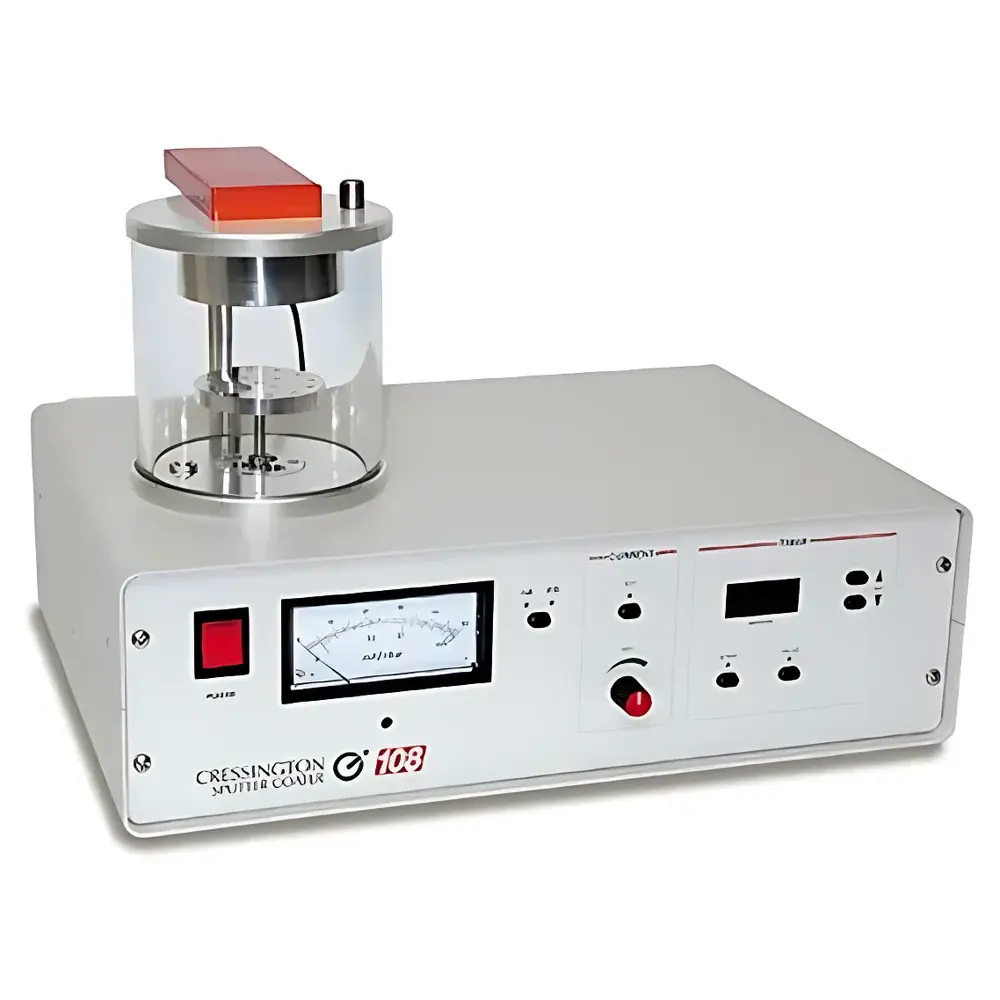
Cressington 108 Cold Cathode Ion Sputter Coater
| Brand | Cressington |
|---|---|
| Origin | United Kingdom |
| Model | 108 |
| Target Materials | Au, Pt, Au/Pd, Pt/Pd, Ag |
| Target Diameter | 57 mm |
| Sputtering Mode | Cold cathode (non-thermal) |
| Chamber Dimensions | 120 mm × 120 mm |
| Sample Stage Diameter | 63 mm |
| Sputtering Gas | Argon or ambient air |
| Compliance | Designed for SEM/EPMA sample preparation per ISO 27207, ASTM E1508, and GLP-aligned lab workflows |
Overview
The Cressington 108 Cold Cathode Ion Sputter Coater is a compact, high-reliability vacuum coating system engineered specifically for routine and high-precision conductive metal film deposition on non-conductive specimens prior to scanning electron microscopy (SEM), energy-dispersive X-ray spectroscopy (EDS), and electron probe microanalysis (EPMA). Unlike thermally driven sputtering or evaporation methods, the 108 employs a cold cathode DC glow discharge configuration—eliminating resistive heating of the target and minimizing thermal load on delicate samples. This architecture ensures minimal specimen distortion, no carbon contamination from filament degradation, and stable, reproducible film thickness control across batch-to-batch operation. Its robust stainless-steel chamber, integrated turbomolecular pumping stage (standard with oil-free backing), and precisely calibrated gas flow regulation deliver consistent base pressures below 5 × 10⁻³ mbar and sputtering stability over extended operational cycles.
Key Features
- Cold cathode sputtering technology—no filament, no thermal drift, no oxidation-induced target degradation
- Modular target holder accommodating standard 57 mm diameter targets (Au, Pt, Au/Pd, Pt/Pd, Ag)
- Optimized chamber geometry (120 mm × 120 mm) enabling uniform coverage across multi-sample mounts and irregular topographies
- Motorized, height-adjustable sample stage (63 mm diameter) with precise centering and rotation capability (optional)
- Dual-gas compatibility: argon (recommended for high-resolution imaging) or filtered ambient air (for rapid screening applications)
- Integrated digital pressure monitoring and time-controlled sputtering (0.1–300 s resolution) with manual or semi-automatic mode selection
- CE-marked, RoHS-compliant construction; designed for integration into ISO 17025-accredited laboratories
Sample Compatibility & Compliance
The Cressington 108 accommodates a broad range of non-conductive and beam-sensitive specimens—including biological tissues, polymers, ceramics, geological thin sections, and forensic particulates—without inducing thermal stress or surface charging artifacts. Its low-energy ion bombardment profile preserves fine ultrastructural detail while delivering sub-2 nm grain-size metallic films ideal for high-magnification secondary electron imaging. The system conforms to key international standards governing SEM sample preparation: ISO 27207 (coating quality assessment), ASTM E1508 (sputter coating for EDS quantification), and supports audit-ready documentation in GLP/GMP environments. Optional software logging (via RS232/USB interface) enables traceable parameter recording aligned with FDA 21 CFR Part 11 requirements when paired with validated LIMS platforms.
Software & Data Management
While the Cressington 108 operates via intuitive front-panel controls, its embedded firmware supports full parameter logging—including sputtering time, gas type, chamber pressure history, and target usage count—exportable as CSV files via USB port. For labs requiring electronic record retention, optional Cressington Control Suite (v3.2+) provides remote monitoring, protocol storage, user access tiers, and automated report generation compliant with laboratory information management systems (LIMS). All firmware updates are distributed through Cressington’s secure customer portal, ensuring long-term validation integrity and cybersecurity alignment with IEC 62443-3-3.
Applications
- Routine SEM sample preparation for morphology analysis in materials science, geology, and life sciences
- EDS-compatible coating for quantitative elemental mapping without spectral interference from oxide layers
- Low-dose cryo-SEM workflows where thermal stability is critical (e.g., frozen-hydrated biological sections)
- Quality assurance in failure analysis labs handling microelectronics, coatings, and composite interfaces
- Teaching laboratories requiring robust, low-maintenance instrumentation with minimal consumables overhead
FAQ
What is the typical base pressure achieved before sputtering?
Typical ultimate pressure is ≤5 × 10⁻³ mbar with standard turbomolecular pump configuration; optional high-vacuum upgrade achieves ≤1 × 10⁻⁴ mbar.
Can the Cressington 108 be used with reactive gases such as oxygen or nitrogen?
No—the 108 is configured exclusively for inert (Ar) or ambient air sputtering; reactive gas operation requires the 208HR platform with mass flow controller and plasma ignition module.
Is calibration required for routine operation?
No scheduled calibration is mandated; however, annual performance verification using certified reference targets (e.g., NIST-traceable Au film thickness standards) is recommended for ISO 17025 compliance.
How often does the target need replacement?
Target lifetime depends on sputtering frequency and duration; under typical lab use (5–10 coatings/day), a 57 mm Au target lasts approximately 12–18 months.
Does the system support automated coating protocols?
Yes—when equipped with Cressington Control Suite and optional motorized shutter, the 108 supports up to 10 pre-programmed coating sequences with variable time/gas steps.



