
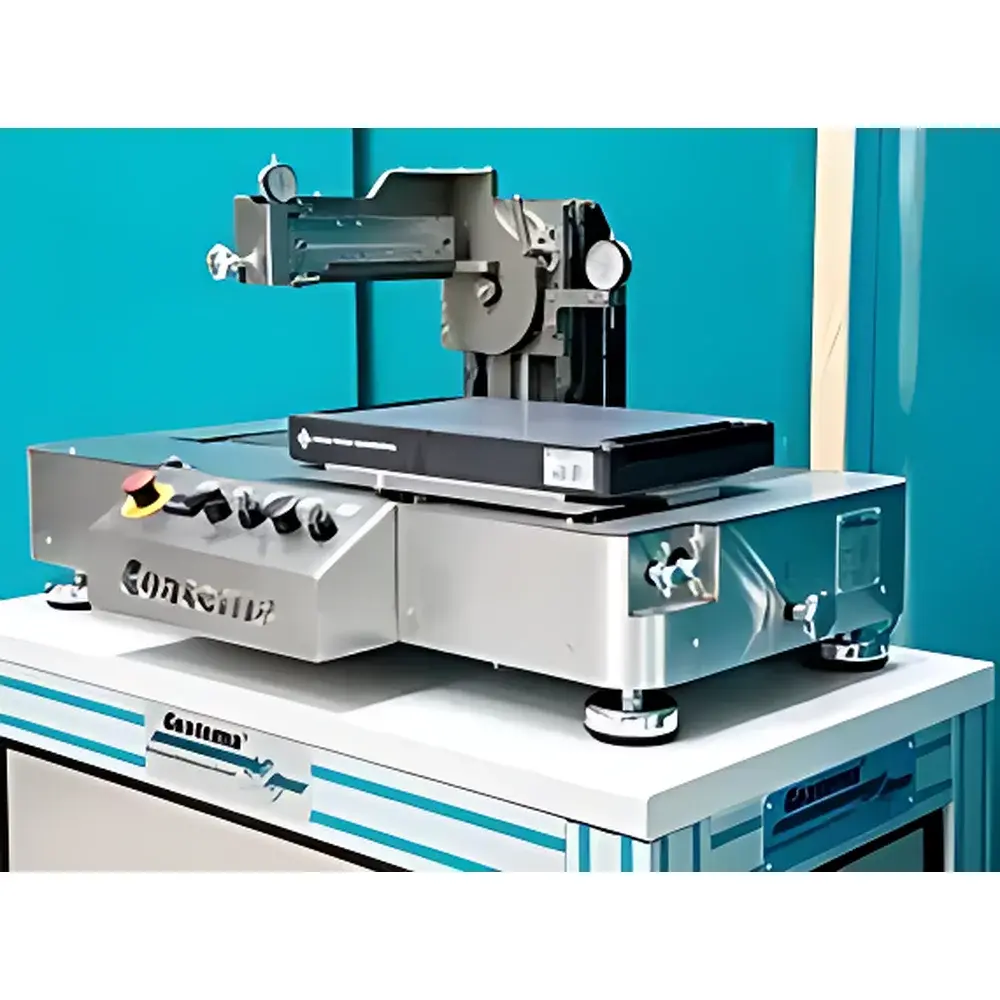
Coatema Test Solution Slot Die Coating System
| Brand | Coatema |
|---|---|
| Origin | Germany |
| Model | Test Solution |
| Application Scope | R&D and Pilot-Scale Precision Slot Die Coating |
| Compliance Framework | Designed for GLP/GMP-adjacent R&D environments |
| Service Network | Technical support centers in Europe, North America, and Asia |
Overview
The Coatema Test Solution Slot Die Coating System is a benchtop-scale, modular precision coating platform engineered for reproducible, thickness-controlled deposition of functional thin films via slot die (orifice) coating—a contactless, pre-metered fluid delivery method grounded in laminar flow hydrodynamics. Unlike knife-over-roll or gravure techniques, slot die coating decouples web speed from wet film thickness by precisely regulating volumetric flow rate, gap height, and die lip geometry, enabling sub-micron thickness uniformity (<±1.5% CV across 100–1,200 mm web widths) under controlled ambient or inert atmosphere conditions. Developed and manufactured in Dormagen, Germany, the system reflects over four decades of Coatema’s expertise in industrial-scale roll-to-roll (R2R) coating process engineering—adapted rigorously for laboratory validation, formulation screening, and pilot-line process transfer. Its architecture supports both static (substrate-stationary) and dynamic (web-fed) operation modes, making it suitable for substrate types ranging from rigid glass and silicon wafers to flexible polymer foils, metal foils, and nonwovens.
Key Features
- Modular die-mounting interface accommodating interchangeable slot die heads (standard 100 mm, upgradable to 200 mm or 400 mm active width) with adjustable lip geometry, shim-based gap control (±1 µm resolution), and integrated temperature regulation (up to 120 °C)
- High-precision dual-servo web handling system with tension feedback control (0.1–50 N range), encoder-synchronized speed control (0.01–10 m/min), and optional vacuum pinning for low-tension substrates
- Integrated fluid delivery subsystem featuring syringe pump or gear pump options (flow range: 0.01–50 mL/min), pressure-compensated metering, and heated fluid path (up to 80 °C) to maintain rheological stability of shear-thinning or thermally sensitive formulations
- Real-time inline monitoring compatibility: optical thickness sensors (e.g., laser interferometry or UV-Vis transmission), IR drying zone integration, and optional in-situ cure modules (UV LED or thermal)
- CE-compliant mechanical design with interlocked safety enclosures, emergency stop circuitry, and ISO 14644-1 Class 7 cleanroom-compatible housing options
Sample Compatibility & Compliance
The Test Solution accommodates substrates from 25 µm PET to 1.1 mm soda-lime glass, including conductive ITO/PEDOT:PSS-coated films, silicon wafers (up to 200 mm diameter), stainless steel foils, and porous membranes. It supports aqueous, solvent-based, and high-viscosity nanocomposite dispersions (up to 10,000 mPa·s at 1 s⁻¹). All wetted components are constructed from chemically resistant materials (316L stainless steel, PTFE, FKM elastomers) compliant with USP Class VI and FDA 21 CFR 177.2600 for medical-grade coating development. The system is engineered to align with ASTM D7267 (Standard Practice for Slot Die Coating of Thin Films), ISO 2137 (Paints and Varnishes – Determination of Flow Properties), and supports audit-ready documentation for GLP-regulated biocoating studies.
Software & Data Management
Control is managed via Coatema’s proprietary CoaControl v3.2 software, running on an embedded industrial PC with deterministic real-time OS. The interface provides synchronized logging of >32 process parameters—including flow rate, web speed, tension, die temperature, and ambient RH—at 10 Hz sampling frequency. All data streams are timestamped, digitally signed, and exportable in CSV/ASAM MDF4 formats. Audit trail functionality complies with FDA 21 CFR Part 11 requirements, including user-level access control, electronic signatures, and immutable change logs. Optional integration with LIMS or MES systems is supported via OPC UA and RESTful API endpoints.
Applications
This system serves as a critical bridge between formulation R&D and production scale-up in industries requiring functional thin-film integrity: OLED and QLED emissive layer deposition; solid-state battery electrode slurries (anode/cathode); perovskite photovoltaic absorber layers; anti-reflective and low-emissivity coatings on architectural glass; microfluidic channel patterning for point-of-care diagnostics; and scalable manufacturing of conductive polymer electrodes for neural interfaces. Its validated repeatability supports DOE-driven optimization of coating window boundaries—critical for transferring processes to full-scale R2R lines certified to ISO 9001 and IATF 16949.
FAQ
What minimum wet film thickness can be achieved with the Test Solution system?
Typical achievable dry thickness ranges from 20 nm (for high-solid-content inks post-drying) to 50 µm, depending on formulation solids content, drying kinetics, and substrate porosity.
Is the system compatible with shear-thinning or particle-loaded suspensions?
Yes—die geometry, pump selection, and fluid path heating enable stable coating of shear-thinning polymers and colloidal suspensions containing nanoparticles up to 200 nm in diameter.
Can the system be integrated into a nitrogen glovebox environment?
Yes—the base frame and electrical cabinet are designed for external integration; feedthroughs for fluid lines, power, and data are configurable per ISO 8573-1 Class 2 compressed gas standards.
Does Coatema provide application support for process parameter optimization?
Yes—Coatema’s global application engineers offer remote and on-site support packages, including coating window mapping, defect root-cause analysis, and DOE protocol development.
What is the lead time for spare dies or custom die geometries?
Standard dies ship within 4–6 weeks; custom geometries (e.g., multi-inlet, tapered lips) require 10–14 weeks following final design freeze and metrology approval.







