
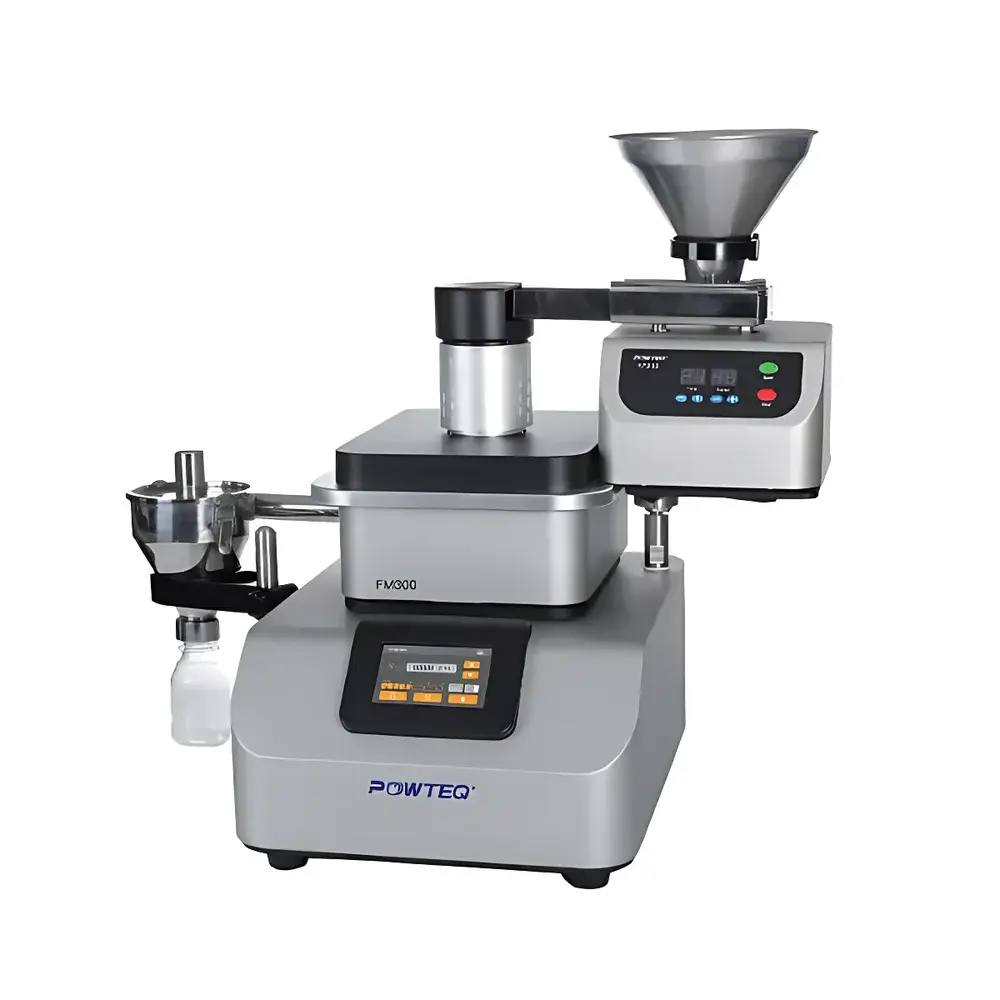
Grindemann FM300 Ultra-Centrifugal Grinder
| Brand | Grindemann |
|---|---|
| Model | FM300 |
| Type | Ultra-centrifugal grinder |
| Origin | Beijing, China |
| Manufacturer | Grindemann Instrument Co., Ltd. |
| Feed size | < 10 mm |
| Final particle size | < 40 µm |
| Output particle size range | 0.01–0.5 mm |
| Rotor diameter | 98 mm |
| Rotational speed | 6,000–23,000 rpm |
| Peripheral rotor speed | 30.8–118.5 m/s |
| Rated power | 1300 W |
| Collection capacity | 1 L (standard collection pan) or 250 mL / 500 mL / 5 L (optional collection bottles) |
Overview
The Grindemann FM300 Ultra-Centrifugal Grinder is an engineered solution for rapid, reproducible, and controlled dry grinding of heterogeneous solid samples across diverse scientific and industrial laboratories. It operates on the principle of ultra-centrifugal comminution—combining high-speed impact, shear, and attrition within a precisely configured rotor-ring sieve system. Unlike conventional jaw or disc mills, the FM300 subjects feed material to two sequential mechanical actions: first, high-velocity radial impact against rotating knife edges under centrifugal acceleration; second, fine-size reduction via compression, shearing, and friction between the rotating rotor and a stationary annular sieve. This dual-stage mechanism ensures minimal thermal load and short residence time (< 10 seconds typical), preserving sample integrity—particularly critical for thermolabile, hygroscopic, or oxidation-sensitive materials. Designed for compliance with routine laboratory workflows, the FM300 supports both ambient and cryogenic grinding protocols, enabling consistent sub-40 µm particle size distribution without requiring pre-drying or extensive sample conditioning.
Key Features
- Two-stage ultra-centrifugal comminution architecture: impact pre-crushing followed by precision sieving and shear refinement
- Adjustable rotational speed (6,000–23,000 rpm), delivering peripheral rotor velocities from 30.8 to 118.5 m/s for tunable energy input
- Interchangeable ring sieves (standard aperture range: 0.01–0.5 mm) allowing precise control over final particle size distribution
- Manually detachable, tool-free grinding chamber components—including 98 mm diameter hardened rotor knives and corrosion-resistant sieve rings—facilitating rapid cleaning, cross-contamination mitigation, and GMP-aligned maintenance
- Integrated splash-proof funnel feed system with gravity-assisted sample introduction and optimized flow dynamics
- Touchscreen HMI interface with programmable speed profiles, runtime presets, and real-time operational status feedback
- Acoustically damped housing achieving < 72 dB(A) at 1 m distance during continuous operation
- Modular collection options: standard 1 L stainless steel collection pan or optional glass/plastic bottles (250 mL, 500 mL, 5 L) compatible with downstream analytical instrumentation
Sample Compatibility & Compliance
The FM300 accommodates a broad spectrum of sample matrices—including soft (e.g., dried leaves, polymers), hard (e.g., coal, ceramics), brittle (e.g., frozen tissue, plastics), and fibrous (e.g., straw, textiles)—without degradation of structural or chemical fidelity. Cryogenic grinding using liquid nitrogen-cooled sample cups enables embrittlement of elastomers, resins, and thermoplastics, ensuring uniform sub-40 µm pulverization. All wetted parts are constructed from wear- and corrosion-resistant alloys or coated with proprietary ceramic-reinforced layers, supporting direct processing of aggressive materials such as fertilizers, agrochemicals, and halogenated organics. The instrument meets mechanical safety requirements per IEC 61000-6-2/6-4 and is suitable for use in GLP-compliant environments where audit-ready documentation of grinding parameters (speed, duration, sieve ID) is required. While not inherently 21 CFR Part 11 compliant, its digital interface supports integration with validated LIMS or ELN systems via RS-232/USB export of session logs.
Software & Data Management
The FM300 features an embedded microcontroller-based operating system with non-volatile parameter memory. Each grinding cycle records timestamp, selected speed, runtime, sieve identification code, and operator ID (via optional RFID badge reader). Exportable CSV logs include raw motor current traces and thermal sensor readings from the motor housing—enabling post-hoc correlation of energy consumption with particle size outcomes. Firmware updates are performed via USB stick; no cloud connectivity or remote access functionality is implemented, preserving data sovereignty in regulated settings. For laboratories implementing ISO/IEC 17025 or ASTM E2917 workflows, the device supports traceable calibration verification through periodic speed and torque validation using external tachometric and dynamometric standards.
Applications
- Elemental analysis preparation: homogenization of soils, sediments, ores, and electronic waste prior to XRF, ICP-OES, or ICP-MS digestion
- Proximate and ultimate analysis: standardized grinding of coal, biomass, and secondary fuels for ash, volatile matter, fixed carbon, and CHN determination per ASTM D3172/D5373
- Pharmaceutical and nutraceutical QA/QC: size reduction of tablets, excipients, and botanical powders for dissolution testing and content uniformity assessment
- Environmental monitoring: cryo-grinding of PCB-contaminated soils or RoHS-targeted polymer fractions for halogen screening
- Agricultural research: rapid milling of grain, feed, and forage samples for NIR calibration model development and protein/nitrogen quantification
- Materials science: production of narrow PSD feedstock for sintering trials, additive manufacturing powder bed characterization, or catalyst support synthesis
FAQ
What is the maximum recommended feed size for the FM300?
Feed particles must be ≤ 10 mm in their largest dimension to ensure consistent throughput and avoid rotor imbalance or sieve blockage.
Can the FM300 process moisture-rich or oily samples?
No—it is designed exclusively for dry grinding. Samples with > 15% moisture content or free oil require pre-drying or alternative milling technologies (e.g., planetary ball mill with cryo-jacketing).
Is the FM300 suitable for regulatory submissions under USP <429> or Ph. Eur. 2.9.31?
While it does not perform “micronization” per se, its ability to generate repeatable sub-40 µm distributions makes it appropriate for preparing homogeneous test portions aligned with those monographs’ sampling representativeness requirements.
How often should the rotor knives and sieve rings be replaced?
Under normal use with medium-hardness samples (e.g., grain, soil), replacement is recommended after 500–800 hours of cumulative operation—or sooner if visual inspection reveals > 10% edge rounding or pitting.
Does Grindemann provide IQ/OQ documentation packages?
Yes—validated installation and operational qualification templates, including test protocols for speed accuracy, temperature stability, and particle size repeatability (n = 5 replicates per sieve), are available upon request for GxP-regulated installations.
Related Products



