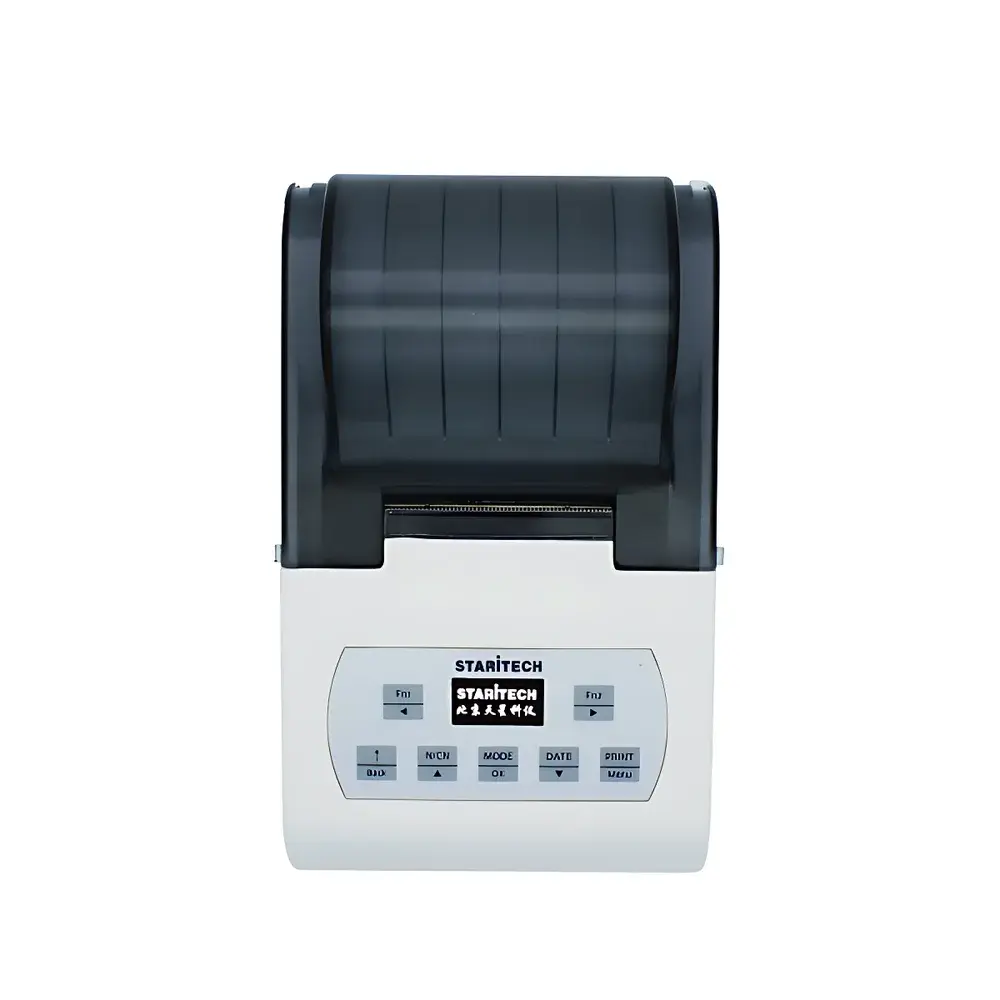
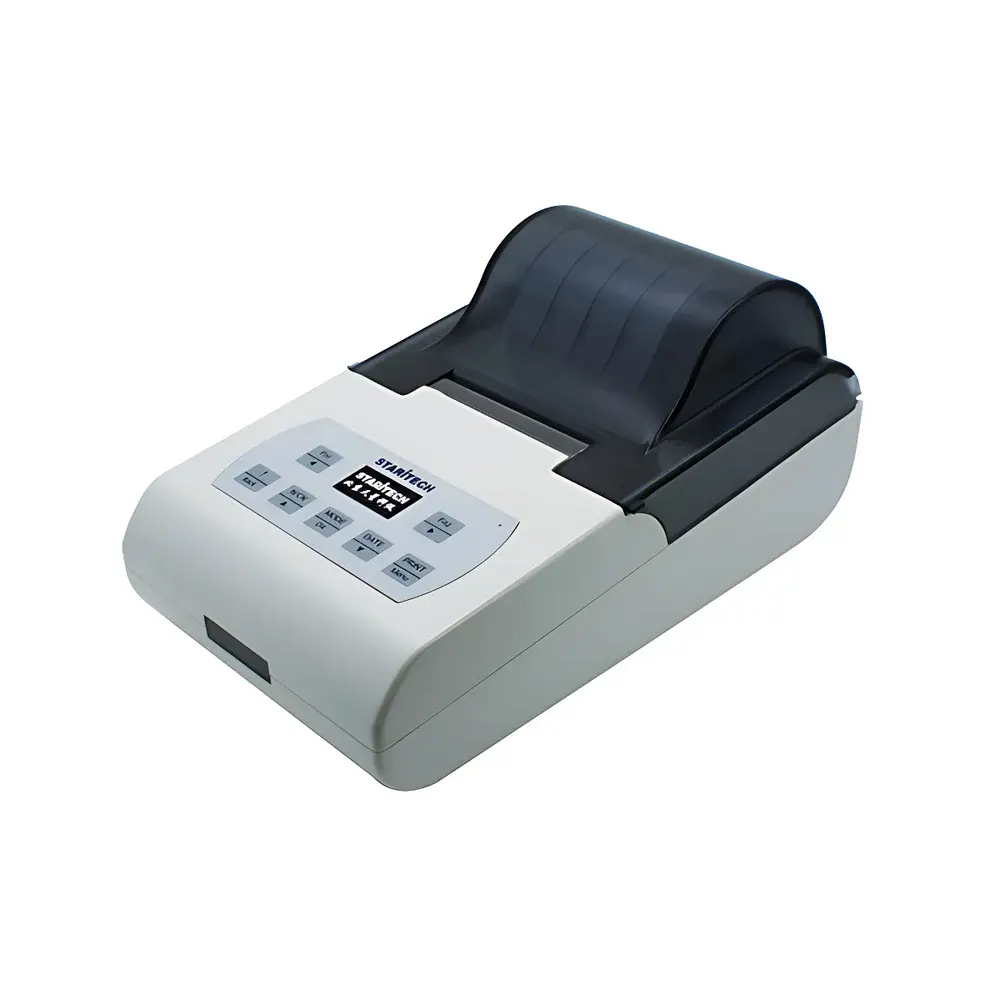
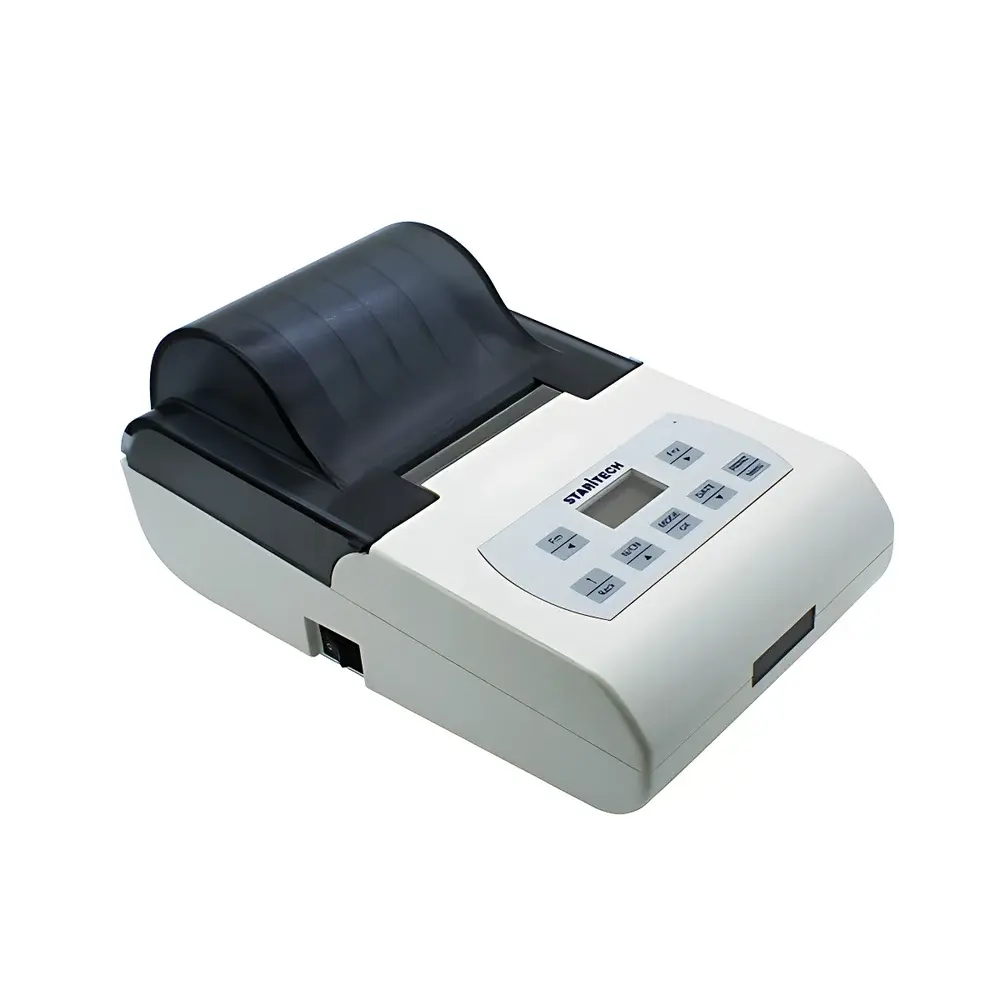
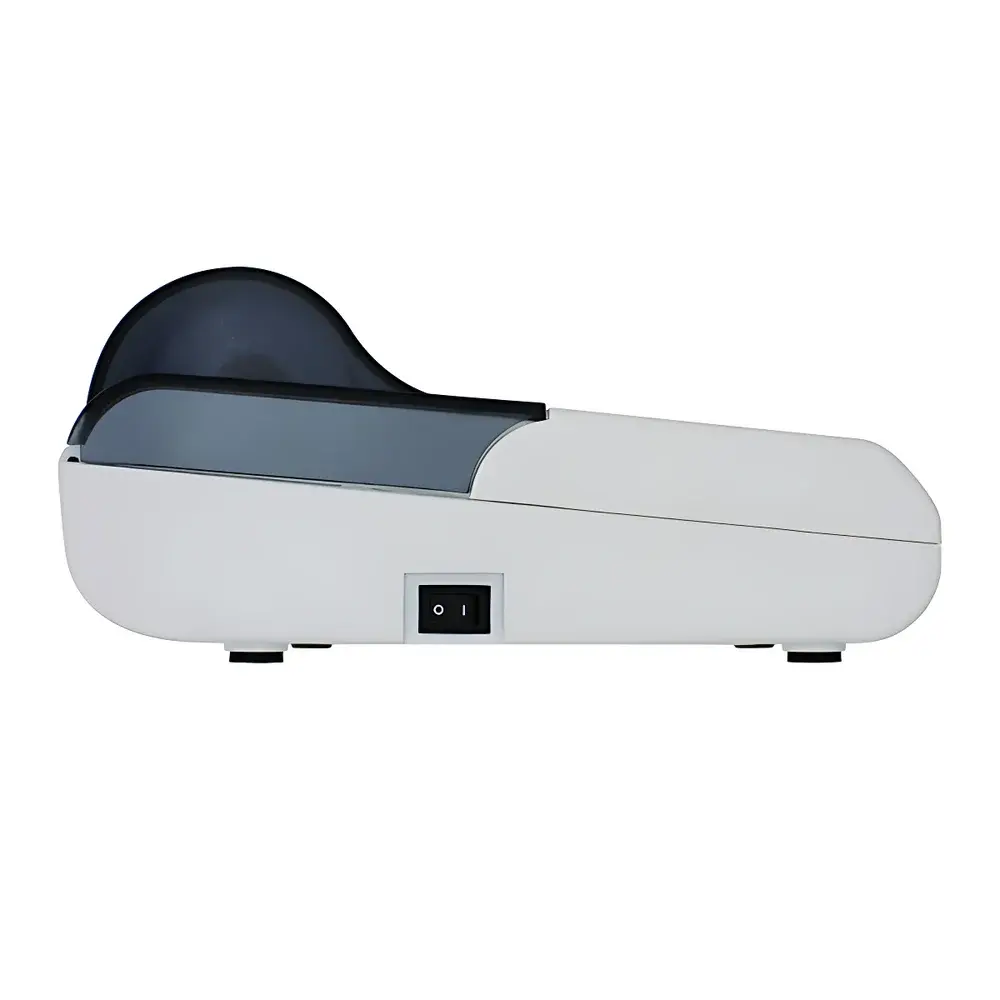
STARiTECH TX-110AD Balance Data Printer for AND Balances
| Brand | STARiTECH |
|---|---|
| Origin | Beijing, China |
| Manufacturer Type | Authorized Distributor |
| Country of Origin | China |
| Model | TX-110AD |
| Price Range | USD 140–420 (FOB) |
| Printing Method | 8-pin impact dot matrix (Epson-compatible), thermal backup option |
| Paper Width | 57 mm |
| Media | Plain paper (non-thermal), ribbon-based (Epson ERC-09 / ERC-22) |
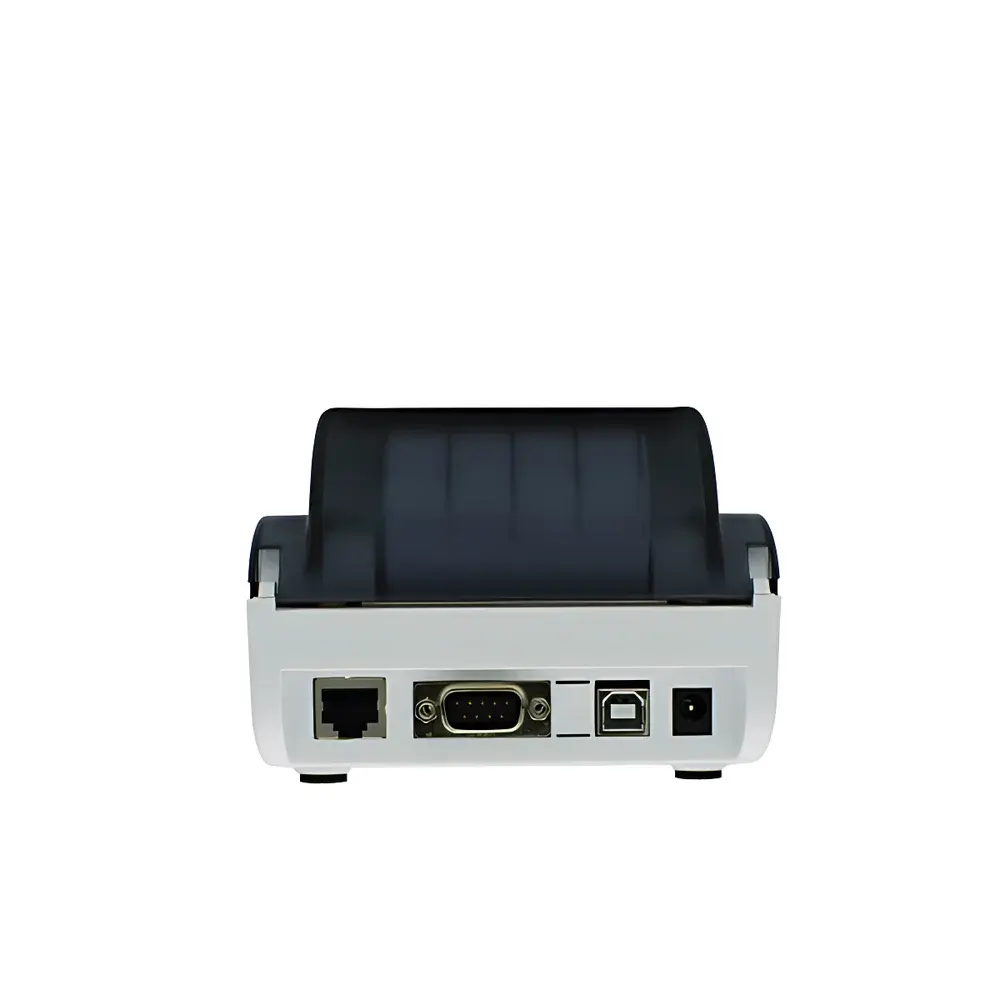
| Interfaces | RS-232C, USB-B, RS-485 |
| Character Capacity per Line | 24 or 40 characters |
| Display | 128×64 OLED, bilingual (English/Chinese) |
| Dimensions (W×H×L) | 114.6 × 86.6 × 188.2 mm |
| Application Modes | Weighing, Tare/Net/Gross, Statistics (up to 300 entries), Pipette & Volumetric Flask Calibration (per JJG 646–2006), Moisture Loss, Incremental Weighing, Recipe Management |
| Data Export | USB flash drive (CSV/Excel-compatible export) |
| Header/Footer Customization | Fully configurable fields (instrument ID, sample ID/batch, timestamp, operator signature, sequence number) |
| GLP/GMP Compliance | Audit-trail enabled, timestamped raw data output, parameter-lockable configuration, FDA 21 CFR Part 11–ready user access control (dual-level permissions) |
Overview
The STARiTECH TX-110AD Balance Data Printer is a dedicated, regulatory-compliant peripheral engineered to interface with analytical and precision balances—including AND (A&D) TX-series instruments—as well as a broad spectrum of laboratory and industrial weighing systems. Unlike generic label or receipt printers, the TX-110AD implements an 8-pin impact dot-matrix printing mechanism using standard plain paper and replaceable ribbons (Epson ERC-09/ERC-22), ensuring archival-grade permanence of printed records. This mechanical printing architecture meets long-term document retention requirements mandated by Good Laboratory Practice (GLP) and Good Manufacturing Practice (GMP) frameworks. The device operates as a standalone data acquisition and processing unit: it receives serial weight data via RS-232C, USB, or RS-485; applies real-time calculation logic (e.g., net/gross conversion, statistical aggregation, temperature-corrected volume derivation); and outputs structured, traceable reports—without reliance on host PC software or proprietary drivers.
Key Features
- Regulatory-ready architecture: Dual-level user permission system (administrator/operator), tamper-evident timestamping, and immutable print log generation support FDA 21 CFR Part 11 alignment and internal GxP audits.
- Configurable report structure: Header and footer elements—including instrument serial number, sample ID/batch code, date/time stamp, operator signature field, and sequential record ID—are individually enable/disable-able and editable via intuitive OLED menu navigation.
- Dedicated calibration workflows: Built-in pipette and volumetric flask calibration mode executes calculations per Chinese National Verification Regulation JJG 646–2006, applying temperature-dependent Kt correction to convert mass readings into volume equivalents at 20 °C reference temperature.
- Statistical processing engine: Performs 64-bit double-precision arithmetic on up to 300 sequential weighings, delivering mean, standard deviation, coefficient of variation (CV%), sum, min/max, and range—fully traceable and exportable.
- Multi-mode operational flexibility: Supports discrete weighing, tare/net/gross sequencing, incremental accumulation, moisture loss tracking, recipe-based batch weighing, and custom formula execution—all with consistent metadata tagging and report formatting.
- Hardware-integrated data mobility: Integrated USB-B port enables direct connection to balances or PCs; optional USB flash drive support allows offline CSV/Excel-formatted data archiving without intermediate software.
Sample Compatibility & Compliance
The TX-110AD achieves broad interoperability through standardized ASCII-based serial protocols (typically ESC/P or custom balance command sets), enabling seamless integration with major balance manufacturers including AND (TX, FX, GF, GH series), Sartorius (CPA, Q, P, BS lines), Mettler Toledo (ME, AG, AL, ZB, ICS), Shimadzu (ATX, AUW, AP, TX), Ohaus (Scout), Shimpo, and INTEK (formerly Sartorius Midrics). It also interfaces with select non-balance instrumentation—including pH meters, potentiometric titrators, Karl Fischer moisture analyzers, dissolution testers, and UV-Vis spectrophotometers—via configurable ASCII command mapping. All printed outputs comply with ISO/IEC 17025 documentation integrity requirements, provide unambiguous linkage between raw weight values and contextual metadata, and retain full audit trail capability under GLP, GMP, and ISO 9001 quality management systems.
Software & Data Management
No external software installation is required: all configuration, calibration setup, and report generation occur locally via the 128×64 monochrome OLED display and tactile keypad. Parameter settings—including temperature offset, decimal places, print density, auto-feed timing, and statistical thresholds—are stored in non-volatile memory with write-protection options. Each printed report includes an embedded time stamp (RTC-backed), unique sequence number, and optional digital signature placeholder—enabling manual or electronic sign-off per internal SOPs. Data exported to USB storage adheres to RFC 4180 CSV conventions, preserving numeric precision and column headers compatible with Excel, LabArchives, and LIMS platforms. Firmware updates are delivered via USB flash drive, maintaining version control and change-log traceability.
Applications
- Quality control laboratories requiring auditable, paper-based weight records for raw material release, finished product testing, and stability studies.
- Pharmaceutical manufacturing units performing volumetric equipment verification (pipettes, burettes, flasks) under USP , , or EU Annex 15 guidelines.
- Contract research organizations (CROs) generating GLP-compliant study reports where instrument-generated paper output serves as primary raw data.
- Chemical synthesis labs executing multi-step recipe weighing with integrated tare management and batch traceability.
- Academic and teaching laboratories needing cost-effective, maintenance-light reporting for student experiments and instrument validation exercises.
FAQ
Does the TX-110AD require a computer to operate?
No—it functions as a fully autonomous peripheral. Configuration, data processing, and printing are handled internally via its embedded microcontroller and OLED interface.
Is thermal paper required?
No. The TX-110AD uses impact printing on standard 57 mm plain paper with Epson-compatible ribbons (ERC-09/ERC-22), ensuring chemical and thermal stability of printed records.
Can it print graphs or trend curves?
Yes. When used in continuous weighing mode (e.g., moisture loss monitoring), the device supports basic x-y curve plotting directly to paper using ASCII-art-style line drawing.
How is user access controlled for GxP compliance?
Two-tier password protection governs access: Operator-level users may initiate prints and adjust non-critical settings; Administrator-level users configure calibration parameters, header/footer templates, and audit-log retention policies.
What standards does the pipette calibration mode follow?
It implements JJG 646–2006 (People’s Republic of China National Verification Regulation for Pipettes), including automatic Kt temperature correction and uncertainty-aware volume reporting at 20 °C.