
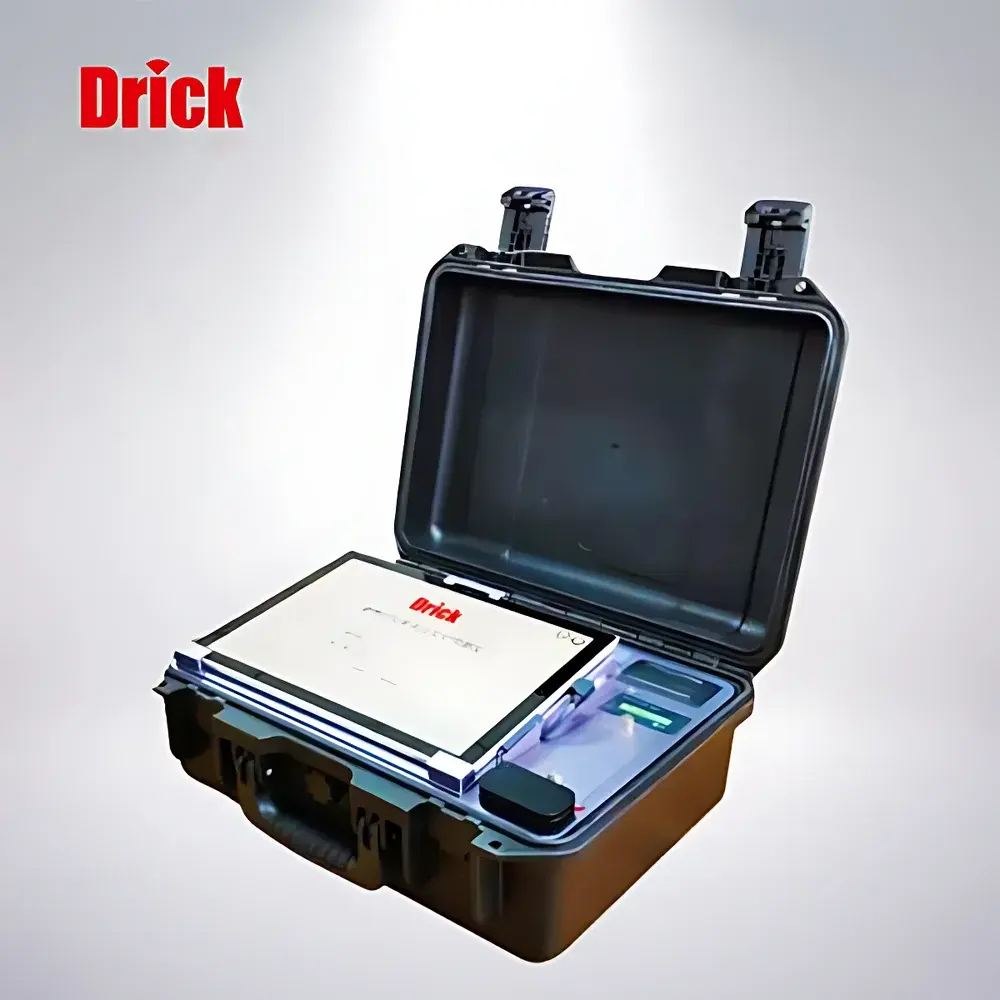
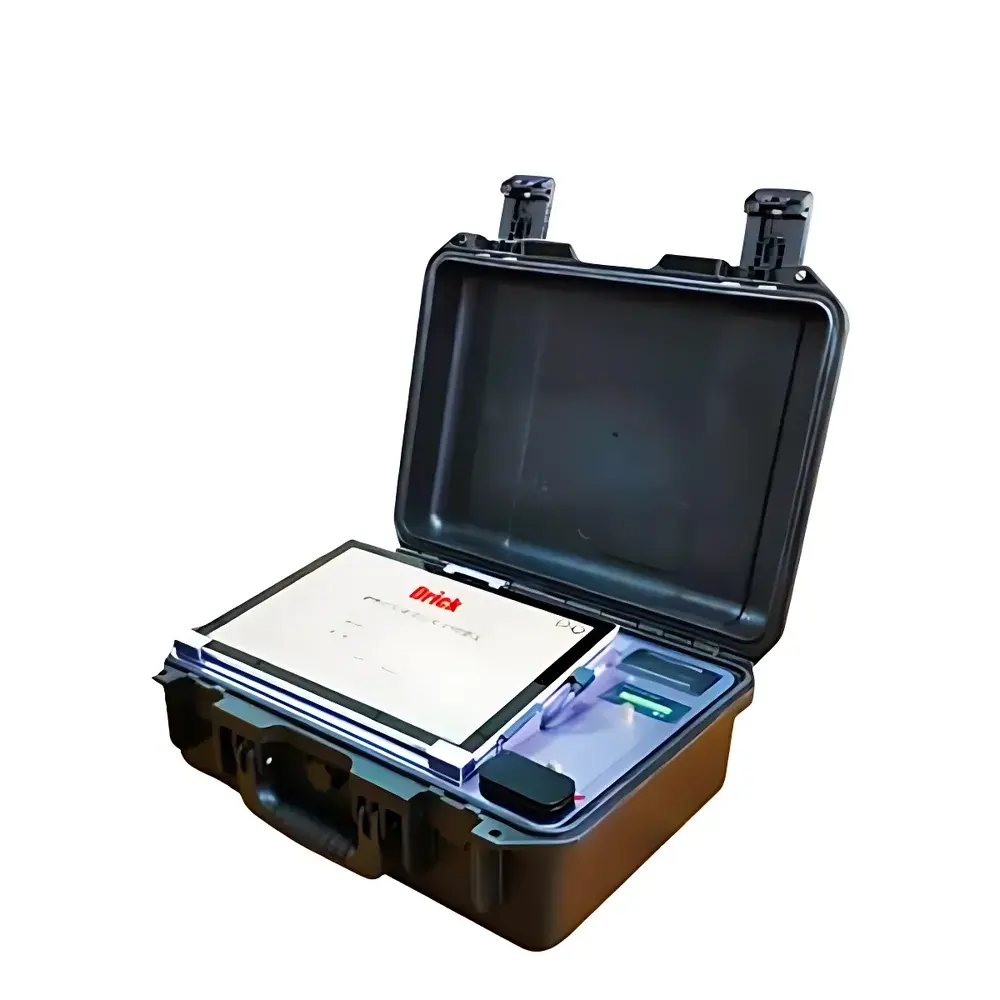
DRK3000FD Portable Raman Spectrometer for Food Safety Analysis
| Brand | Drick |
|---|---|
| Origin | Shandong, China |
| Manufacturer Type | OEM Manufacturer |
| Country of Origin | China |
| Model | DRK3000FD |
| Price | USD 28,500 (FOB Qingdao) |
| Laser Wavelength | 785 nm |
| Spectral Range | 250–2700 cm⁻¹ |
| Spectral Resolution | ≤6 cm⁻¹ (FWHM) |
| Detector | Cooled 2048-pixel CCD |
| Working Distance | 6 mm |
| Optical Density (OD) of Notch Filter | >8 |
| Numerical Aperture | 0.3 |
| Entrance Slit / Collection Aperture | 7 mm |
| Power Stability (σ/� | ): <±0.2% |
| Battery Capacity | 10,000 mAh Li-ion |
| Operating Time | >4 h |
| Operating Temperature | −10 °C to +40 °C |
| Relative Humidity | ≤90% RH (non-condensing) |
| Connectivity | Bluetooth 5.0, Wi-Fi 802.11 b/g/n, LTE Cat-4 (China Unicom), Dual USB 2.0 |
| Onboard Audio Alert | Integrated buzzer |
| Sample Modes | Non-contact surface scan & vial-based immersion |
| Database | Preloaded Raman library for adulterants, banned drugs, veterinary residues, hormones, and illegal additives in food, pharmaceuticals, cosmetics, and dietary supplements |
Overview
The DRK3000FD Portable Raman Spectrometer is an integrated, field-deployable analytical platform engineered for rapid, non-destructive identification and screening of chemical contaminants in food supply chains. It operates on the principle of inelastic light scattering—Raman spectroscopy—at an excitation wavelength of 785 nm, optimized to minimize fluorescence interference from complex organic matrices such as dairy products, fruits, meat extracts, and herbal preparations. The system employs a thermoelectrically cooled 2048-pixel linear CCD detector coupled with a high-efficiency plane-reflection grating spectrometer, delivering consistent spectral acquisition across the 250–2700 cm⁻¹ fingerprint region with ≤6 cm⁻¹ resolution (FWHM). Its optical architecture features a high-transmission notch filter (OD >8), numerical aperture of 0.3, and fixed 6 mm working distance—enabling stable signal coupling from solid, powder, liquid, and thin-film samples without physical contact or extensive sample preparation. Designed for regulatory frontline use, the DRK3000FD meets core functional requirements for on-site screening under ISO/IEC 17025-aligned workflows and supports trace-level detection of targeted analytes—including β-agonists (e.g., clenbuterol), nitrofurans, malachite green, melamine, Sudan dyes, and steroid hormones—based on spectral matching against reference libraries.
Key Features
- Field-rugged design: Total mass ≤10 kg; footprint ≤20 × 30 × 40 cm; IP54-rated enclosure for dust and splash resistance
- Integrated power management: 10,000 mAh rechargeable lithium-ion battery with onboard charging circuitry; >4 hours continuous operation under standard scanning conditions
- Multi-modal sampling: Supports both non-contact surface interrogation (e.g., packaged foods, fruit skins) and vial-based immersion (aqueous suspensions, homogenized extracts)
- Adaptive laser control: Adjustable 785 nm diode laser output to balance signal-to-noise ratio and photodegradation risk across diverse sample types
- Embedded connectivity suite: Dual-band Wi-Fi (802.11 b/g/n), Bluetooth 5.0, and LTE Cat-4 module (China Unicom band) for real-time data upload, remote firmware updates, and cloud-based spectral correlation
- On-device decision support: Real-time spectral matching engine with visual alert (LED + audible buzzer) when detected peaks align with flagged compounds in the onboard library
Sample Compatibility & Compliance
The DRK3000FD accommodates heterogeneous sample forms without derivatization or extraction: intact solids (e.g., grains, spices), powdered blends (milk powder, flour), viscous liquids (honey, sauces), aqueous solutions (pesticide rinsates), and polymer films (packaging materials). Its optical path tolerates ambient humidity up to 90% RH and operational temperatures from −10 °C to +40 °C—validated per IEC 60068-2 environmental stress testing protocols. While not certified to ISO 17025 as a standalone calibration instrument, its hardware architecture and software audit trail functionality (timestamped spectra, operator ID tagging, version-controlled library metadata) align with GLP documentation practices required for preliminary screening in food safety laboratories operating under China’s GB 2763–2021 and EU Regulation (EC) No 396/2005 frameworks.
Software & Data Management
The instrument runs embedded Linux-based firmware with a touchscreen GUI supporting multilingual UI (English, Chinese, Spanish). Spectral acquisition, preprocessing (cosmic ray removal, baseline correction via asymmetric least squares), and library matching are performed locally. The onboard database contains >1,200 reference Raman spectra covering prohibited substances in food and feed—curated from NIST, FDA CFSAN, and CNCA-certified reference materials. Users may annotate ≥50 custom compounds using spectral peak assignment tools and export annotated libraries in .spc or .jdx format. All acquired spectra are timestamped, geotagged (via GPS-enabled LTE module), and stored with SHA-256 checksums. Audit logs record operator actions, calibration events, and library modifications—supporting traceability in regulated environments requiring 21 CFR Part 11–compliant data integrity (when deployed with validated third-party LIMS integration).
Applications
- Routine surveillance of pesticide residues in fresh produce at border inspection posts
- On-farm verification of veterinary drug withdrawal periods in livestock tissue and milk
- Screening for unauthorized colorants (e.g., Rhodamine B, Sudan IV) in chili powder and palm oil
- Identification of adulterants in infant formula, protein supplements, and traditional herbal products
- Field validation of cleaning efficacy in food processing equipment via surface residue mapping
- Training and capacity building in regional food safety laboratories with limited access to benchtop instrumentation
FAQ
Does the DRK3000FD require external calibration standards for daily operation?
No. The system incorporates an internal silicon reference peak (520.7 cm⁻¹) for automatic wavelength calibration prior to each measurement sequence. Certified polystyrene and cyclohexane standards are recommended for quarterly performance verification.
Can the spectral library be updated remotely?
Yes. Firmware and library updates can be pushed over LTE or Wi-Fi using signed package files authenticated via RSA-2048 signatures.
Is the device compliant with FDA or EU import screening protocols?
It is designed to support screening workflows aligned with FDA Import Alert 99-05 and EU Commission Implementing Regulation (EU) 2022/2427, though final method validation remains the responsibility of the end-user laboratory per AOAC Official Method guidelines.
What is the minimum detectable concentration for common antibiotics in milk?
Detection limits vary by compound and matrix; typical LODs range from 10–100 µg/kg for fluoroquinolones and tetracyclines in skimmed milk homogenates under optimized acquisition parameters (30 s integration, 3× averaging).
Does the system support quantitative analysis?
The DRK3000FD is primarily configured for qualitative and semi-quantitative screening. Quantitative accuracy requires matrix-matched calibration curves generated externally and imported into the software’s regression module.






