
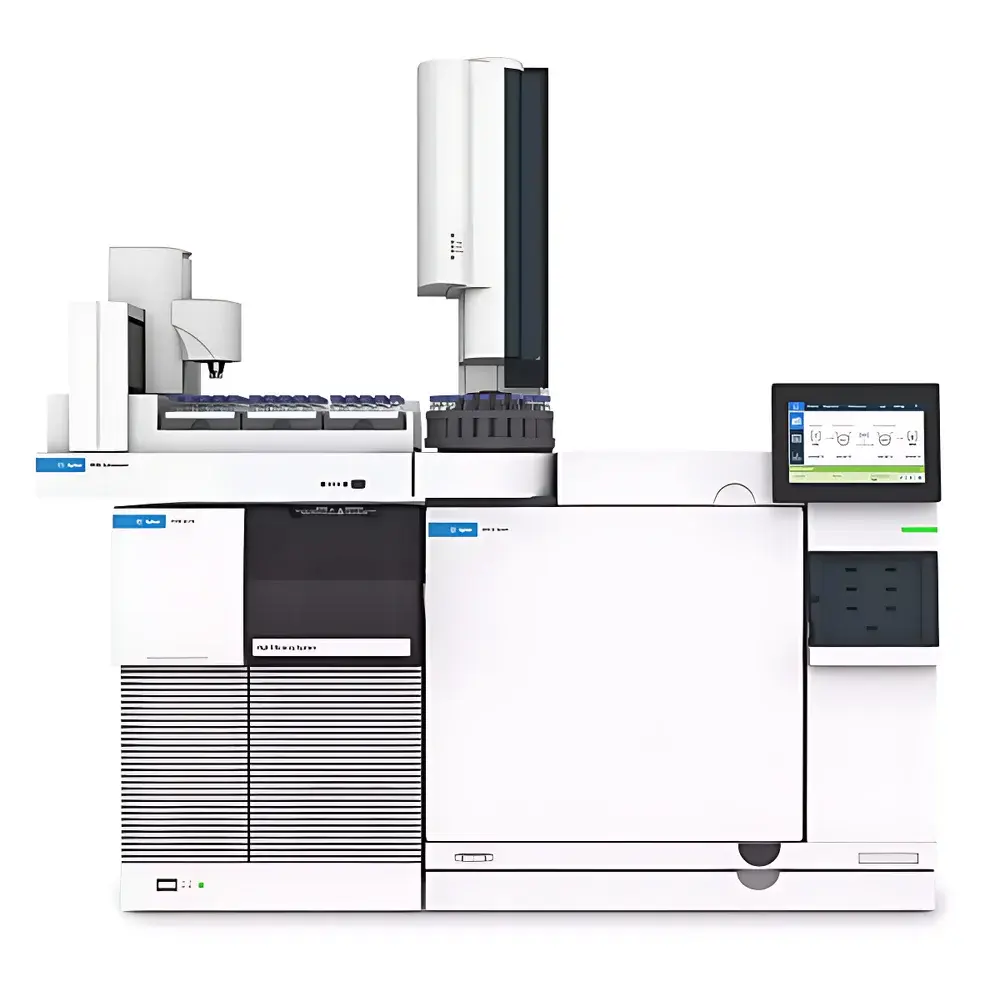
Agilent 7010C Triple Quadrupole Gas Chromatography-Mass Spectrometry System
| Brand | Agilent Technologies |
|---|---|
| Origin | USA |
| Model | 7010C |
| Instrument Type | Triple Quadrupole Mass Spectrometer |
| GC Configuration | Conventional Gas Chromatography Coupling |
| Scan Speed | ≤ 20,000 Da/s |
Overview
The Agilent 7010C Triple Quadrupole Gas Chromatography-Mass Spectrometry (GC/TQ) System is a high-performance, research-grade analytical platform engineered for ultra-trace quantification in complex matrices. It operates on the fundamental principle of tandem mass spectrometry—employing three quadrupole mass filters in sequence (Q1 → collision cell → Q3) to isolate precursor ions, induce controlled fragmentation via collision-induced dissociation (CID), and selectively detect characteristic product ions. This configuration delivers exceptional specificity, sensitivity, and dynamic range—critical for regulated environmental, food safety, and forensic applications where matrix interference, low analyte abundance, and strict regulatory detection limits prevail. The system integrates seamlessly with Agilent’s 8890 or Intuvo 9000 Gas Chromatographs, leveraging advanced hardware synchronization and real-time data coordination to ensure retention time stability, peak fidelity, and method robustness across diverse sample types.
Key Features
- High-Efficiency Source (HES): Optimized ion optics and enhanced electron emission deliver >2× higher ion transmission efficiency compared to standard EI sources—enabling sub-attogram (ag) detection limits for dioxins and furans under EPA Method 1613B.
- Agilent JetClean Intelligent Ion Source: Integrated hydrogen-mediated thermal cleaning eliminates manual source maintenance intervals; extends operational uptime and ensures consistent ionization performance across hundreds of injections.
- SWARM Auto-Tuning: Fully automated, intelligent tuning algorithm that completes mass calibration, gain calibration, and resolution optimization in half the time of prior-generation GC/TQ systems—reducing setup overhead and improving inter-day reproducibility.
- Advanced Acquisition Modes: Includes triggered MRM (tMRM), synchronized dynamic MRM/Scan (dMRM/Scan), and data-dependent tMRM—enabling simultaneous quantitative analysis of >200 target compounds and untargeted screening within a single chromatographic run.
- Heated Gold-Plated Quadrupoles & Tri-Axis HED-EM Detector: Minimize neutral noise and improve signal-to-noise ratio; fast pump-down capability reduces cooldown time between runs, supporting high-throughput laboratory workflows.
- Integrated Diagnostics & Touchscreen Interface: Real-time system health monitoring, predictive error logging, and guided troubleshooting via browser-based or local touchscreen interface—reducing mean time to repair (MTTR) and supporting GLP-compliant instrument qualification.
Sample Compatibility & Compliance
The 7010C GC/TQ supports liquid, solid, and gaseous samples following standard EPA, ISO, and ASTM extraction and cleanup protocols—including EPA Methods 1613B (dioxins/furans), 8270 (semivolatiles), and 8082 (PCBs). Its compatibility with the Agilent Reference Compound Injection Valve enables precise, contamination-free introduction of certified standards directly into the ion source—critical for eliminating false positives in dioxin analysis and fulfilling ATP (Alternative Test Procedure) validation requirements. The system meets essential regulatory compliance criteria for data integrity and auditability: built-in electronic signatures, full audit trail logging, role-based access control, and 21 CFR Part 11 / EU Annex 11–compliant security architecture are enforced through MassHunter software configuration and deployment controls.
Software & Data Management
Agilent MassHunter Workstation provides end-to-end workflow control—from instrument method setup and acquisition to processing, reporting, and archiving. MassHunter Optimizer automates MRM transition optimization, collision energy ramping, and dwell time allocation, significantly accelerating method development. Retention Time Locking (RTL) functionality ensures method portability across Agilent GC platforms without revalidation. The included Pesticides and Environmental Pollutants Database v4.0 contains >1,100 compounds with validated MRM transitions and >7,500 matrix-optimized transitions—supporting rapid library-based method creation and minimizing cross-talk and co-elution artifacts. All raw and processed data files are stored in vendor-neutral .D format, fully compatible with third-party LIMS and ELN integrations.
Applications
- Ultra-trace analysis of PCDDs/PCDFs in soil, sediment, tissue, and air samples per EPA 1613B and ISO 18073.
- Multi-residue pesticide screening and confirmation in food commodities (e.g., fruits, vegetables, cereals) compliant with SANTE/2023/1283 guidelines.
- Quantitative determination of persistent organic pollutants (POPs), brominated flame retardants (PBDEs, HBCDs), and emerging contaminants (e.g., PFAS precursors) in environmental monitoring programs.
- Forensic toxicology workflows requiring high-specificity confirmation of controlled substances in biological fluids.
- Method transfer and validation from legacy Agilent 5975/5977 MSD systems—leveraging MassHunter’s backward-compatible method migration tools and RTL-enabled retention time alignment.
FAQ
Does the 7010C support EPA 1613B Alternative Test Procedures (ATP)?
Yes—the 7010C, when configured with the Agilent Reference Compound Injection Valve and operated under validated conditions, satisfies all hardware and performance criteria specified in the EPA 1613B ATP for PCDD/PCDF analysis.
Can I migrate existing GC/MSD methods to the 7010C without manual re-optimization?
Yes—MassHunter Optimizer enables semi-automated method conversion from Agilent 5975/5977 GC/MSD platforms, including automatic MRM parameter generation and retention time locking.
Is the system compliant with FDA 21 CFR Part 11 requirements?
Yes—MassHunter software includes configurable electronic signatures, complete audit trails, secure user authentication, and data integrity safeguards aligned with 21 CFR Part 11 and EU Annex 11.
What is the typical detection limit for 2,3,7,8-TCDD using the 7010C?
Under optimized conditions with HES and JetClean, instrumental detection limits for 2,3,7,8-TCDD are consistently below 0.1 ag on-column, meeting stringent regulatory thresholds for environmental dioxin analysis.
How does the SWARM tuning algorithm improve daily operation?
SWARM reduces total tuning time by up to 50%, maintains consistent mass axis calibration across extended runs, and automatically flags deviations—supporting uninterrupted high-throughput operation and reducing operator dependency.



