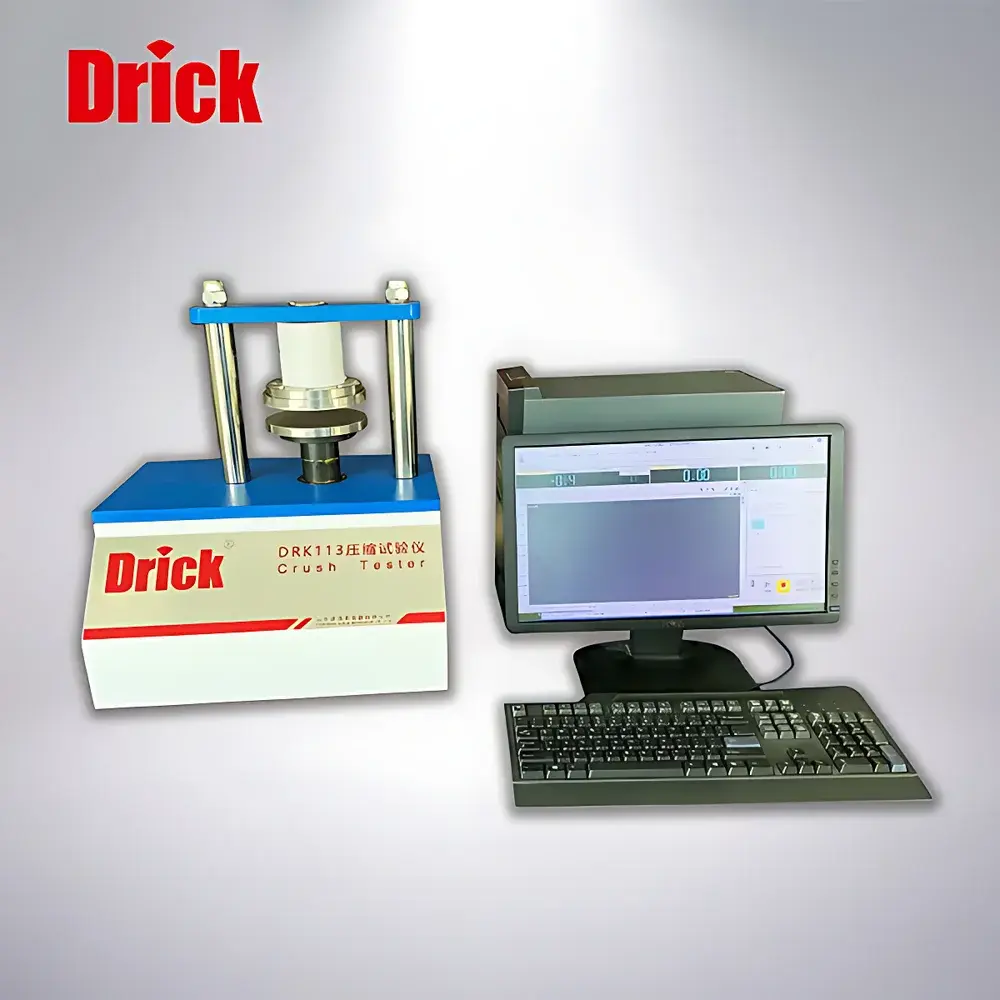
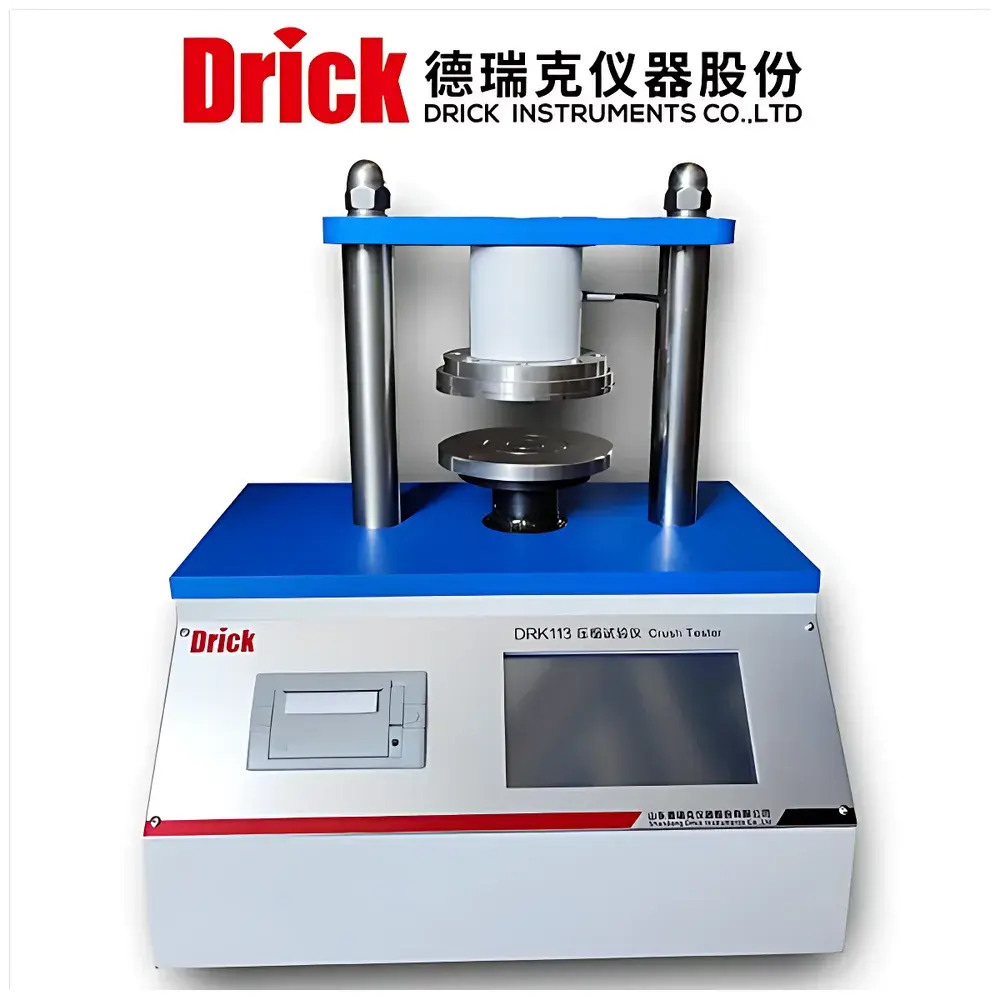
Drick DRK113E Edge Crush Test (ECT), Flat Crush Test (FCT), Ring Crush Test (RCT), and Ply Adhesion Test (PAT) Compression Tester
| Brand | Drick |
|---|---|
| Model | DRK113E |
| Origin | Shandong, China |
| Manufacturer Type | Direct Manufacturer |
| Compliance | ISO 12192, ISO 3035, ISO 3037, ISO 7263, GB/T 2679.6, GB/T 2679.8, GB/T 6546, GB/T 6548, QB/T 1048 |
| Test Range | 0.15–1.00 mm thickness substrates |
| Max Specimen Diameter | <60 mm (for CMT) |
| Load Cell Accuracy | High-precision strain-gauge transducer |
| Control Interface | PC-based software with real-time force/deformation plotting, statistical analysis, auto-reset, and GLP-compliant data export |
Overview
The Drick DRK113E is a dedicated compression testing system engineered for standardized mechanical evaluation of corrugated fiberboard and paper-based packaging materials. It operates on the fundamental principle of uniaxial compressive loading under controlled displacement or force control, adhering to established physical test methodologies defined in international and national standards—including edge crush (ECT), flat crush (FCT), ring crush (RCT), ply adhesion (PAT), and core crush (CMT). The instrument implements a fixed upper platen configuration with a high-stability load cell mounted beneath the lower platen, ensuring minimal mechanical hysteresis and optimal signal fidelity during dynamic compression events. Its microprocessor-controlled actuation system delivers precise crosshead speed regulation across multiple test modes, enabling repeatable application of ASTM/ISO-specified loading rates—critical for inter-laboratory comparability and regulatory acceptance.
Key Features
- Integrated electromechanical architecture with compact footprint and modular service design for long-term operational reliability;
- Fixed upper compression platen combined with a precision-calibrated load cell (strain-gauge type) for high-resolution force measurement and low noise floor;
- Real-time synchronized acquisition of both compressive force (N or kN) and axial deformation (mm), displayed as live stress–strain curves during testing;
- PC-based control software supporting automated test sequencing, parameter presetting (e.g., preload, dwell time, crosshead speed), and pass/fail logic based on user-defined thresholds;
- Comprehensive data handling suite including statistical summarization (mean, SD, CV%), automatic report generation (PDF/CSV), timestamped audit trails, and 21 CFR Part 11–compatible electronic signatures (optional configuration);
- Tool-less platen interchange system facilitating rapid reconfiguration between ECT, FCT, RCT, PAT, and CMT fixtures without recalibration;
- Self-diagnostic firmware with error logging, overload protection, and mechanical end-stop limit switches for operator safety and equipment integrity.
Sample Compatibility & Compliance
The DRK113E accommodates specimens conforming to standard geometries specified in ISO and GB methods: ECT strips (15 × 100 mm), FCT samples (100 × 100 mm), RCT liners (15 × 152 mm), PAT “L”-shaped delamination coupons, and CMT cores ≤60 mm in diameter. It supports testing of single-faced, double-faced, and triple-wall corrugated board; linerboard; fluting medium; and small-diameter rigid containers (e.g., paper cups, food-grade bowls, cylindrical tubes). All test protocols align with ISO 12192 (ring crush), ISO 3035 (flat crush of single-layer board), ISO 3037 (edge crush, unwaxed), ISO 7263 (fluted medium flat crush), GB/T 2679.8 (ring crush), GB/T 6546 (edge crush), GB/T 6548 (adhesive bond strength), and QB/T 1048 (general packaging compression). Instrument validation documentation includes factory calibration certificates traceable to NIM (National Institute of Metrology, China) standards.
Software & Data Management
The proprietary Windows-compatible software provides full GLP/GMP-aligned data governance. Each test record contains embedded metadata: operator ID, sample ID, environmental conditions (optional humidity/temperature input), test date/time, calibration status, and version-stamped firmware identification. Raw data streams are stored in encrypted binary format with SHA-256 hash verification. Export functions support CSV (tabular), XML (structured metadata), and PDF (formatted reports with embedded graphs and pass/fail annotations). Audit trail functionality logs all user actions—including parameter edits, result overrides, and report exports—with immutable timestamps. Optional 21 CFR Part 11 compliance package includes role-based access control, biometric or token-based login, and electronic signature workflows for regulated quality systems.
Applications
This system serves as a primary mechanical characterization tool in packaging R&D laboratories, paper mill QC departments, third-party certification bodies (e.g., SGS, Intertek), and food/pharma packaging validation units. Typical use cases include: evaluating flute geometry influence on ECT performance; benchmarking adhesive formulations for improved PAT values; validating linerboard stiffness for sustainable lightweighting initiatives; verifying compliance of retail-ready packaging with Amazon ISTA 3A or FEFCO 201 requirements; and conducting accelerated aging studies where compression resistance is monitored pre- and post-humidity cycling. Its adaptability to non-standard geometries also enables custom method development for novel honeycomb panels, molded fiber trays, and bio-based composite substrates.
FAQ
What standards does the DRK113E fully support out-of-the-box?
It natively implements test routines for ISO 12192, ISO 3035, ISO 3037, ISO 7263, GB/T 2679.6, GB/T 2679.8, GB/T 6546, GB/T 6548, and QB/T 1048 — with configurable parameters matching each standard’s prescribed specimen dimensions, loading rate, and reporting format.
Can the system be integrated into an existing LIMS or MES environment?
Yes — via optional OPC UA or RESTful API modules, enabling bidirectional data exchange with laboratory information management systems and enterprise manufacturing execution platforms.
Is periodic recalibration required, and what documentation is provided?
Annual recalibration is recommended per ISO/IEC 17025 guidelines; Drick supplies a NIM-traceable calibration certificate with initial delivery, including linearity, repeatability, and zero-drift verification data across the full 0–500 N range.
Does the instrument support variable-speed testing for creep or relaxation analysis?
While primarily optimized for quasi-static compression per standard methods, the firmware allows programmable multi-step velocity profiles — suitable for basic time-dependent behavior assessment when paired with extended-duration data logging.
What maintenance intervals are advised for sustained accuracy?
Platen alignment verification every 6 months; load cell zero-check before each shift; mechanical guide lubrication every 12 months; and full preventive maintenance (including encoder calibration and motor torque verification) annually by certified field service engineers.