
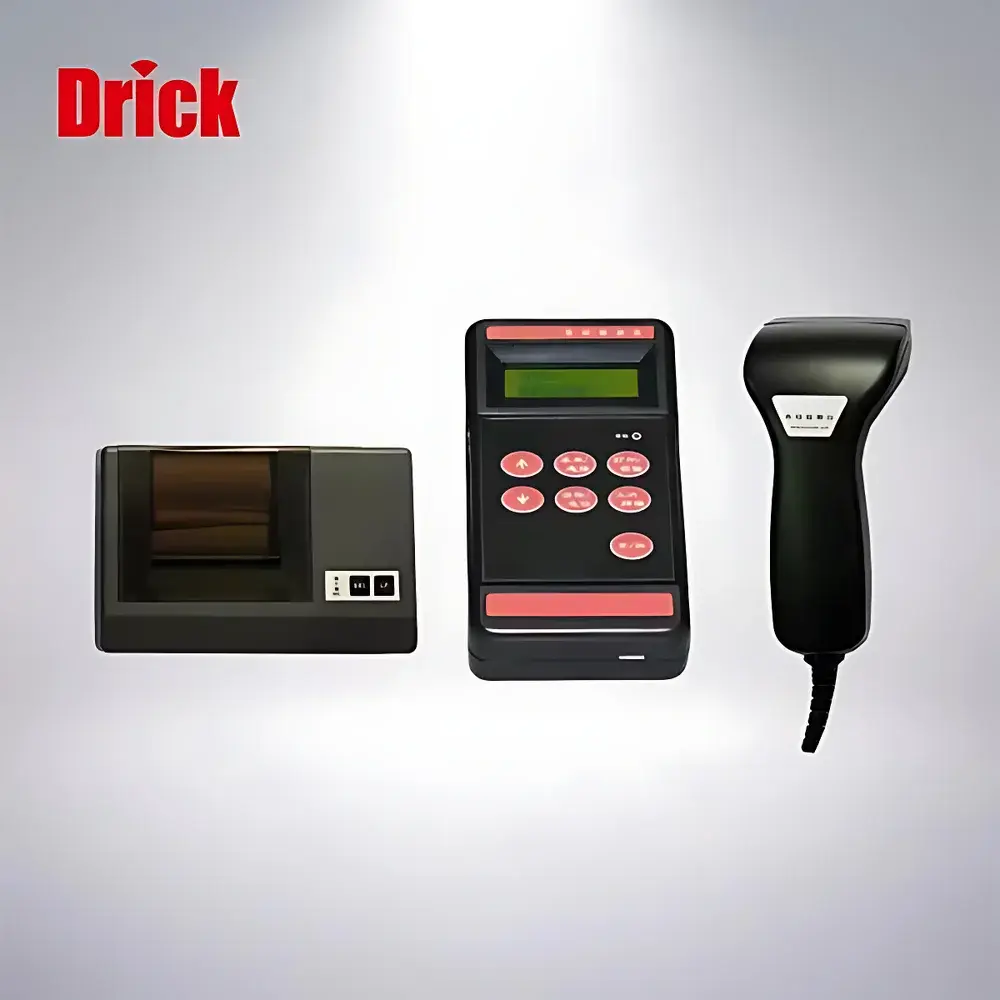
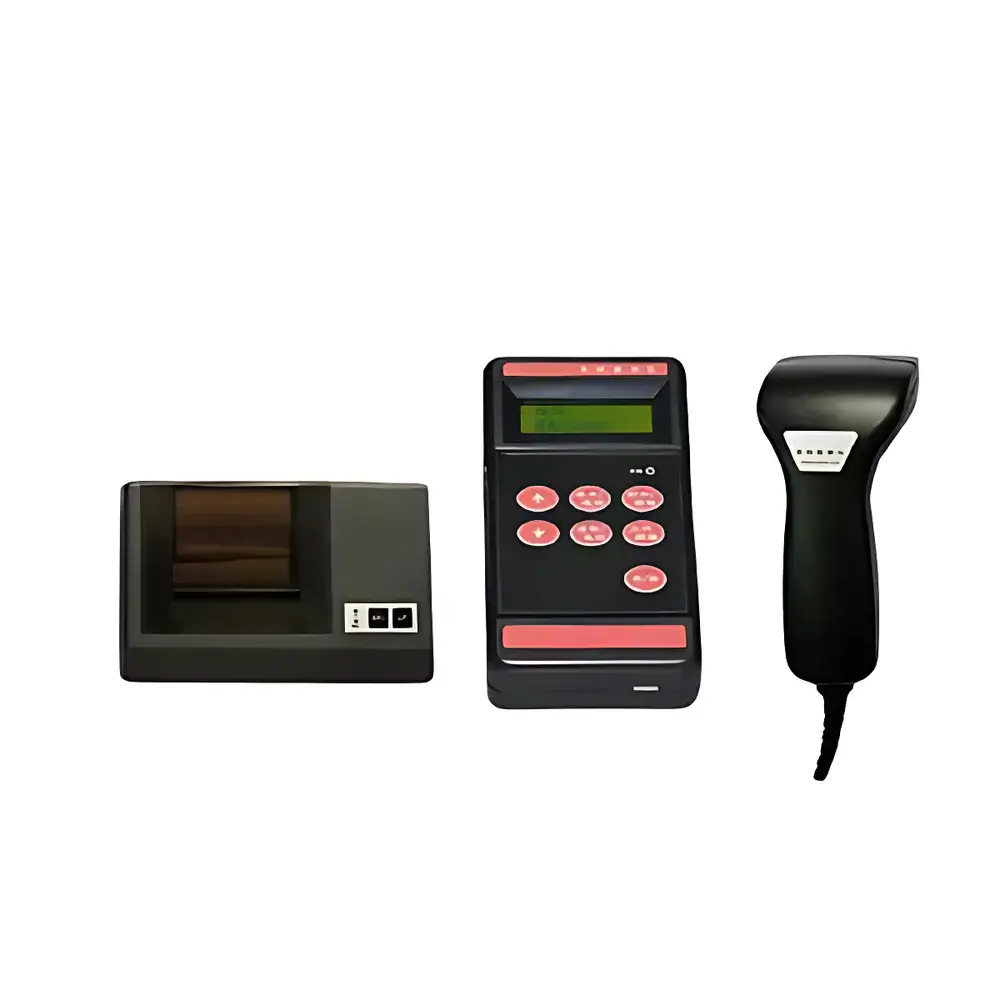
Drick DRK125A Portable Barcode Verification System
| Brand | Drick |
|---|---|
| Origin | Shandong, China |
| Manufacturer Type | Direct Manufacturer |
| Region of Origin | Domestic (China) |
| Model | DRK125A |
| Light Source | 660 nm LED |
| Aperture Options | 0.076 mm (3 mil), 0.127 mm (5 mil), 0.152 mm (6 mil), 0.254 mm (10 mil) |
| Max Barcode Length (incl. quiet zones) | 72 mm |
| Storage Capacity | ≥10,000 single-scan EAN-13 verification results |
| Display | Dual-line LCD with Chinese/English UI |
| Interface | RS-232 serial port, USB (shared with CCD imager) |
| Power Supply | 4×AA alkaline (included), 4×AA Ni-MH rechargeable (user-supplied), or dedicated DC adapter (included) |
| Weight (main unit, no batteries) | 0.3 kg |
| Operating Temp. | 10–40 °C |
| Operating Humidity | 30–80% RH |
| Storage Temp. | 5–50 °C |
| Storage Humidity | 10–90% RH |
Overview
The Drick DRK125A Portable Barcode Verification System is a precision-grade, handheld instrument engineered for ISO/IEC 15416-compliant reflectance-based verification of linear (1D) barcode symbols. It operates on the principle of calibrated optical measurement—using a stable 660 nm red LED light source and four selectable aperture sizes—to capture high-fidelity scan reflectance profiles (SRPs) across the full symbol length, including quiet zones. Unlike basic barcode readers, the DRK125A performs full ANSI/ISO conformance testing: it calculates and reports individual parameter grades (e.g., Symbol Contrast, Minimum Reflectance, Edge Contrast, Modulation, Decode, Defects) and synthesizes them into an overall Symbol Grade (A–F), in strict accordance with ISO/IEC 15416:2016 and GB/T 18348–2008. Its embedded CCD imaging engine supports bidirectional scanning and automatic symbology identification, enabling reliable verification without manual mode selection. Designed for field deployment and lab bench use alike, the DRK125A bridges the gap between portable convenience and metrological traceability—making it suitable for quality assurance teams in regulated environments where barcode legibility directly impacts traceability, compliance, and process integrity.
Key Features
- Automatic symbology recognition for EAN-13, EAN-8, UPC-A, UPC-E, Code 128, Code 39, Interleaved 2 of 5 (ITF), Codabar, and other widely deployed linear barcode standards
- Four user-selectable measurement apertures (3, 5, 6, and 10 mil) aligned with ISO/IEC 15416 requirements to ensure appropriate spatial resolution for varying print resolutions and magnifications
- Single-scan or multi-scan (up to 10 scans) verification mode; computes arithmetic mean Symbol Grade and parameter stability metrics to assess repeatability
- On-device storage of ≥10,000 complete EAN-13 verification records—including raw SRP data, grade breakdowns, pass/fail status, timestamp, and operator ID (if configured)
- Dual-language interface (Chinese/English) with intuitive menu navigation and real-time visual feedback via dual-color decoding indicator LED and audible beeper alerts
- Integrated RS-232 serial interface for direct connection to thermal printers; USB 2.0 port (shared with CCD imager) for bulk export of verification logs to external storage or LIMS
- Triple-power architecture: 4×AA alkaline (supplied), 4×AA Ni-MH rechargeable (user-provided), or optional external DC adapter—enabling >8 hours of continuous operation under typical duty cycles
- Intelligent power management with programmable sleep timeout and auto-shutdown; low-battery warning (audible beep every 13–15 seconds) ensures uninterrupted workflow continuity
Sample Compatibility & Compliance
The DRK125A verifies printed linear barcodes on substrates including paper labels, corrugated cartons, plastic films, and coated packaging materials—provided surfaces are clean, dry, and free of smudges, dust, or specular glare. It complies fully with ISO/IEC 15416:2016 for linear symbol verification and aligns with national standard GB/T 18348–2008 for barcode quality assessment in China. While not certified to FDA 21 CFR Part 11 out-of-the-box, its audit-ready data export (CSV-formatted logs with timestamps and grade metadata) supports integration into GLP/GMP documentation workflows when paired with validated SOPs. The instrument meets electromagnetic compatibility (EMC) requirements per GB/T 17626 series and operates within environmental limits defined for Class II industrial equipment (10–40 °C, 30–80% RH).
Software & Data Management
No proprietary PC software is required for core operation—the DRK125A functions autonomously with embedded firmware. However, exported CSV files (via USB) are structured for seamless ingestion into Excel, LabVIEW, or enterprise quality management systems (QMS). Each record contains: symbology ID, scan count, aperture used, Symbol Grade (A–F), six ANSI parameter grades, normalized reflectance values, pass/fail flag, date/time stamp, and unique test ID. Optional custom reporting templates can be developed using open-format parsing—facilitating automated compliance reporting for ISO 9001 internal audits or supplier qualification programs. Firmware updates are delivered via USB stick, ensuring long-term maintainability without dependency on cloud infrastructure.
Applications
- Pre-shipment verification of retail packaging (EAN/UPC) in consumer goods manufacturing and contract packaging facilities
- Medical device labeling validation per UDI requirements (21 CFR Part 801, EU MDR Annex I), where A-grade barcodes are mandated for traceability
- In-process quality control on flexographic and thermal-transfer printing lines—detecting ink spread, edge roughness, or contrast loss before roll conversion
- Logistics and warehousing operations verifying barcode readability across diverse scanning hardware (laser, CCD, mobile imagers)
- Regulatory submissions support: generating auditable verification evidence for FDA, CE Marking, or NMPA registration dossiers
- Third-party certification labs performing accredited barcode conformance testing under ISO/IEC 17025 scope
FAQ
Does the DRK125A support GS1 DataBar or 2D symbologies like QR Code?
No—the DRK125A is designed exclusively for linear (1D) barcode verification per ISO/IEC 15416. It does not decode or grade GS1 DataBar, QR Code, Data Matrix, or PDF417.
Can verification results be exported in PDF format directly from the device?
No—results are exported as plain-text CSV files via USB. PDF generation requires post-processing on a host computer using spreadsheet or reporting software.
Is calibration traceable to NIST or other national metrology institutes?
The DRK125A includes factory calibration against reference reflectance standards. Full traceability documentation (including calibration certificate with uncertainty budget) is available upon request at time of purchase.
What is the warranty period and service support coverage?
Drick provides a 24-month limited warranty covering parts and labor. Extended service plans, including on-site calibration and firmware validation, are available through authorized regional service centers.
How does the DRK125A handle damaged or low-contrast barcodes during verification?
It captures full SRPs and reports all seven ANSI parameters individually—even if decoding fails. A “Decode” grade of F does not preclude analysis of contrast, modulation, or defects, supporting root-cause diagnosis in print process troubleshooting.




