
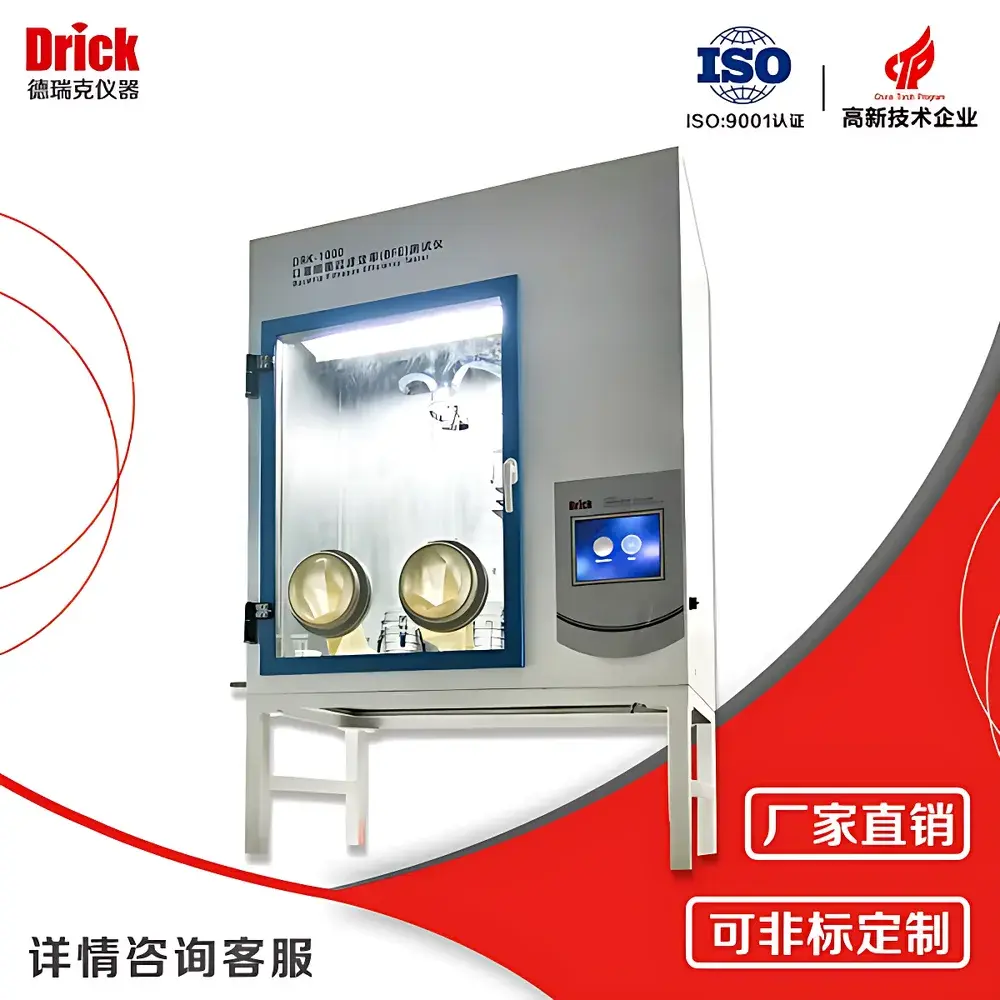
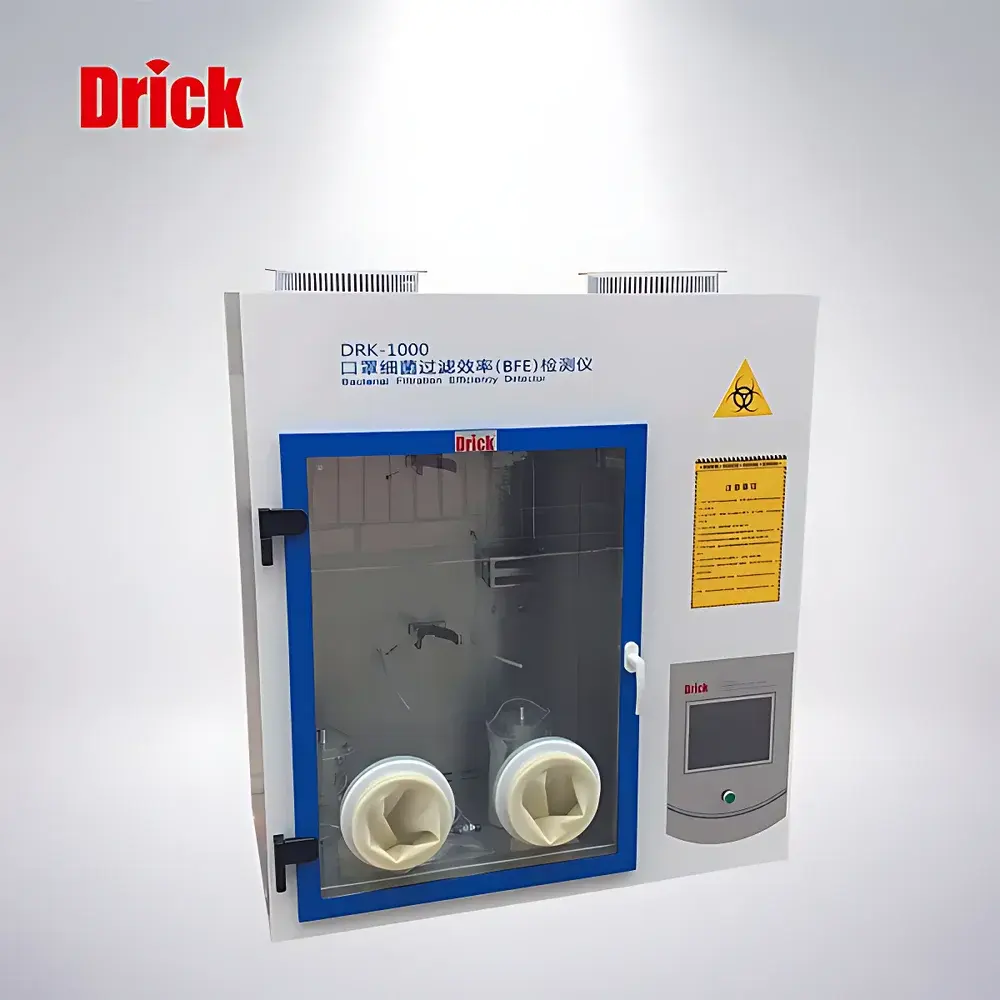
Drick DRK1000 Bacterial Filtration Efficiency (BFE) Tester for Single-Use Medical Surgical Masks
| Brand | Drick |
|---|---|
| Origin | Shandong, China |
| Manufacturer Type | Direct Manufacturer |
| Origin Category | Domestic (China) |
| Model | DRK1000 |
| Price | USD 7,000 (approx.) |
Overview
The Drick DRK1000 Bacterial Filtration Efficiency (BFE) Tester is a precision-engineered instrument designed to quantify the bacterial aerosol capture performance of single-use medical surgical masks in accordance with internationally recognized regulatory and testing standards. It operates on the principle of controlled microbial aerosol generation, dual-path simultaneous sampling via six-stage Andersen cascade impactors, and colony-forming unit (CFU) enumeration. The system employs a validated *Staphylococcus aureus* (ATCC 6538) challenge aerosol with a mass median aerodynamic diameter (MMAD) of 3.0 ± 0.3 µm and geometric standard deviation ≤ 1.5 — matching the particle size distribution specified in ASTM F2101, ISO 18184, EN 14683:2019, and YY 0469–2011 Annex B. Its negative-pressure cabinet architecture ensures operator biosafety during aerosol handling, while the dual-channel comparative sampling design minimizes inter-test variability and enhances measurement reproducibility across batch validation and QC workflows.
Key Features
- Negative-pressure containment cabinet with ≥5 m³/min ventilation rate and front-mounted switchable tempered glass viewing door (1000 × 730 mm) for real-time procedural observation
- Dual independent sampling channels (A & B), each equipped with a six-stage Andersen impactor calibrated to capture defined aerodynamic particle fractions: Stage I (>7 µm), II (4.7–7 µm), III (3.3–4.7 µm), IV (2.1–3.3 µm), V (1.1–2.1 µm), VI (0.6–1.1 µm)
- Integrated high-efficiency aerosol generator delivering stable, monodisperse *S. aureus* suspension at programmable雾化 flow rates (8–10 L/min, ±5.0% accuracy)
- Precision-controlled peristaltic pumps (0.006–3.0 mL/min, ±2.5% accuracy) for consistent microbial suspension delivery to the nebulizer
- Dual 28.3 L/min sampling flow paths with real-time pressure monitoring upstream of flow meters (–20 to 0 kPa, ±2.5% accuracy) and aerosol chamber pressure control (–90 to –120 Pa, ±2.0% accuracy)
- Embedded industrial-grade microcomputer with 10.4-inch high-brightness color touchscreen interface and USB port for secure data export to USB storage devices
- Onboard LED illumination, adjustable-height support frame (±100 mm vertical range), and HEPA filtration (≥99.99% efficiency for particles ≥0.3 µm) in exhaust path
- Compliant with GLP-aligned data integrity requirements: timestamped test records, operator ID logging, and non-editable audit trail for all critical parameters
Sample Compatibility & Compliance
The DRK1000 accepts flat, circular, or rectangular mask specimens up to 150 mm in maximum dimension, secured within a standardized aerosol exposure chamber (600 × Ø85 × 3 mm). It supports both qualitative pass/fail assessment and quantitative BFE calculation per ISO 18184:2014 and ASTM F2101–19 methodologies. Regulatory alignment includes full traceability to YY 0469–2011 Annex B, EN 14683:2019 Class I/II/IIIR requirements, ASTM F2100–19 (Level 1–3 barrier performance), and FDA-recognized consensus standards for medical device biocompatibility evaluation. All pressure, flow, and timing parameters are calibrated against NIST-traceable references and documented per Q/0212 ZRB003–2011 technical specification.
Software & Data Management
The embedded control software provides guided workflow execution from aerosol priming through sampling termination and post-run data summary. Each test generates a structured dataset including: aerosol generation duration, total viable CFU counts per impactor stage, calculated BFE (%) using the formula BFE = [1 − (Ctest/Ccontrol)] × 100, and statistical uncertainty based on replicate standard deviation. Raw data files (CSV format) retain full metadata: test ID, date/time, operator, environmental temperature (0–50 °C), and all real-time sensor logs. Data export complies with 21 CFR Part 11 principles — electronic signatures, role-based access control, and immutable record retention for ≥100,000 test entries.
Applications
- Quality control release testing of surgical masks, procedure masks, and respirator components in GMP-certified manufacturing facilities
- Regulatory submission support for CE marking, NMPA registration, and FDA 510(k) clearance pathways
- Method validation and transfer between QC labs and third-party testing organizations (e.g., SGS, TÜV, UL)
- Comparative filtration studies across material types (melt-blown polypropylene, electrospun nanofibers, hybrid composites)
- Accelerated aging and humidity-conditioned BFE stability assessment per ISO 11607–1
- Training and proficiency testing for microbiological safety laboratories under ISO/IEC 17025 accreditation
FAQ
What microbial strain is used for BFE challenge, and is strain substitution permitted?
The DRK1000 is validated for *Staphylococcus aureus* ATCC 6538 as specified in ASTM F2101 and YY 0469. Alternative strains require full re-validation per ISO 17025 Clause 6.4.3.
Does the system support automated colony counting integration?
No native image analysis module is included; however, exported CFU data is compatible with third-party colony counters (e.g., Synbiosis ProtoCOL, iQ-CELL) via CSV import.
Is calibration certification provided with shipment?
Yes — each unit ships with a factory calibration report traceable to national metrology institutes, covering flow, pressure, temperature, and timing subsystems.
Can the DRK1000 be used for viral filtration efficiency (VFE) testing?
Not without hardware and protocol modification; VFE requires φX174 bacteriophage or MS2 coliphage challenge systems, different impactor cut-points, and biosafety level 2 (BSL-2) containment upgrades.
What maintenance intervals are recommended for the HEPA filter and Andersen stages?
HEPA filters require replacement every 12 months or after 2,000 operational hours; Andersen aluminum stages must be cleaned ultrasonically and inspected for orifice deformation before each 10th test cycle.





