
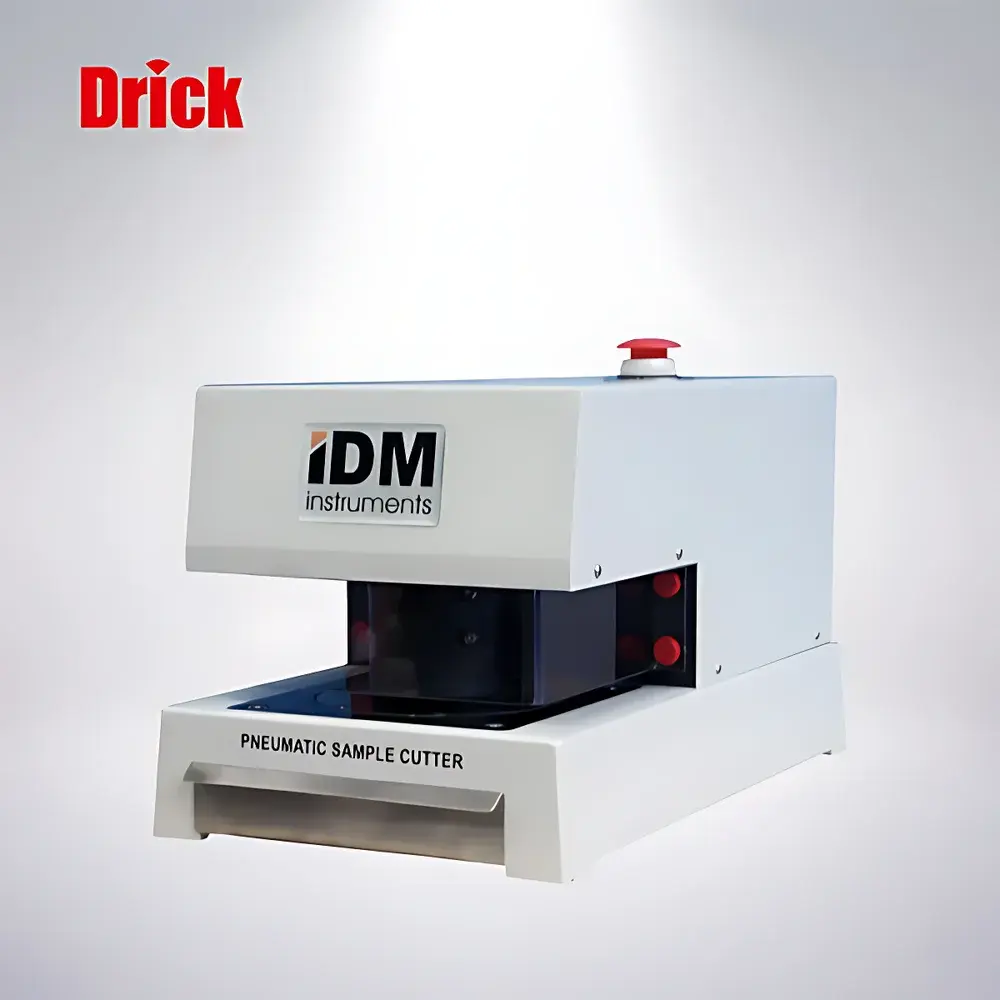
IDM C0043 Pneumatic Sample Cutting Machine
| Brand | IDM |
|---|---|
| Origin | Shandong, China |
| Model | C0043 |
| Instrument Type | Precision Pneumatic Cutting Machine |
| Sample Thickness Range | 0–4 mm |
| Basis Weight Range | 35–1000 gsm |
| Cutting Force Actuation | Pneumatic (80–100 psi) |
| Standard Compliance | ISO 1924, TAPPI T414, ASTM D726, SCAN P10, BS EN 21924, APPITA AS/NZS 1301.414, DIN 53124 |
| Dimensions (H×W×D) | 250 × 230 × 380 mm |
| Weight | 23 kg |
| Safety Certification | CE-compliant guarding per EN ISO 13857 |
| Blade & Die Material | Hardened Alloy Steel |
| Optional Accessories | Custom die sets (e.g., 238.1 × 70 mm, 62 × 50 mm, 63 × 53 mm, 50 × 62 mm, 38 × 70 mm, 15 × 100 mm), Foot-actuated pneumatic switch |
Overview
The IDM C0043 Pneumatic Sample Cutting Machine is an engineered solution for high-reproducibility specimen preparation in quality control and R&D laboratories handling fibrous sheet materials. Designed around a controlled pneumatic actuation system, it delivers consistent, burr-free cuts across standardized test specimens—critical for tensile, burst, tear, and grammage testing protocols. Unlike manually operated or hydraulic cutters, the C0043 eliminates operator-dependent force variability by maintaining precise stroke velocity and dwell time under regulated air pressure (80–100 psi), ensuring dimensional fidelity across batches. Its compact footprint (250 × 230 × 380 mm) enables integration into constrained benchtop environments without compromising mechanical rigidity or cutting accuracy. The machine conforms to internationally recognized paper and board testing standards—including ISO 1924-2 (tensile properties), TAPPI T414 (burst strength), ASTM D726 (surface strength), and SCAN P10 (tensile index)—making it suitable for accredited labs operating under ISO/IEC 17025 requirements.
Key Features
- Pneumatic drive system with adjustable pressure regulation ensures repeatable cutting force and minimizes operator fatigue during high-throughput sample preparation.
- Front-loading specimen feed design allows unobstructed visual alignment and rapid material positioning—reducing setup time and improving workflow continuity.
- Hardened alloy steel punch and die set engineered for extended service life, even when processing abrasive or multi-layered substrates such as corrugated board and coated papers.
- Integrated safety guarding compliant with EN ISO 13857, including fixed physical barriers and interlocked access points to prevent accidental actuation during loading or maintenance.
- Benchtop form factor (23 kg total mass) supports stable operation on standard laboratory work surfaces without anchoring or vibration isolation requirements.
- Modular die interface accommodates standardized and custom-cut geometries—including circular, square, and rectangular formats—enabling method-specific specimen generation per ISO, TAPPI, or internal SOPs.
Sample Compatibility & Compliance
The C0043 is validated for use with cellulose-based sheet materials ranging from lightweight tissue (35 gsm) to heavy-duty packaging board (1000 gsm), with thicknesses up to 4 mm. It accommodates both single-sheet and stacked configurations—supporting multi-layer laminates, corrugated medium, and composite boards. All cutting dimensions adhere to metrological traceability requirements defined in ISO/IEC 17025 Clause 6.4.1, and die geometry tolerances are maintained within ±0.1 mm per batch. Regulatory alignment includes full compatibility with GLP documentation workflows and audit-ready calibration records for instrument qualification (IQ/OQ). Routine verification against reference specimens (e.g., NIST-traceable dimension standards) satisfies internal QC protocols and external accreditation body expectations.
Software & Data Management
While the C0043 operates as a standalone mechanical instrument, its design integrates seamlessly into digital lab ecosystems. Each unit ships with a manufacturer-provided calibration logbook and a serialized certificate of conformance referencing applicable ISO and TAPPI test method annexes. For labs implementing LIMS or ELN platforms, the device supports manual entry of cut count, date/time stamps, and die ID—enabling full chain-of-custody tracking. Optional foot-switch configuration allows hands-free operation, reducing contamination risk in cleanroom or hygienic processing environments. No proprietary firmware or embedded software is present; all operational parameters remain fully transparent and auditable—facilitating compliance with FDA 21 CFR Part 11 where electronic recordkeeping is employed alongside manual logging.
Applications
- Preparation of standardized test specimens for tensile strength (ISO 1924-2), burst resistance (TAPPI T403), and folding endurance (ISO 5628).
- High-volume sampling of corrugated board for edge crush test (ECT) and compression testing per FEFCO/ISTA guidelines.
- Quality assurance in pulp and paper mills, converting facilities, and packaging R&D centers requiring strict adherence to ISO, SCAN, or APPITA specifications.
- Academic and governmental research labs conducting comparative studies on fiber morphology, coating uniformity, or recycled content effects on mechanical performance.
- Regulatory submission support for medical packaging validation (e.g., ASTM F1608 seal strength specimen prep) and food contact material testing (EU 10/2011 Annex I compliance).
FAQ
What standards does the C0043 comply with for specimen preparation?
It meets dimensional and procedural requirements of ISO 1924, TAPPI T414, ASTM D726, SCAN P10, BS EN 21924, APPITA AS/NZS 1301.414, and DIN 53124.
Can the machine cut multiple layers simultaneously?
Yes—it supports stacked cutting of up to five sheets depending on basis weight and substrate compressibility, provided total thickness remains ≤4 mm.
Is die customization available for non-standard specimen geometries?
Yes—IDM offers OEM die fabrication services with engineering drawings and material certification for alloy steel tooling.
What maintenance is required for long-term precision?
Recommended quarterly inspection of pneumatic seals, annual lubrication of guide rails, and biannual verification of die clearance using calibrated feeler gauges.
Does the unit require electrical power?
No—only compressed air supply (80–100 psi, oil-free, <5 µm particulate filtration) is needed; optional foot switch is passive pneumatic actuation.



