
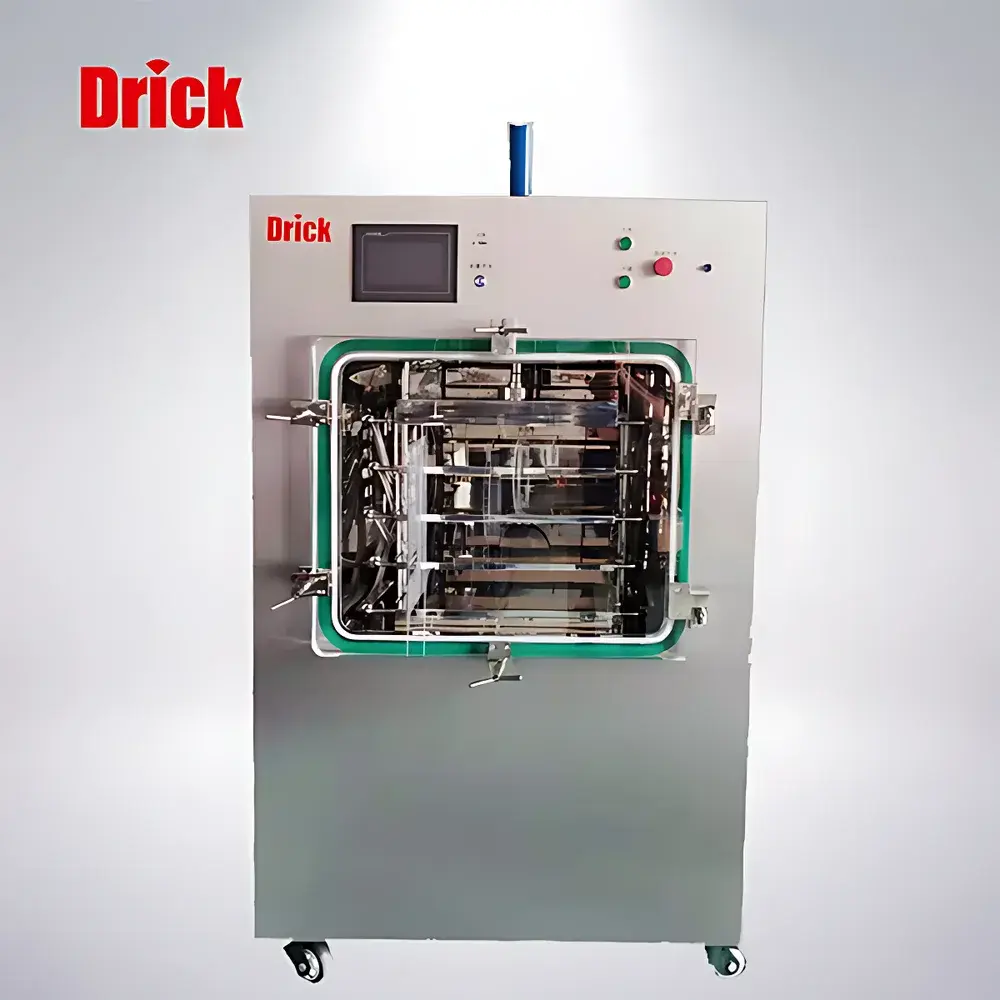
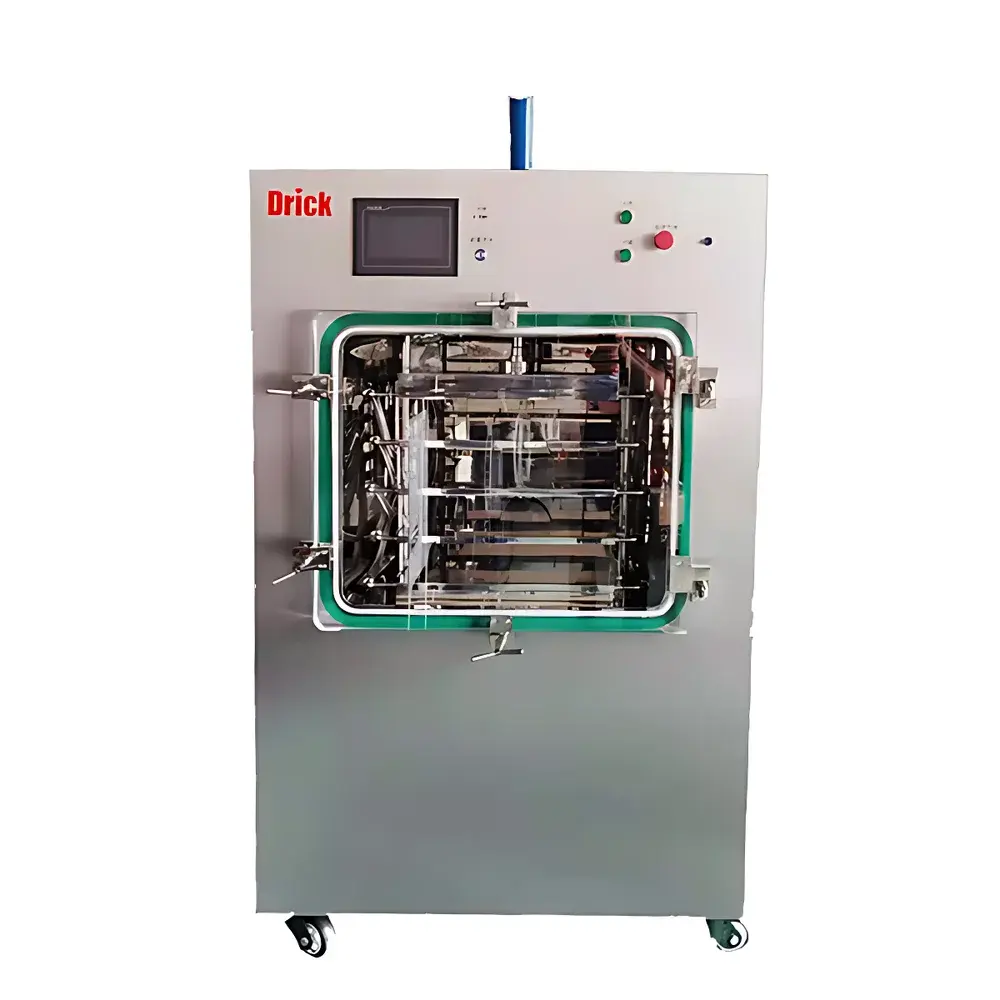
Drick DRK-75L100FGP Benchtop Freeze Dryer
| Brand | Drick |
|---|---|
| Origin | Shandong, China |
| Manufacturer Type | Direct Manufacturer |
| Product Category | Domestic |
| Model | DRK-75L100FGP |
| Instrument Type | Standard Shelf-Type Freeze Dryer |
| Application Scope | Laboratory Use |
| Lyophilization Area | 1.04 m² |
| Ultimate Vacuum Pressure | <5 Pa |
| Condensate Capacity (24 h) | 20 kg/24 h |
| Cold Trap Temperature | <−75 °C |
Overview
The Drick DRK-75L100FGP is a benchtop shelf-type freeze dryer engineered for reliable, reproducible lyophilization of heat-sensitive biological, pharmaceutical, and research-grade samples in controlled laboratory environments. It operates on the fundamental principle of sublimation—removing water from frozen material under deep vacuum while maintaining sample integrity through precise thermal management. The system integrates a high-efficiency dual-stage cascade refrigeration unit capable of achieving cold trap temperatures below −75 °C, enabling rapid ice capture and stable primary drying conditions. Its 1.04 m² shelf area supports scalable batch processing across multiple vial configurations or open-dish formats, making it suitable for method development, stability studies, and small-batch production validation in compliance with GLP and early-stage GMP workflows.
Key Features
- Shelf-type design with stainless steel drying chamber and electro-polished condenser surfaces for enhanced corrosion resistance and cleanability
- Ultimate vacuum capability of <5 Pa, maintained via oil-free dual-stage vacuum pump (pump not included; compatible with ISO-standard dry scroll or diaphragm pumps)
- Cascade refrigeration system delivering sustained cold trap temperature ≤−75 °C, optimized for high-moisture-load samples including aqueous buffers, cell lysates, and protein formulations
- Intuitive touchscreen HMI with programmable drying profiles (pre-freeze, primary drying, secondary drying), real-time pressure and temperature logging, and password-protected user access levels
- Shelf temperature control range: −50 °C to +60 °C (±1.0 °C accuracy), with independent shelf heating capability for controlled desorption during secondary drying
- Integrated vacuum sensor with digital Pirani/capacitance manometer hybrid readout for accurate low-pressure monitoring across the full operational range
Sample Compatibility & Compliance
The DRK-75L100FGP accommodates standard Ø12–Ø30 mm serum vials (up to 1,200 units per batch), Petri dishes, and custom trays within its uniform shelf geometry. It supports lyophilization of sterile-filtered solutions, microbial cultures, enzyme preparations, diagnostic reagents, and excipient-blended APIs. While not certified for full cGMP manufacturing, the system meets essential design criteria referenced in ISO 22081 (freeze-drying terminology), ASTM F2476 (lyophilization process validation guidance), and USP (lyophilization of sterile products). Its data logging architecture supports audit-ready traceability when paired with compliant external PCs running validated software.
Software & Data Management
The embedded controller records time-stamped data for shelf temperature, condenser temperature, chamber pressure, and elapsed cycle time at configurable intervals (1–60 s). Export is supported via USB 2.0 to CSV format for offline analysis in Excel, MATLAB, or statistical process control platforms. Optional Ethernet connectivity enables remote monitoring and integration into centralized lab infrastructure. For regulated environments, Drick provides IQ/OQ documentation templates aligned with FDA 21 CFR Part 11 requirements—including electronic signature support, user role management, and change audit trails—when deployed with validated third-party LIMS or ELN systems.
Applications
- Pharmaceutical R&D: Stabilization of monoclonal antibodies, vaccines, and oligonucleotide therapeutics prior to analytical characterization
- Academic & Clinical Research: Preservation of tissue homogenates, plasma fractions, and microbiome samples without structural degradation
- Food Science: Dehydration of probiotics, flavor extracts, and functional ingredients while retaining volatile compounds and enzymatic activity
- Materials Chemistry: Preparation of porous scaffolds, aerogels, and catalyst precursors requiring controlled pore morphology
- Environmental Testing Labs: Long-term archiving of waterborne pathogen isolates and sediment extracts for retrospective analysis
- Quality Control Laboratories: Routine moisture content verification in raw materials per ISO 15512 and AOAC 952.12 methodologies
FAQ
What is the maximum batch volume this freeze dryer can handle?
Based on a standard 10 mL fill volume per vial and optimal spacing, the 1.04 m² shelf area supports up to approximately 1,200 vials per cycle. Actual capacity depends on container geometry, fill height, and required sublimation front uniformity.
Is the vacuum pump included with the system?
No—the DRK-75L100FGP is supplied without a vacuum pump. Users must select a compatible oil-free pump rated for ≤5 Pa ultimate pressure and ≥10 m³/h pumping speed; Drick provides technical specifications and mounting interface guidelines.
Can shelf temperature be ramped during primary drying?
Yes—programmable shelf temperature ramps are fully supported, allowing dynamic control of sublimation rate and product temperature in accordance with design space modeling (e.g., based on product collapse temperature determined by DSC or MIRS).
Does the system meet regulatory requirements for GLP-compliant studies?
The hardware and firmware architecture supports GLP adherence when operated under documented SOPs, with calibrated sensors, version-controlled software, and secure data export. Full qualification (IQ/OQ/PQ) must be performed by the end user or authorized service partner.
What maintenance intervals are recommended for long-term reliability?
Daily: Visual inspection of O-rings and condenser frost accumulation. Quarterly: Refrigerant charge verification and vacuum seal integrity test. Annually: Calibration of all critical sensors (PT100 shelf probes, capacitance manometer) and full system performance validation per manufacturer’s protocol.



