
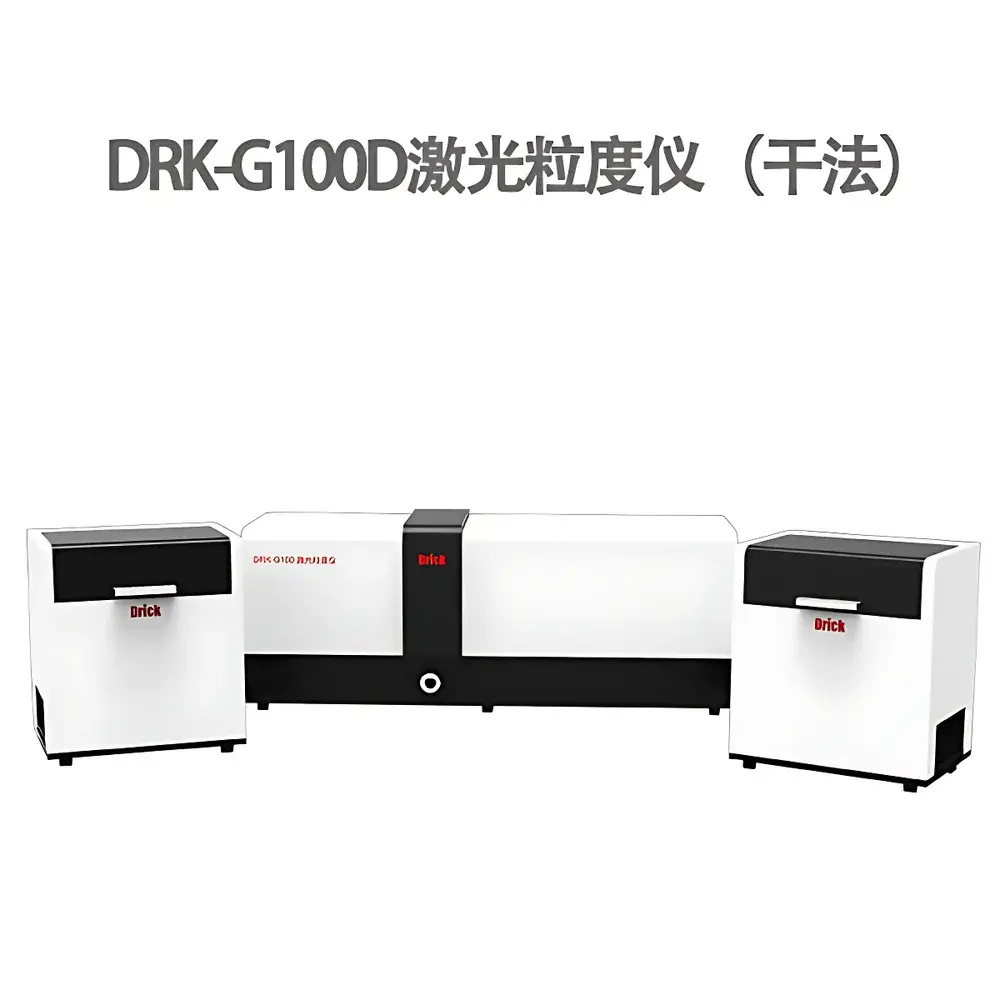
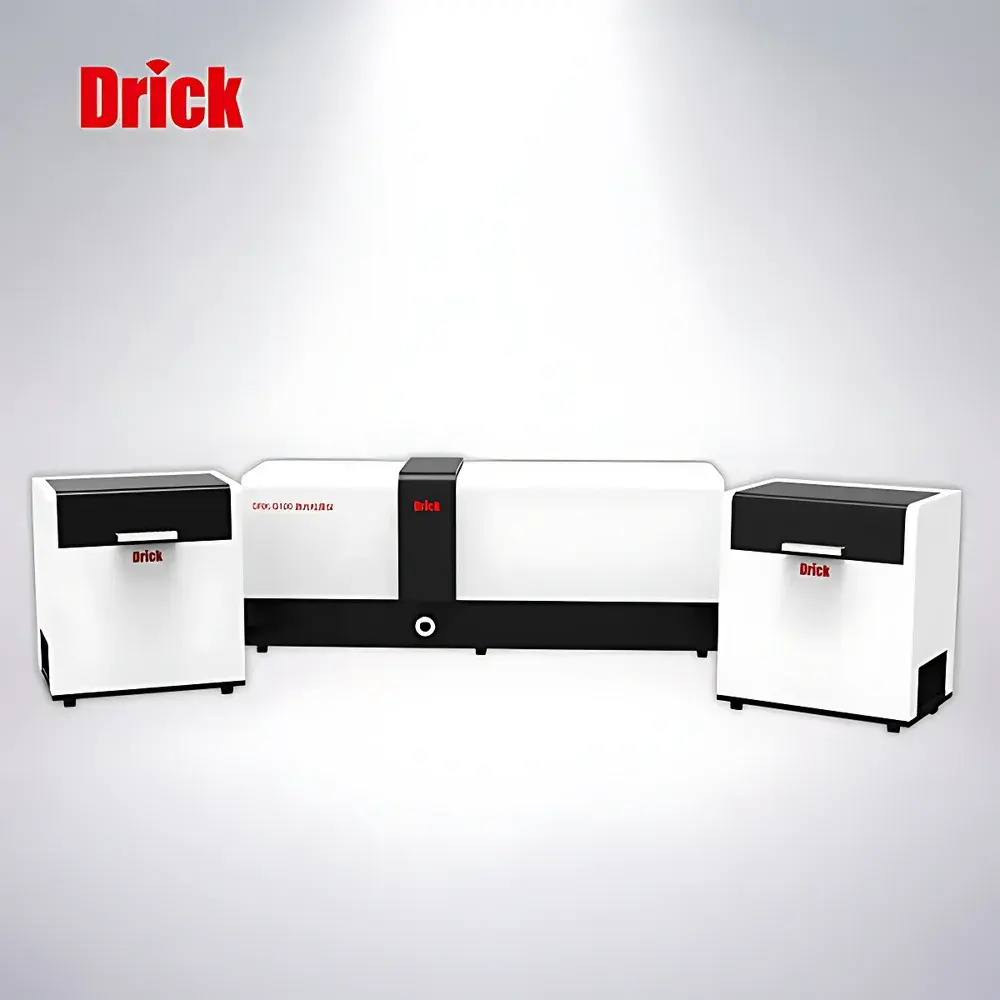
Drick DRK-G100D Dry-Dispersion Laser Particle Size Analyzer
| Brand | Drick |
|---|---|
| Origin | Shandong, China |
| Manufacturer Type | OEM Manufacturer |
| Product Category | Domestic |
| Model | DRK-G100D |
| Dispersion Method | Dry Dispersion |
| Instrument Type | Laboratory Laser Particle Size Analyzer |
| Measurement Range (Dry Mode) | 0.1–1000 µm |
| Repeatability | <1% RSD (verified against national standard reference material, D50) |
Overview
The Drick DRK-G100D is a laboratory-grade dry-dispersion laser particle size analyzer engineered for high-precision, rapid, and reproducible granulometric characterization of free-flowing powders and dry particulate materials. It operates on the principle of Fraunhofer diffraction and Mie scattering theory—automatically selecting the optimal optical model based on sample refractive index input—to deliver robust size distribution data across a wide dynamic range. Designed specifically for environments where solvent-free analysis is mandatory—such as in pharmaceutical dry powder inhaler (DPI) development, catalyst screening, or battery cathode/anode material QC—the DRK-G100D eliminates liquid handling, sedimentation delays, and dispersion medium interference. Its integrated turbulent air jet dispersion system ensures de-agglomeration without mechanical shear, preserving primary particle integrity while achieving stable, representative aerosol generation for optical interrogation.
Key Features
- Optimized dry dispersion module with programmable airflow pressure (0.1–0.6 MPa) and vortex-assisted de-agglomeration to minimize particle breakage and static adhesion
- High-sensitivity dual-lens optical system with 532 nm green laser source and 104-channel photodetector array for enhanced resolution in the submicron and coarse ranges
- Real-time monitoring of dispersion stability via integrated light-scattering intensity feedback loop—automatically halting measurement if signal variance exceeds ±2% over 5 s
- Modular design compliant with ISO 13320:2020 for laser diffraction particle sizing, supporting both volume-based (D10/D50/D90) and surface-area-weighted distributions
- IP54-rated enclosure with ESD-safe housing and grounded sample chamber—suitable for operation in regulated GMP/QC laboratories
- Self-diagnostic optical alignment routine executed at power-on and before each measurement sequence to ensure long-term measurement fidelity
Sample Compatibility & Compliance
The DRK-G100D accommodates a broad spectrum of industrially relevant dry powders—including metal oxides, polymer resins, ceramic precursors, excipients, toners, and food-grade starches—without requiring sonication, surfactants, or centrifugation. Sample mass loading is adjustable from 10 mg to 5 g depending on particle density and optical contrast. The instrument meets essential regulatory prerequisites for analytical instrumentation used in quality control workflows: it supports audit trail generation (user login, parameter changes, report exports), electronic signature capability per FDA 21 CFR Part 11 (when paired with validated software configuration), and full traceability to NIST-traceable particle size standards (e.g., NIST SRM 1963, 2800). All firmware and calibration protocols are documented per GLP/GMP Annex 11 requirements.
Software & Data Management
The proprietary Drick Particle Analysis Suite (v4.2+) provides intuitive workflow-driven operation—from method setup and real-time scatter plot visualization to ISO-compliant reporting. Raw scattering patterns are stored in HDF5 format for reprocessing; batch analysis mode enables comparative statistical evaluation across up to 99 samples with ANOVA-ready export to CSV or Excel. Software modules include SOP template manager, multi-instrument synchronization, and customizable report templates aligned with internal QA documentation standards. Data integrity safeguards include write-protected raw data folders, automatic timestamping, and role-based access control (administrator, analyst, reviewer). Exported reports embed digital signatures and full metadata (instrument ID, calibration date, operator ID, environmental conditions).
Applications
- Pharmaceutical solid dosage form development: excipient flowability assessment, DPI formulation optimization, and blend uniformity verification
- Advanced materials R&D: characterization of nanostructured battery electrode powders, additive manufacturing metal feedstocks, and graphene oxide aggregates
- Quality assurance in fine chemical manufacturing: catalyst particle distribution control, pigment dispersion consistency, and polymer powder melt index correlation
- Environmental particulate monitoring: airborne dust fractionation (PM10/PM2.5 simulation), fly ash morphology correlation, and soil sediment classification
- Academic research: fundamental studies on agglomeration kinetics, electrostatic charging effects on dry dispersion, and fractal dimension estimation from multi-angle scattering residuals
FAQ
What refractive index values should be entered for accurate Mie theory calculation?
Typical default values are provided for common materials (e.g., SiO₂: 1.54 + 0.0i; TiO₂: 2.55 + 0.1i). Users must input literature-validated complex refractive indices for critical applications—especially when analyzing absorbing or anisotropic particles.
Is the DRK-G100D compatible with external vacuum or inert gas purge systems?
Yes—the instrument features dual gas inlet ports (compressed air and auxiliary purge line) and optional O-ring-sealed sample chamber upgrade for operation under nitrogen or argon for moisture-sensitive or pyrophoric materials.
How often does the optical system require recalibration?
Factory calibration is valid for 12 months under normal use. Annual verification using certified PSL or glass microsphere standards (e.g., NIST SRM 1963) is recommended; drift detection is automated during startup diagnostics.
Can the system export data directly to LIMS or ELN platforms?
Yes—via configurable ODBC driver and XML/JSON API interface, enabling seamless integration with major laboratory informatics systems including LabWare LIMS, Thermo Fisher SampleManager, and Dotmatics ELN.
Does the instrument support ASTM D4294 or ISO 8503 surface profile analysis?
No—this is a dedicated laser diffraction particle size analyzer. Surface roughness profiling requires stylus or optical profilometry instrumentation; however, DRK-G100D data may inform downstream surface area estimation via BET correlation models.



