
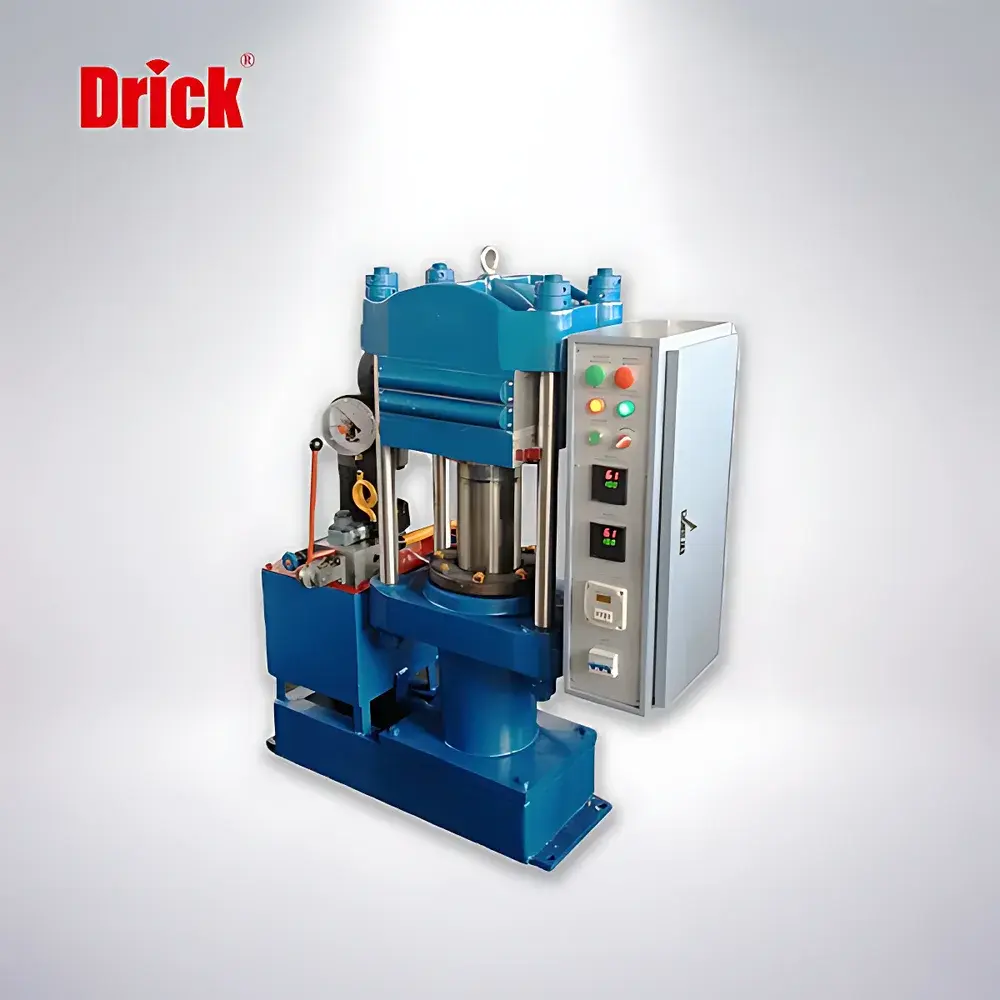
Drick QLB-25T 25-Ton Electrically Heated平板硫化机
| Key | Brand: Drick |
|---|---|
| Origin | Shandong, China |
| Manufacturer Type | Direct Manufacturer |
| Model | QLB-25T |
| Power Supply | 220 V AC |
| Total Clamping Force | 250 kN |
| Max Working Hydraulic Pressure | 14 MPa |
| Plunger Stroke | 250 mm |
| Hot Plate Area | 350 × 350 mm |
| Plunger Diameter | Ø152 mm |
| Hot Plate Layers | 1 |
| Hot Plate Spacing | 125 mm |
| Operating Temperature Range | 0–200 °C (optional up to 300 °C) |
| Heating Method | Electric (6 × tubular heaters, 0.4 kW each, total 2.4 kW per plate) |
| Hydraulic Pump Motor Power | 2.2 kW |
| Total Installed Power | 9.4 kW |
| Machine Weight | 700 kg |
| Compliance Standard | GB/T 25155–2010 |
Overview
The Drick QLB-25T is a precision-engineered, single-layer electrically heated hydraulic press designed specifically for vulcanization of rubber compounds and compression molding of thermosetting plastics. It operates on the principle of controlled thermal and mechanical energy application: heat is uniformly distributed across the hot plate surface via six asymmetrically spaced tubular heating elements, while hydraulic pressure—generated by a dedicated 100/6 gear pump driven by a 2.2 kW motor—is applied vertically in a downward-closing column-type configuration. This architecture ensures stable clamping force delivery (250 kN nominal), minimal thermal drift, and high repeatability in crosslinking kinetics during curing cycles. Unlike steam-heated alternatives, the QLB-25T eliminates boiler dependency, reducing ambient emissions and simplifying facility integration—making it suitable for ISO 14001-aligned production environments and GLP-compliant laboratory-scale process validation.
Key Features
- Column-type rigid frame with four vertical guide columns and precision-machined plunger assembly (Ø152 mm), ensuring parallelism and load uniformity across the 350 × 350 mm hot plate surface.
- Electric heating system with six independently rated tubular elements (0.4 kW each, total 2.4 kW per plate), arranged in non-uniform spacing to compensate for radial thermal gradients—achieving ±1.5 °C temperature uniformity across the plate at steady state (measured per GB/T 25155–2010 Annex B).
- Dedicated hydraulic power unit with N32/N46-grade hydraulic oil compatibility, integrated 100/6 gear pump, magnetic starter with built-in overload protection, and isolated oil reservoir mounted left of main frame to minimize thermal coupling with hot plates.
- Modular electrical control cabinet (mounted right of main frame) housing dual-function controls: motor start/stop sequencing, solenoid valve actuation for directional flow control, and PID-based temperature regulation with digital setpoint display.
- No-pressure-drop design: sealed hydraulic circuit with low-noise pump operation (<68 dB(A)), leak-tested cylinder seals, and pressure-hold capability verified over 30-minute dwell cycles at maximum rated load.
Sample Compatibility & Compliance
The QLB-25T accommodates standard ASTM D5335, ISO 34-1, and GB/T 528 test specimens—including dumbbell-shaped tensile bars, compression discs, and molded O-rings—as well as custom molds up to 350 × 350 mm footprint. Its 125 mm inter-plate clearance allows multi-layer mold stacks or auxiliary tooling fixtures. The machine conforms to GB/T 25155–2010 “Specifications for Rubber Vulcanizing Presses”, including requirements for structural safety margins (≥1.5× rated load), thermal stability verification, and emergency stop response time (<0.5 s). While not CE-marked out-of-box, its electrical architecture complies with IEC 60204-1 fundamentals; optional CE conversion kits—including EN 61000-6-2/6-4 EMC shielding and dual-channel safety relays—are available upon request for EU deployment.
Software & Data Management
The base configuration includes analog temperature monitoring and manual pressure actuation. For traceable process documentation, an optional RS-485 interface enables connection to third-party SCADA systems (e.g., Ignition, Siemens SIMATIC WinCC) or custom LabVIEW-based data loggers. When paired with external PT100 sensors and pressure transducers, users may record time-stamped cure profiles (temperature vs. time, pressure vs. time) aligned with ASTM D5289 and ISO 6502 cure curve standards. Audit trails—including operator ID, cycle timestamp, setpoint deviations, and thermal soak duration—can be exported in CSV format for FDA 21 CFR Part 11–compliant review when deployed under quality management systems (QMS) such as ISO 9001 or IATF 16949.
Applications
- Vulcanization of natural rubber (NR), styrene-butadiene rubber (SBR), ethylene propylene diene monomer (EPDM), and nitrile rubber (NBR) formulations for automotive seals, conveyor belts, and vibration isolators.
- Compression molding of phenolic, melamine, and urea-formaldehyde resins used in electrical insulators, appliance housings, and decorative laminates.
- Preform consolidation and crosslinking validation in R&D labs—supporting Mooney viscosity correlation studies, scorch time (ts1/ts2) determination, and optimal cure time (t90) mapping per ASTM D1646 and ISO 289.
- Small-batch production of medical-grade silicone components under controlled thermal ramp rates (0.5–5 °C/min), meeting USP Class VI biocompatibility preprocessing requirements.
FAQ
What is the maximum recommended operating temperature for continuous use?
The standard configuration supports sustained operation up to 200 °C; optional high-temp insulation and upgraded gasket materials extend validated performance to 300 °C for specialized elastomers.
Does the machine support programmable multi-step cure cycles?
Not natively—but with the optional digital controller upgrade (part no. QLB-DCU-25T), users can define up to 5 segmented ramp/soak profiles with independent pressure hold triggers.
What maintenance intervals are specified for hydraulic oil replacement?
Per GB/T 25155–2010, hydraulic oil must be filtered through a 100-mesh (150 µm) screen before initial fill and replaced every 1,500 operational hours or annually—whichever occurs first—with particle count analysis recommended after 500 hours.
Can the QLB-25T be integrated into an automated production line?
Yes—via dry-contact I/O signals (start, stop, cycle complete, fault) and Modbus RTU protocol support on the optional controller module, enabling synchronization with PLCs and robotic part handling systems.
Is calibration certification included with shipment?
A factory-verified pressure and temperature calibration report (traceable to CNAS-accredited standards) is provided; full ISO/IEC 17025 calibration services are available as a post-purchase option.






