
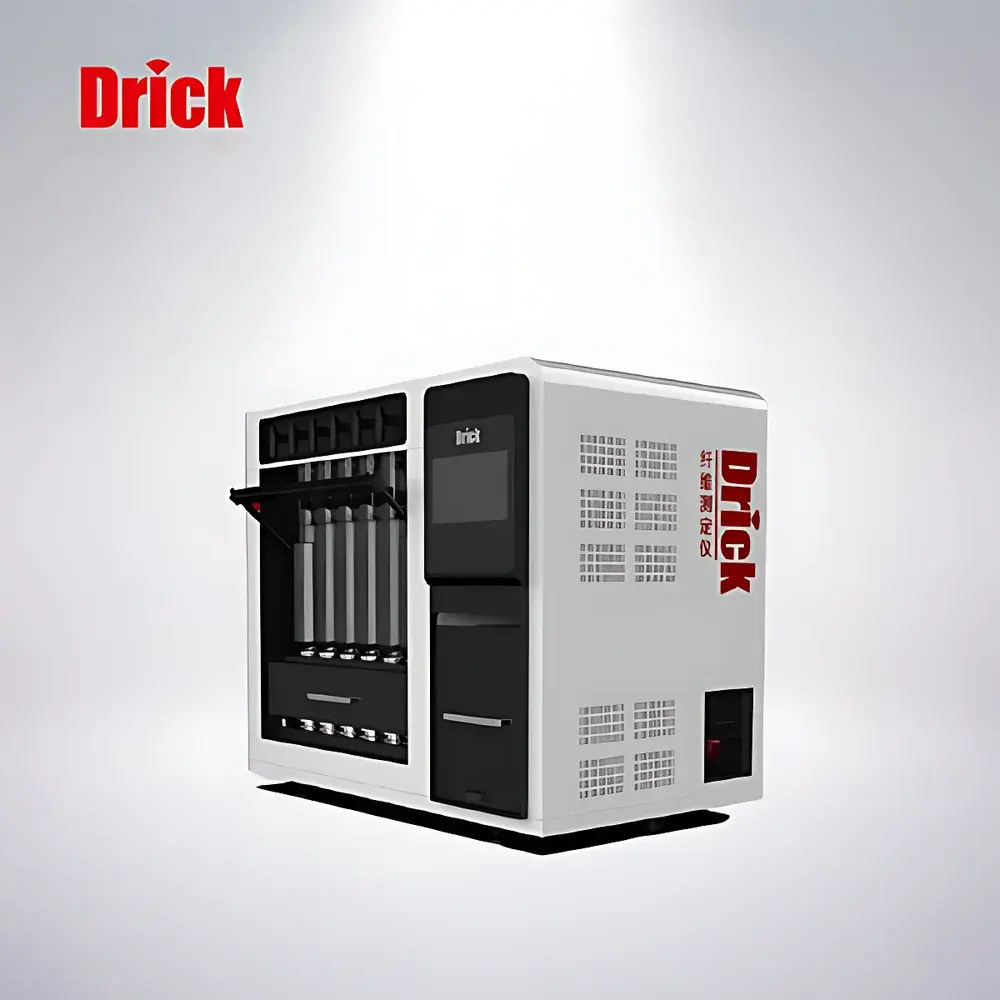
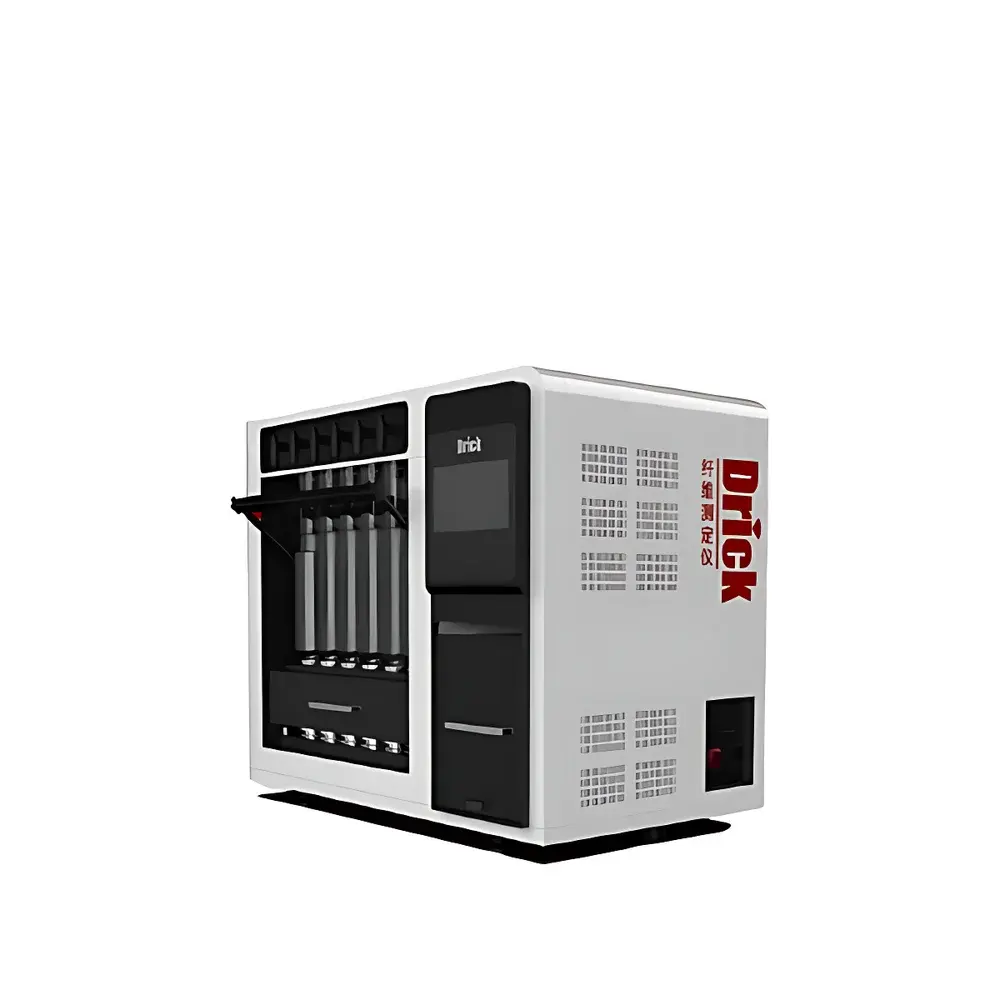
Drick DRK-F416 Van Soest Fiber Analyzer (Weende & Sequential Detergent Method)
| Brand | Drick |
|---|---|
| Origin | Shandong, China |
| Manufacturer Type | Direct Manufacturer |
| Country of Origin | China |
| Model | DRK-F416 |
| Power Rating | 2.2 kW |
| Voltage | 220 V AC ±10%, 50 Hz |
| Dimensions (L×W×H) | 776 × 476 × 644 mm |
| Sample Weight Range | 0.5–3 g |
| Measurement Range | 0.1–100% |
| Repeatability Error | ≤0.4% (for crude fiber <10%) |
| Batch Capacity | 6 samples |
| Distilled Water Preheating Time | 10–12 min |
| Boiling Duration | 13–15 min |
| Standard Crucible Set | 5 sizes included |
| Optional Accessory | Cold Extraction Unit |
Overview
The Drick DRK-F416 Van Soest Fiber Analyzer is a semi-automated sequential detergent fiber analysis system engineered for precision and regulatory compliance in animal nutrition, feed quality control, and agricultural research laboratories. It implements the classical Weende method for crude fiber determination and the standardized Van Soest (sequential detergent) methodology for fractionating neutral detergent fiber (NDF), acid detergent fiber (ADF), acid detergent lignin (ADL), cellulose, hemicellulose, and residual ash. The instrument operates on gravimetric principles following controlled acid/base hydrolysis, filtration, drying, and incineration steps—fully aligned with AOAC Official Methods 973.18 and 2002.04, as well as ISO 6865:2000 and GB/T 5515–2022 (determination of crude fiber in cereals and cereal products) and GB/T 6434–2022 (determination of crude fiber in feed). Its integrated infrared crucible heating architecture ensures rapid, uniform thermal transfer across all six sample positions, minimizing inter-sample variability and enhancing analytical reproducibility.
Key Features
- Embedded microcontroller-based temperature regulation system with ±0.5 °C stability across all heating zones during digestion cycles.
- Front-access solvent reservoir drawer design eliminates overhead reagent refilling—reducing operator exposure to hot surfaces and corrosive reagents (e.g., H₂SO₄, NaOH, neutral/acid detergent solutions).
- Chemical-isolated waste evacuation path: no peristaltic or diaphragm pump contacts aggressive solvents—extending service life and reducing maintenance frequency.
- Automated crucible backflush function prevents filter clogging during vacuum-assisted filtration, ensuring consistent flow rates and complete residue recovery.
- Overflow prevention logic integrated into liquid dispensing control—halts delivery if fill level exceeds safe threshold, mitigating splash hazards and protecting personnel from acid/base splashes.
- Adjustable crucible heating power (20–100% range) enables optimization of digestion kinetics for diverse matrices (e.g., high-lignin forages vs. low-fiber grains).
- Built-in preheating mode reduces total cycle time by initiating thermal ramping prior to sample loading—cutting average assay duration by ~18% compared to conventional start-from-cold protocols.
- Five standard crucible sizes (25–60 mL volume range) accommodate heterogeneous particulate samples—from finely ground alfalfa hay to coarse corn silage.
- Infrared monolithic heating elements deliver radial thermal symmetry to each crucible, eliminating hot-spot formation and improving digestibility consistency (CV <2.1% for replicate NDF assays).
Sample Compatibility & Compliance
The DRK-F416 supports solid, dry, and milled biological matrices including but not limited to: alfalfa meal, soybean hulls, wheat straw, distillers’ dried grains (DDGS), pet food formulations, bakery by-products, and botanical extracts. All digestion protocols conform to GLP documentation requirements, with timestamped event logs covering reagent addition, heating phase initiation, boiling duration, filtration onset, and final drying. Instrument validation reports include traceable calibration against NIST-traceable thermocouples and certified reference materials (CRM) such as NIST SRM 1846 (Animal Feed) for interlaboratory verification. Data output complies with FDA 21 CFR Part 11 readiness when paired with optional audit-trail-enabled software modules.
Software & Data Management
The embedded control interface provides real-time monitoring of temperature, elapsed time, and step status via a 7-inch TFT LCD. Experimental parameters—including digestion times, heating profiles, and rinse volumes—are user-configurable and stored in non-volatile memory (≥10,000 method presets). USB export enables CSV-formatted raw data transfer for integration into LIMS environments or statistical analysis platforms (e.g., JMP, R, SAS). Optional PC-based software offers electronic lab notebook (ELN) functionality, automated report generation (PDF/Excel), and full audit trail capability—including user login tracking, parameter change history, and electronic signature support for QA/QC sign-off.
Applications
- Determination of crude fiber content in compound feeds and premixes per GB/T 6434–2022 and AOAC 967.08.
- Sequential extraction of NDF, ADF, ADL, cellulose, and hemicellulose for ruminant nutritional modeling (NRC 2001, CNCPS v6.5).
- Quality assessment of forage crops during harvest scheduling and storage evaluation.
- Regulatory testing of pet food fiber claims under AAFCO guidelines.
- Research into dietary fiber structure–function relationships in functional food development.
- Validation of enzymatic fiber hydrolysis protocols prior to HPLC or GC-MS carbohydrate profiling.
FAQ
Does the DRK-F416 comply with AOAC and ISO fiber analysis standards?
Yes—it fully supports AOAC 973.18 (NDF), 2002.04 (ADF), and ISO 6865:2000 through hardware-controlled digestion timing, temperature fidelity, and gravimetric workflow integrity.
Can the system perform cold solvent extraction prior to fiber digestion?
When equipped with the optional Cold Extraction Unit, it enables Soxhlet-free lipid removal using petroleum ether or hexane at ambient or chilled temperatures—critical for high-fat samples like distillers’ grains or oilseed meals.
Is method validation documentation available?
Drick supplies a Factory Acceptance Test (FAT) report, temperature uniformity mapping data, repeatability study results (n=6 per CRM), and a traceable calibration certificate for all critical sensors.
What maintenance intervals are recommended for long-term reliability?
Crucible heating elements require annual resistance verification; solvent lines should be flushed weekly with deionized water; and IR emitter alignment should be checked every 6 months using supplied alignment jig.
How is data integrity ensured during multi-user operation?
Each user account is assigned unique credentials; all method modifications and run executions are logged with timestamps, IP addresses (if networked), and operator IDs—enabling full forensic reconstruction per 21 CFR Part 11 §11.10(e).




