
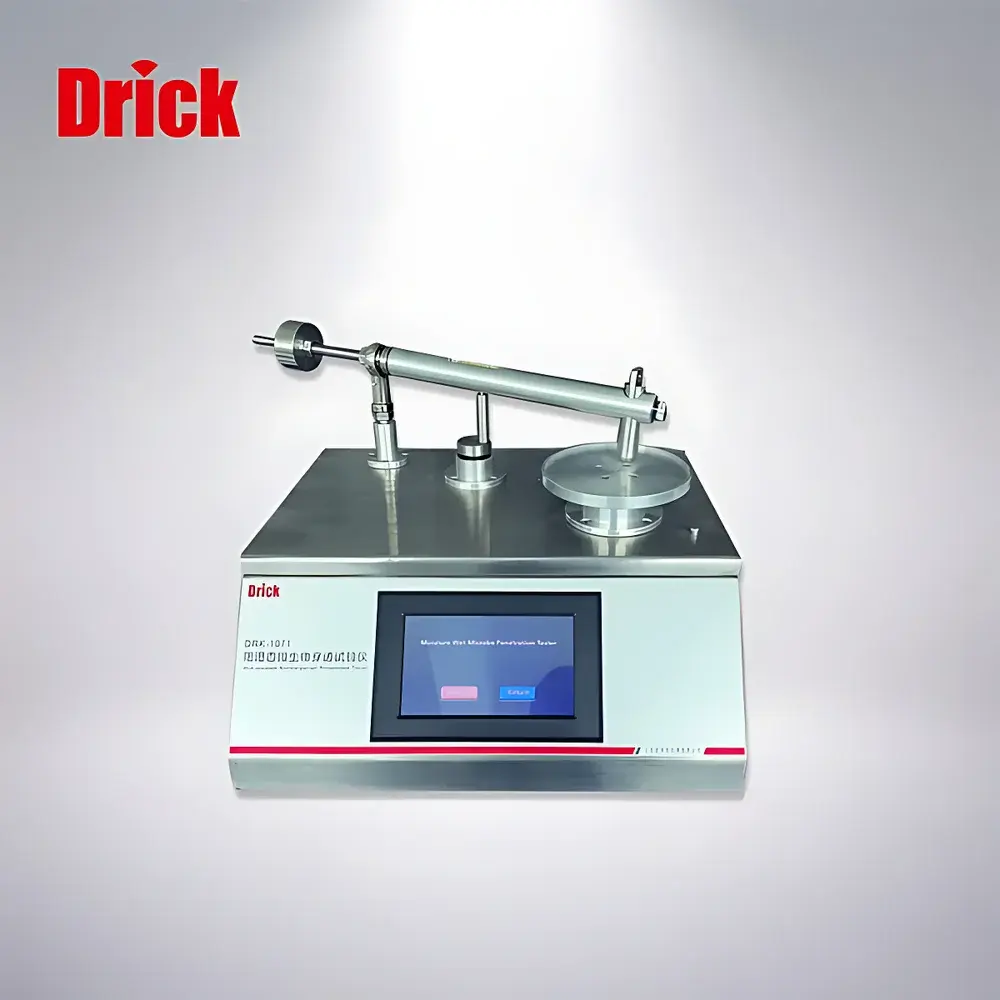
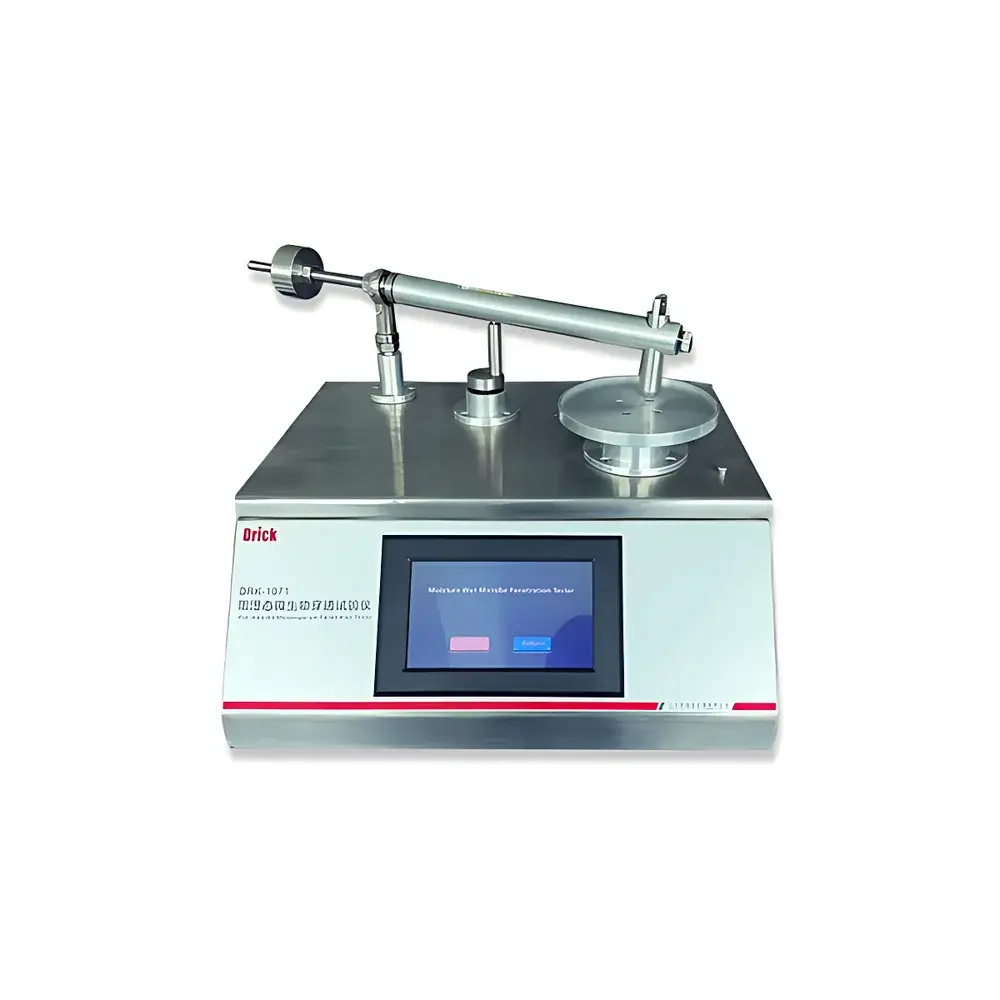
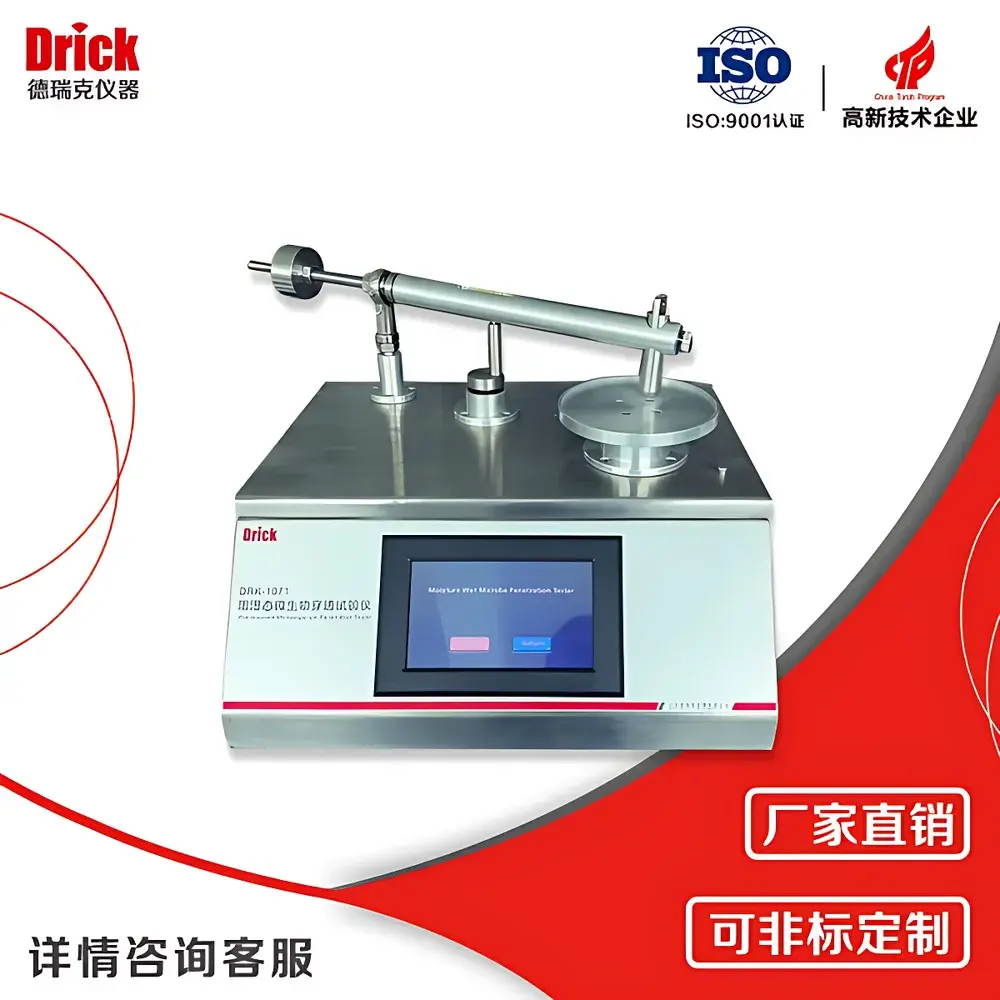
Drick DRK-1071 Wet-State Microbial Penetration Tester for Medical Cleanroom Garments
| Brand | Drick |
|---|---|
| Origin | Shandong, China |
| Manufacturer Type | Direct Manufacturer |
| Country of Origin | China |
| Model | DRK-1071 |
| Price | Upon Request |
| Display | Color Touchscreen Interface |
| Rotation Speed | 60 rpm ±1 rpm |
| Applied Force | 3 N ±0.02 N |
| Outer Wheel Speed | 5–6 rpm |
| Timer Range | 0–99.99 min |
| Weighted Mass (Inner + Outer Ring) | 800 g ±1 g |
| Dimensions (W×D×H) | 460 × 400 × 350 mm |
| Net Weight | 30 kg |
Overview
The Drick DRK-1071 Wet-State Microbial Penetration Tester is a precision-engineered instrument designed to evaluate the barrier performance of medical protective textiles—including surgical gowns, drapes, and cleanroom garments—against bacterial penetration under wet-state mechanical stress conditions. It operates in strict accordance with the biophysical principle of simulated mechanical abrasion coupled with liquid-borne microbial challenge, replicating real-world clinical scenarios where fabrics are subjected to friction while contaminated with microbial suspensions. The test method is grounded in controlled rotational motion of a standardized agar plate beneath a dynamically loaded, laterally oscillating test finger, enabling quantitative assessment of microorganism transmission through fabric specimens under hydrated, pressure-applied conditions. This methodology directly supports regulatory evaluation of barrier integrity as required for ISO 13485-certified manufacturing and FDA-listed Class I/II medical devices.
Key Features
- High-resolution color touchscreen interface with intuitive navigation and real-time parameter monitoring—enabling seamless setup, execution, and status tracking without external software dependency.
- Low-noise, brushless DC motor-driven turntable ensuring stable 60 rpm ±1 rpm rotation with minimal vibration, critical for reproducible mechanical loading across repeated test cycles.
- Laterally reciprocating test finger guided by a precision-machined outer wheel rotating at 5–6 rpm, delivering consistent radial displacement from center to periphery of the agar surface during each revolution.
- Adjustable vertical loading mechanism calibrated to apply a precisely controlled force of 3 N ±0.02 N—traceable to national metrological standards—to simulate clinically relevant contact pressure between garment and skin or equipment.
- Fully stainless-steel construction (AISI 304) for all wet-contact components—including turntable, test finger assembly, and weighted ring system—ensuring long-term corrosion resistance against saline, nutrient broth, and disinfectant residues.
- Programmable digital timer with 0.01-minute resolution (0–99.99 min), supporting both single-cycle and multi-stage protocols aligned with YY/T 0506.6-2009 and ISO 22610:2018 Annex A requirements.
Sample Compatibility & Compliance
The DRK-1071 accommodates flat textile specimens up to 150 mm in diameter, compatible with nonwoven, woven, laminated, and coated barrier materials used in ASTM F1670/F1671-compliant surgical apparel. Test configurations comply fully with YY/T 0506.6-2009 (Chinese national standard for patient and healthcare personnel protective apparel) and ISO 22610:2018 (international standard for evaluating resistance to wet bacterial penetration). All mechanical parameters—including rotational speed, applied load, lateral stroke profile, and timing resolution—are validated against the normative test procedures defined in Clause 6 of ISO 22610:2018. Instrument calibration documentation supports GLP-compliant laboratory audits and satisfies traceability requirements under ISO/IEC 17025:2017 for testing laboratories.
Software & Data Management
While the DRK-1071 operates as a standalone hardware platform with embedded firmware, its operational parameters are fully configurable and digitally logged via internal non-volatile memory. Each test run stores timestamped records of setpoints (force, duration, speed), operator ID (via alphanumeric input), and pass/fail status based on colony-forming unit (CFU) counts observed post-incubation. Export functionality supports USB-based retrieval of CSV-formatted test logs for integration into LIMS or QMS platforms. Audit trail features include immutable event timestamps, user access logs, and change history for critical parameters—meeting baseline data integrity expectations under FDA 21 CFR Part 11 for electronic records in regulated environments.
Applications
- Validation of barrier efficacy for ISO 13485-certified surgical gown manufacturers prior to market release.
- Quality control screening of incoming raw materials (e.g., SMS nonwovens, polyethylene-coated substrates) in cleanroom garment production lines.
- Comparative evaluation of new hydrophobic coatings or plasma-treated surfaces intended to enhance wet-state microbial resistance.
- Root cause analysis of field-reported barrier failures in sterile processing departments or operating rooms.
- Supporting technical dossiers for CE marking submissions under MDR Annex II, particularly for Class I reusable drapes and Class IIa surgical gowns.
FAQ
What microbiological agents are recommended for use with the DRK-1071?
Staphylococcus aureus ATCC 6538 or Klebsiella pneumoniae ATCC 4352 are specified in ISO 22610:2018; suspension concentrations must be prepared to yield 1 × 10⁶ CFU/mL in tryptic soy broth with 0.1% Tween 80.
Is the DRK-1071 suitable for dry-state microbial penetration testing?
No—this instrument is specifically engineered for wet-state evaluation per ISO 22610. Dry-state testing requires alternative apparatus compliant with ISO 22611 or ASTM F1671.
Can test parameters be modified beyond the standard 3 N load or 60 rpm speed?
Yes—while default settings align with ISO 22610, the instrument allows manual override for R&D investigations; deviations must be justified and documented per internal SOPs and referenced in final test reports.
Does the system include agar plate temperature control?
No—the DRK-1071 does not regulate agar temperature; users must pre-condition plates to 35 ±2 °C prior to placement on the turntable, as specified in Clause 7.3 of ISO 22610:2018.
What maintenance intervals are recommended for long-term accuracy?
Monthly verification of applied force using certified deadweight standards and annual calibration of rotational speed and timer accuracy by an ISO/IEC 17025-accredited service provider are advised.






