
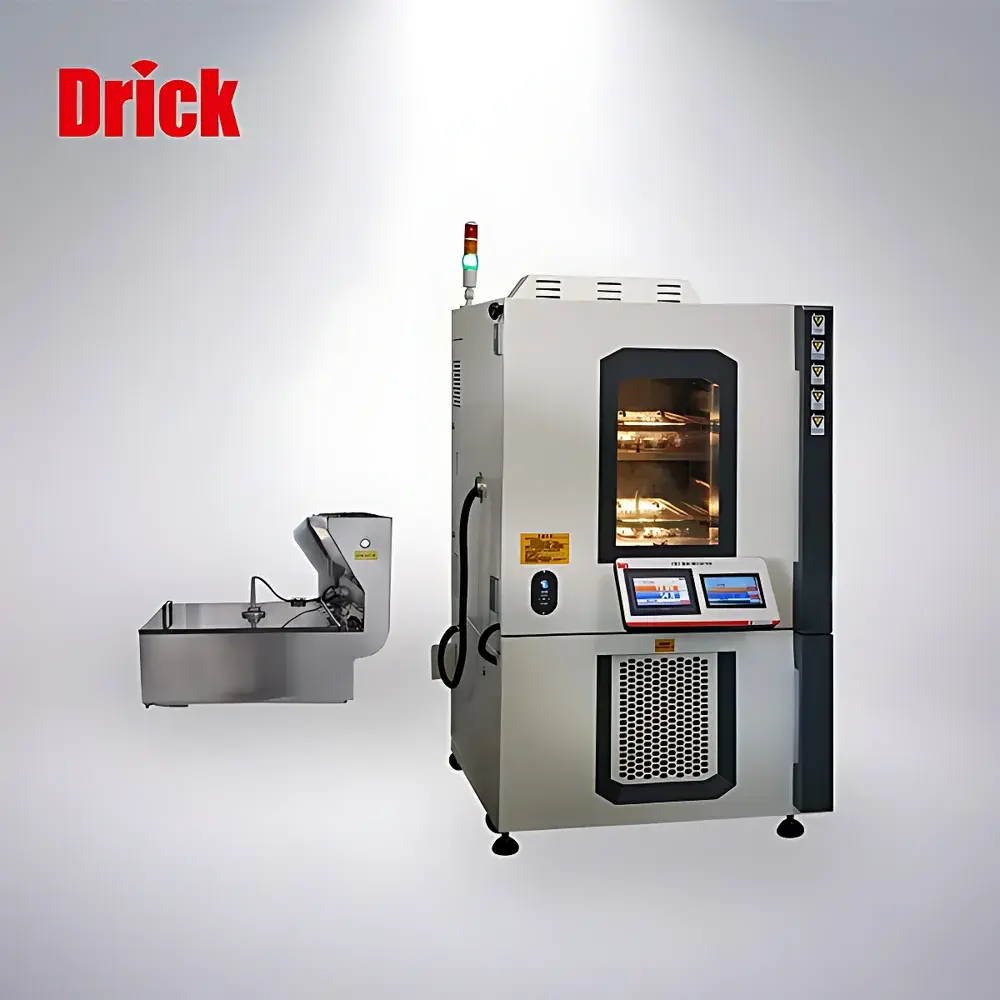


Drick DRK258B Textile Thermal and Moisture Resistance Testing System
| Brand | Drick |
|---|---|
| Origin | Shandong, China |
| Manufacturer Type | OEM/ODM Producer |
| Country of Origin | China |
| Model | DRK258B |
| Price | USD 7,000 (FOB Qingdao) |
| Climate Chamber Dimensions (L×W×H) | 630 × 660 × 800 mm |
| Temperature Range & Accuracy | 15–48 °C ±0.1 °C |
| Humidity Range & Accuracy | 30–95 %RH ±2 %RH |
| Controlled Test Conditions | 20 °C ±0.1 °C / 65 %RH ±3 %RH (for thermal resistance) |
| Air Velocity Control Range & Accuracy | 0–2 m/s ±0.05 m/s |
| Specimen Platform Vertical Travel & Accuracy | 0–70 mm ±0.1 mm (motorized) |
| Thermal Resistance Range/Resolution/Accuracy | 0–2 m²·K/W / 0.0001 m²·K/W / ≤±2 % |
| Repeatability (Rct) | ≤±2 % |
| Moisture Resistance Range/Resolution/Accuracy | 0–1000 m²·Pa/W / 0.01 m²·Pa/W / ≤±2 % |
| Repeatability (Ret) | ≤±2 % |
| Heated Plate Temperature Range & Accuracy | 20–50 °C ±0.1 °C |
| Heated Plate Dimensions | 254 × 254 mm |
| Specimen Thickness Capacity | 0–70 mm |
| Overall Dimensions (L×W×H) | 1000 × 750 × 1800 mm |
| Power Supply | AC 220 V, 4 kW |
| Net Weight | 300 kg |
Overview
The Drick DRK258B Textile Thermal and Moisture Resistance Testing System is a precision-engineered instrument designed for the quantitative evaluation of thermal insulation (Rct) and evaporative resistance (Ret) in textiles, garments, bedding assemblies, and multilayer fabric composites. It operates on the principle of guarded hot-plate calorimetry under controlled environmental conditions—simulating human skin heat and moisture transfer behavior in standardized climatic chambers. The system conforms to internationally recognized test methodologies including ISO 11092:2014 (E), GB/T 11048–2018, and ASTM F1868–22, enabling laboratories to generate data suitable for regulatory submissions, product development validation, and comparative performance benchmarking across global supply chains.
Key Features
- High-stability climate chamber with dual independent PID control loops for temperature (15–48 °C ±0.1 °C) and relative humidity (30–95 %RH ±2 %RH), ensuring reproducible test environments per ISO 11092 Annex A.
- Motorized, precision-positioned specimen platform (0–70 mm travel ±0.1 mm) that dynamically adjusts vertical distance between the heated plate and sample surface—critical for maintaining consistent air gap geometry during Rct and Ret measurements.
- Uniform laminar airflow generation (0–2 m/s ±0.05 m/s) over the test surface via calibrated axial fan and flow straightening grid, meeting the boundary condition requirements specified in ASTM F1868 for convective heat/mass transfer simulation.
- 254 mm × 254 mm stainless-steel heated plate with embedded platinum RTD sensors and closed-loop temperature regulation (20–50 °C ±0.1 °C), delivering stable thermal flux and minimizing edge effects.
- Dual-range high-resolution transducers: thermal resistance measurement from 0 to 2 m²·K/W (resolution 0.0001 m²·K/W), moisture resistance from 0 to 1000 m²·Pa/W (resolution 0.01 m²·Pa/W), both with certified accuracy ≤±2 % and repeatability ≤±2 % (n≥10).
- Integrated safety interlocks, overtemperature cutoffs, and real-time fault diagnostics compliant with IEC 61000-6-2/6-4 EMC standards and CE machinery directive requirements.
Sample Compatibility & Compliance
The DRK258B accommodates flat textile specimens up to 70 mm thick—including knits, wovens, nonwovens, laminates, and layered garment systems—without requiring cutting or mounting fixtures beyond standard clamping. Its modular chamber design supports full-size garment testing when used with optional anthropomorphic manikin adapters (sold separately). All operational parameters and calibration procedures are traceable to NIST-traceable reference standards and documented in accordance with ISO/IEC 17025:2017 laboratory accreditation requirements. Data output formats comply with GLP audit trails and support 21 CFR Part 11–ready electronic signatures when integrated with validated LIMS platforms.
Software & Data Management
The system ships with proprietary Windows-based control software featuring real-time graphical monitoring of chamber T/RH, plate temperature, air velocity, and dynamic Rct/Ret convergence curves. Raw sensor data is logged at 10 Hz with timestamped metadata (operator ID, sample ID, test method, environmental setpoints). Export options include CSV, XML, and PDF reports pre-formatted to match ISO 11092 reporting templates. Audit logs record all user actions—including parameter modifications, calibration events, and report generation—with immutable timestamps. Optional API integration enables bidirectional communication with enterprise QMS systems (e.g., MasterControl, TrackWise) for automated CAPA linkage and trending analysis.
Applications
- Performance validation of outdoor apparel (e.g., insulated jackets, rain shells) against EN 342 and ISO 15371 thermal protection criteria.
- R&D of moisture-wicking base layers and sportswear fabrics targeting low Ret values (<60 m²·Pa/W) under ASTM F1868 Condition B (35 °C / 40 %RH).
- Quality assurance of medical gowns, surgical drapes, and protective workwear per ISO 20471 and ASTM F2878 barrier performance specifications.
- Comparative assessment of sustainable textile innovations—such as bio-based insulation fillings or phase-change material (PCM)-integrated weaves—against baseline synthetic counterparts.
- Supporting certification workflows for OEKO-TEX® Standard 100, bluesign®, and Higg Index Material Sustainability Index (MSI) scoring.
FAQ
What standards does the DRK258B fully support out-of-the-box?
It natively implements test protocols defined in ISO 11092:2014, GB/T 11048–2018, and ASTM F1868–22, including automatic switching between thermal resistance (Rct) and evaporative resistance (Ret) modes with preconfigured environmental setpoints.
Is external calibration required before first use?
Yes—initial verification must be performed using NIST-traceable reference materials (e.g., standard insulating foams for Rct, hydrophilic membranes for Ret) prior to routine operation. Annual recalibration is recommended per ISO/IEC 17025 guidelines.
Can the system test finished garments—not just fabric swatches?
Yes, provided the garment is mounted on a compatible thermal manikin or placed flat within the chamber footprint. Optional garment-mounting frames and manikin interface kits are available upon request.
Does the software meet FDA 21 CFR Part 11 requirements?
The base software includes electronic signature capability, audit trail logging, and role-based access control. Full Part 11 compliance requires site-specific validation documentation and integration with a qualified electronic records management system.
What maintenance intervals are recommended for long-term accuracy?
Daily: visual inspection of air filters and chamber seals. Quarterly: verification of RTD sensor drift and airflow calibration. Annually: full metrological recalibration by an accredited service provider with certificate of conformance.





