
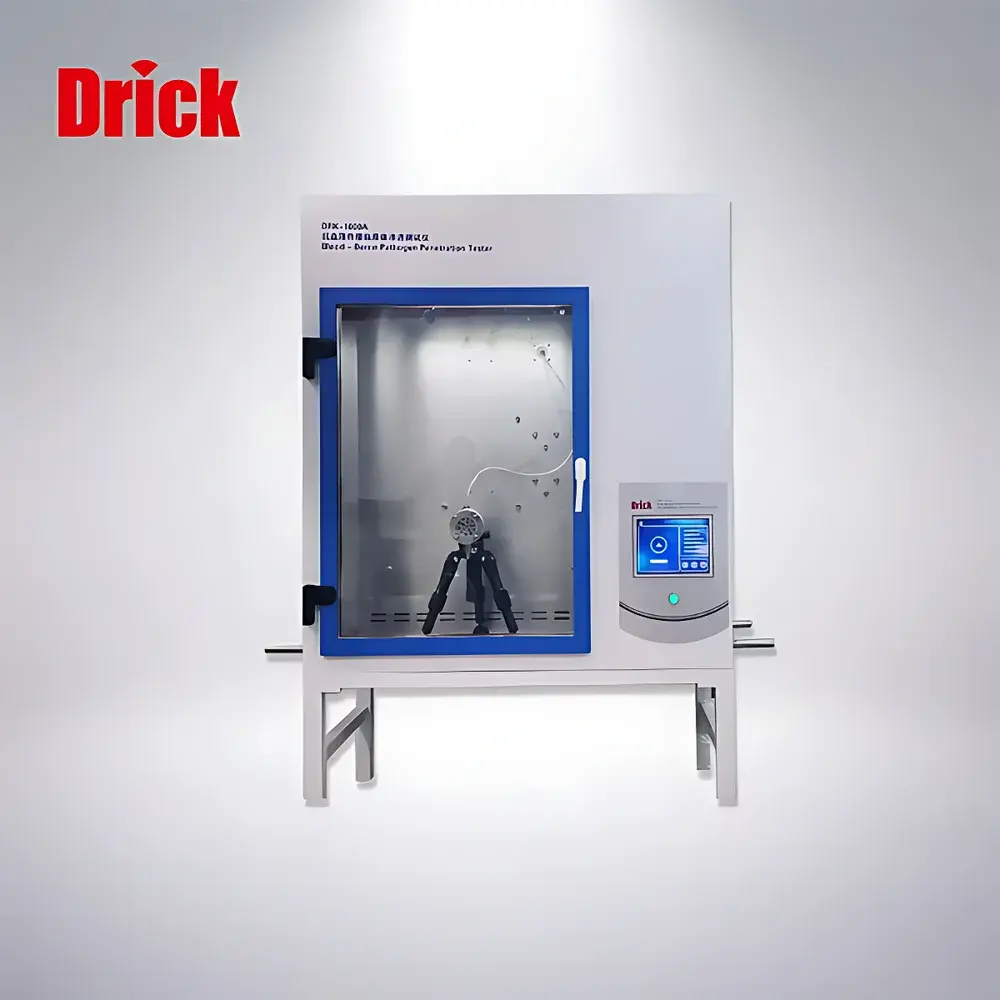
Drick DRK-1000A Bloodborne Pathogen Penetration Tester for Protective Apparel
| Brand | Drick |
|---|---|
| Origin | Shandong, China |
| Manufacturer Type | Direct Manufacturer |
| Country of Origin | China |
| Model | DRK-1000A |
| Price | USD 7,000 (approx.) |
| Power Supply | AC 220 V, 50 Hz |
| Rated Power | 250 W |
| Test Specimen Size | 75 mm × 75 mm |
| Clamp Torque | 13.6 N·m |
| Pressurized Area | 28.27 cm² |
| Negative Pressure Range | −50 to −200 Pa |
| HEPA Filtration Efficiency | >99.99% |
| Cabinet Airflow Volume | ≥5 m³/min |
| Data Storage Capacity | 5,000 test records |
| Dimensions (Main Unit) | 1180 mm (L) × 650 mm (W) × 1300 mm (H) |
| Adjustable Stand Height Range | ±100 mm from 600 mm base |
| Net Weight | ~150 kg |
| Compliance | ASTM F1670-1995, ASTM F1671-1996, ISO 16603:2004, ISO 16604:2004 |
Overview
The Drick DRK-1000A Bloodborne Pathogen Penetration Tester is a purpose-built, regulatory-compliant instrument engineered for quantitative evaluation of liquid barrier performance in personal protective equipment (PPE), specifically medical gowns, coveralls, gloves, boot covers, and surgical drapes. It operates on the principle of hydrostatic pressure challenge under controlled negative-pressure containment, simulating real-world exposure to blood, synthetic blood, and viral surrogates (e.g., Phi-X174 bacteriophage) as defined in ASTM F1671 and ISO 16604. Unlike generic hydrostatic head testers, the DRK-1000A integrates a fully sealed negative-pressure cabinet with certified HEPA filtration, enabling safe handling of biohazardous challenge agents while maintaining operator biosafety at Biosafety Level 2 (BSL-2) equivalence. Its design conforms to internationally recognized test protocols for assessing resistance to penetration by bloodborne pathogens—including HIV, HBV, and HCV—through textile and laminated barrier materials.
Key Features
- Fully enclosed negative-pressure test chamber with adjustable vacuum range (−50 to −200 Pa) and ≥5 m³/min airflow, ensuring consistent environmental control during testing.
- Integrated dual-stage HEPA filtration system (≥99.99% efficiency at 0.3 µm) on both intake and exhaust pathways, meeting ISO 14644-1 Class 5 cleanroom air requirements within the operator zone.
- Automated pressure regulation system using high-accuracy imported piezoresistive pressure sensors (±0.5% FS full-scale accuracy), eliminating manual calibration drift and ensuring reproducible challenge pressure application.
- Stainless-steel penetration test cell with precision-machined clamping mechanism (13.6 N·m torque) and 28.27 cm² standardized test area, minimizing edge leakage and specimen deformation during pressurization.
- Industrial-grade 10.1-inch capacitive touchscreen HMI with intuitive GUI, supporting multi-language interface (English default), real-time pressure curve visualization, and pass/fail threshold configuration per ASTM/ISO criteria.
- Onboard data logging with non-volatile memory (5,000 test records), USB export capability (CSV format), and timestamped audit trail including operator ID, test parameters, and environmental metadata.
- Dual-layer cabinet construction: inner 304 stainless steel monolithic weldment + outer powder-coated cold-rolled steel, with fire-retardant thermal insulation between layers per UL 94 V-0 rating.
- Integrated safety systems including residual-current circuit breaker (RCCB), LED task lighting (500 lux at test surface), and interlocked access door with automatic vacuum cutoff.
Sample Compatibility & Compliance
The DRK-1000A accommodates flat, non-stretchable specimens measuring 75 mm × 75 mm—standardized per ASTM F1670 and ISO 16603. Compatible sample types include woven/nonwoven fabrics, SMS laminates, microporous films, coated textiles, and composite barrier materials used in ASTM Level 1–4 gowns and isolation apparel. The system supports challenge agents specified in major regulatory frameworks: synthetic blood (ASTM F1670), Phi-X174 bacteriophage suspension (ASTM F1671), and surrogate viral particles per ISO 16604. All mechanical and environmental performance metrics are traceable to national metrology standards (CNAS-accredited calibration). The instrument satisfies essential requirements of FDA 21 CFR Part 820 (QSR), EU MDR Annex I General Safety and Performance Requirements (GSPR), and ISO 13485:2016 clause 7.6 (monitoring and measuring equipment control).
Software & Data Management
The embedded firmware implements deterministic real-time control with 100 ms sampling resolution for pressure transients. Data files comply with ALCOA+ principles (Attributable, Legible, Contemporaneous, Original, Accurate, Complete, Consistent, Enduring, Available) and support 21 CFR Part 11 compliance when paired with optional network-enabled PC software (sold separately). Exported CSV logs include column headers aligned with ISO/IEC 17025 reporting requirements: test ID, date/time, operator code, material ID, challenge agent concentration, applied pressure (kPa), duration (s), visual penetration observation (pass/fail), and digital image capture timestamp (if external camera integrated). Audit trails are immutable and cannot be edited or deleted without system administrator privileges.
Applications
- Quality assurance testing of disposable and reusable medical gowns during incoming inspection and batch release.
- R&D validation of novel barrier coatings, electrospun nanofibers, and plasma-treated substrates for enhanced fluid repellency.
- Regulatory submission support for FDA 510(k), CE Marking (Class I/IIa), and Health Canada Medical Device License applications.
- Third-party certification testing per ISO 13485-accredited laboratories performing EN 14126:2003 and GB 19082–2009 evaluations.
- Comparative analysis of aging effects (UV exposure, autoclaving, repeated laundering) on PPE barrier integrity.
- Training and competency assessment for infection prevention teams in hospital central sterile processing departments.
FAQ
What biosafety level does the DRK-1000A support for Phi-X174 testing?
The integrated negative-pressure cabinet and dual HEPA filtration enable safe operation at BSL-2 equivalent containment when used with appropriate PPE and standard operating procedures.
Can the system be validated for GMP environments?
Yes—the hardware architecture, sensor traceability, and data integrity features align with Annex 11 and ISO/IEC 17025 requirements; IQ/OQ/PQ documentation templates are available upon request.
Is ASTM F1671-2013 supported, or only the 1996 version listed?
The pressure control algorithm and test logic are fully compatible with ASTM F1671-2013; firmware updates ensure alignment with current editions of referenced standards.
Does the instrument require external compressed air or vacuum sources?
No—all pneumatic functions—including pressure generation and cabinet evacuation—are self-contained via integrated brushless DC vacuum pump and servo-controlled solenoid manifold.
How is specimen leakage visually assessed during testing?
The illuminated test chamber provides uniform 500-lux illumination; penetration is determined by direct visual observation of red dye breakthrough on the specimen’s reverse side against a white backing plate, per ASTM F1670 section 7.3.







