
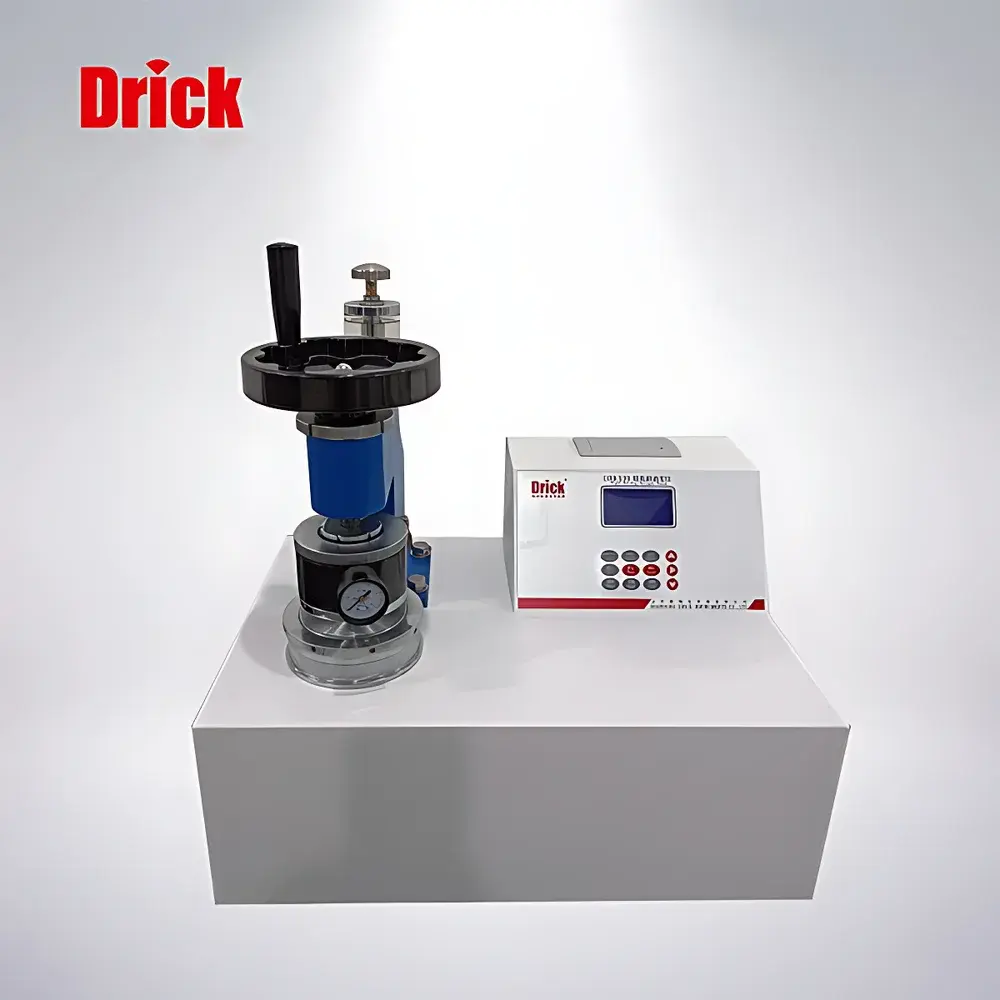
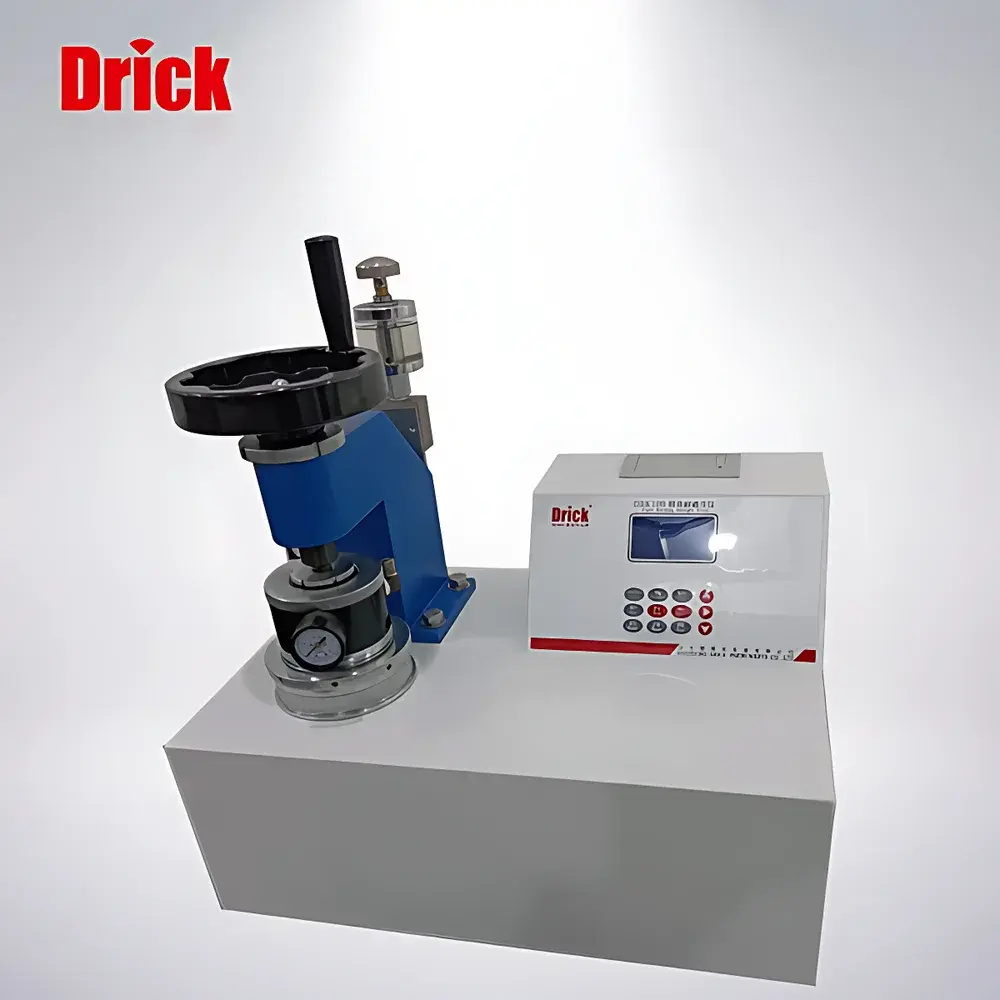
Drick DRK109A Button-Operated Bursting Strength Tester for Paper and Corrugated Board
| Brand | Drick |
|---|---|
| Origin | Shandong, China |
| Manufacturer Type | Direct Manufacturer |
| Country of Origin | China |
| Model | DRK109A |
| Measuring Range | 250–6000 kPa |
| Clamping Force (Upper/Lower Platen) | >690 kPa |
| Hydraulic Oil Delivery Rate | 170 ±15 mL/min |
| Diaphragm Resistance | 170–220 kPa at 10 mm dome height |
| Accuracy Class | Class 1 (Resolution: 0.1 kPa) |
| Indication Accuracy | ±0.5% F.S. |
| Hydraulic Seal Integrity | Pressure drop <10% of P<sub>max</sub> within 1 minute at upper limit |
| Clamp Ring Diameter | φ31.5 ±0.05 mm |
| Dimensions (L×W×H) | 530×360×550 mm |
| Motor Power | 90 W |
| Power Supply | 220 V ±10%, 50 Hz |
| Weight | 75 kg |
Overview
The Drick DRK109A Button-Operated Bursting Strength Tester is a precision hydraulic instrument engineered for the quantitative determination of bursting strength in paper, paperboard, and corrugated fiberboard—critical mechanical parameters directly correlated with resistance to rupture under distributed compressive loading. Based on the Mullen principle, the device applies controlled hydraulic pressure via a flexible rubber diaphragm to a clamped circular specimen until failure occurs. The burst pressure is measured in kilopascals (kPa), providing a direct metric of material integrity under multiaxial stress conditions. Designed for compliance with international standard test methods—including ISO 2759, GB/T 454, GB/T 6545, GB 1539, and QB/T 1057—the DRK109A serves as a foundational tool in quality assurance laboratories across pulp & paper manufacturing, packaging R&D, third-party certification bodies, and regulatory testing facilities.
Key Features
- Microprocessor-based control system with intuitive button interface—no touchscreen or PC dependency—ensuring operational robustness in industrial environments.
- Integrated hydraulic actuation system featuring a copper-steel cylinder assembly with four-stage sealing architecture, validated for leak-free performance up to 6000 kPa.
- Calibrated diaphragm module with traceable dome-height–pressure response curves (170–220 kPa at 10 mm; 250–350 kPa at 18 mm), enabling precise compensation for membrane contribution per ISO 2759 Annex A.
- High-fidelity pressure transduction with Class 1 accuracy (±0.5% F.S.), 0.1 kPa resolution, and real-time digital display synchronized with analog gauge backup.
- Dual-clamp design with hardened steel platens and precisely machined φ31.5 ±0.05 mm annular rings, ensuring uniform specimen confinement and minimal edge-effect deviation.
- Onboard data management supporting storage of up to 500 test batches (20 specimens per batch), with timestamped records retained in non-volatile memory.
- Embedded thermal line printer (9-pin, high-duty cycle) delivering immediate hardcopy output compliant with GLP documentation requirements.
Sample Compatibility & Compliance
The DRK109A accommodates standard test specimens conforming to ISO 2759 and GB/T 454—circular samples of 100 mm diameter, cut perpendicular to grain direction. It is validated for single-ply papers (e.g., kraft liner, test liner), multi-ply boards (e.g., solid bleached sulfate, recycled board), and all common corrugated configurations (single-, double-, and triple-wall). Non-paper substrates—including woven silk, cotton fabric, and synthetic nonwovens—may be evaluated subject to diaphragm compatibility verification and procedural adaptation per ASTM D774 (for textile bursting). All calibration, verification, and operation procedures align with ISO/IEC 17025 general requirements for competence of testing and calibration laboratories. Instrument validation documentation supports audit readiness for FDA 21 CFR Part 11 (where electronic records are archived), ISO 9001, and IATF 16949 traceability frameworks.
Software & Data Management
The DRK109A operates without external software dependency; all firmware logic—including burst detection thresholding, peak-hold capture, statistical aggregation (mean, SD, CV%), and pass/fail flagging—is embedded in the controller’s ROM. Test records include specimen ID, date/time stamp, burst pressure (kPa), and operator code (manually entered). Data export is not supported via USB or Ethernet; however, printed reports contain full metrological metadata required for laboratory notebooks and internal QA archives. Memory retention remains intact during power interruption. Firmware updates—when released—are performed via proprietary serial interface using Drick-certified service tools, maintaining configuration integrity and measurement traceability.
Applications
- Quality conformance testing of incoming raw materials (e.g., linerboard, medium, chipboard) against supplier specifications.
- In-process monitoring of wet-end and calendering parameters in paper machine optimization studies.
- Corrugated box design validation—correlating board bursting strength with compression performance in edge crush tests (ECT) and box compression tests (BCT).
- Accelerated aging studies evaluating degradation of archival papers under humidity/temperature stress.
- Regulatory submission support for packaging compliance under EU Directive 94/62/EC (packaging waste) and U.S. FDA 21 CFR 176.170 (indirect food additives).
- Comparative benchmarking of recycled content impact on structural integrity across fiber furnish blends.
FAQ
What standards does the DRK109A comply with?
The instrument is designed and verified to meet ISO 2759, GB/T 454, GB/T 6545, GB 1539, and QB/T 1057. Calibration certificates reference NIST-traceable pressure standards.
Is operator training required before first use?
Yes—basic operator qualification includes understanding of specimen preparation per ISO 186, clamp torque verification (using supplied wrenches), diaphragm replacement protocol, and interpretation of burst curve morphology per ISO 2759 Clause 8.
How often must the hydraulic oil be replaced?
Under normal usage (≤20 tests/day), silicone oil should be replaced every 18 months or after 5,000 cycles, whichever occurs first. Drick supplies OEM-grade fluid (viscosity grade ISO VG 10) with each unit.
Can test data be exported to Excel or LIMS?
No native export functionality exists; however, printed reports may be scanned and OCR-processed for integration into LIMS or ERP systems where permitted by local data governance policy.
What maintenance intervals are recommended?
Monthly visual inspection of seals and diaphragm integrity; quarterly verification of clamp force (>690 kPa) using calibrated load cell; annual full metrological recalibration by an accredited provider.





