
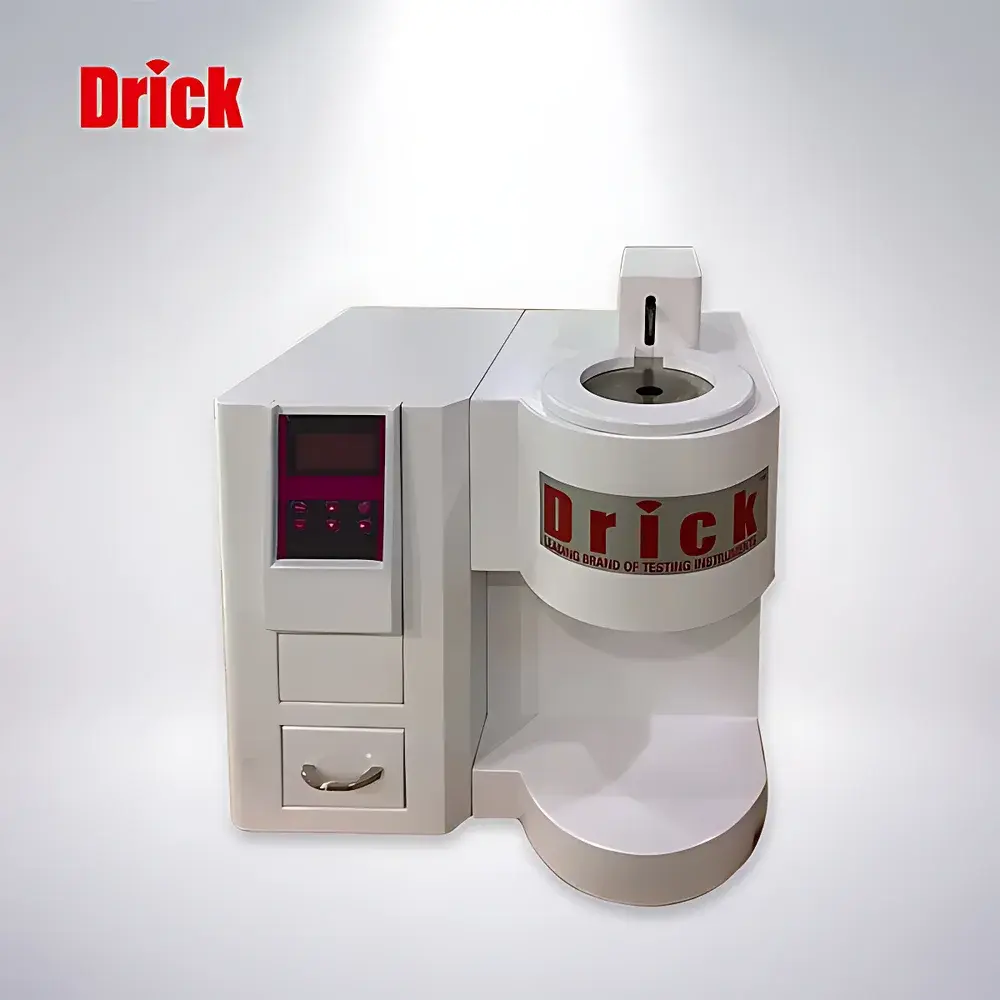
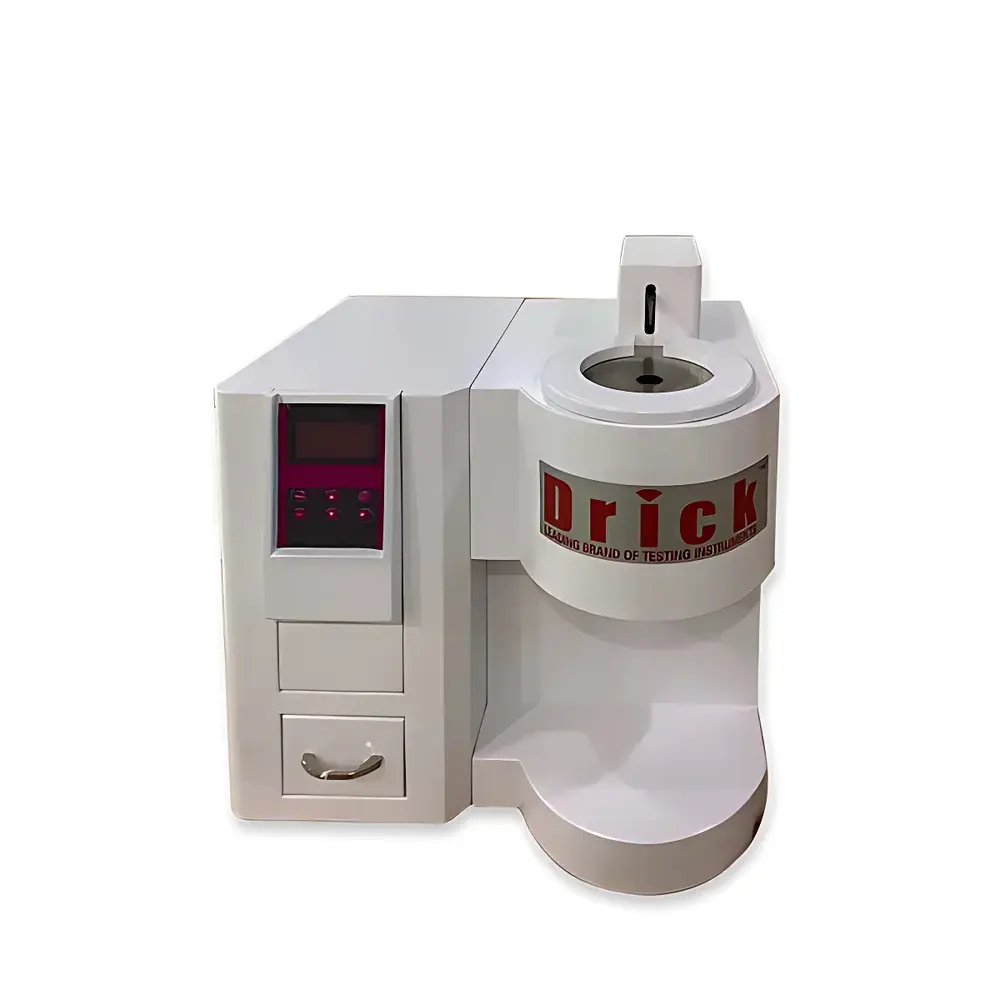
Drick XRL-400C Advanced Melt Flow Indexer
| Brand | Drick |
|---|---|
| Origin | Shandong, China |
| Manufacturer Type | Direct Manufacturer |
| Product Category | Domestic |
| Model | XRL-400C |
| Price | USD 7,000 (FOB) |
| Measurement Range | MFR 0.01–600.00 g/10 min |
| Temperature Control Range | 50–400 °C |
| Temperature Accuracy | ±0.1 °C |
| Display Resolution | 0.01 °C |
| Barrel ID | 9.55 ± 0.025 mm, Length: 160 mm |
| Piston Head Diameter | 9.475 ± 0.01 mm, Mass: 106 g |
| Die ID | 2.095 mm, Length: 8 ± 0.025 mm |
| Standard Loads | 0.325, 1.2, 2.16, 3.8, 5.0, 10.0, 21.6 kg (±0.5% accuracy) |
| Displacement Range | 0–30 mm, Accuracy: ±0.05 mm |
| Power Supply | 220 V ±10%, 50 Hz |
| Heating Power | 550 W |
| Dimensions (L×W×H) | 560 × 376 × 530 mm |
Overview
The Drick XRL-400C Advanced Melt Flow Indexer is a precision-engineered instrument designed for standardized determination of melt mass flow rate (MFR) and melt volume flow rate (MVR) of thermoplastic polymers under defined temperature and load conditions. It operates on the fundamental principle of extrusion rheometry—measuring the mass or volume of polymer melt extruded through a standardized capillary die under controlled thermal and mechanical conditions over a fixed time interval (typically 10 minutes). This method conforms to internationally recognized test protocols including ISO 1133-1 & -2, ASTM D1238, ASTM D3364, GB/T 3682, DIN 53735, and UNI 5640. The XRL-400C is calibrated and validated in accordance with JB/T 5456, the Chinese national technical specification for melt flow indexers, ensuring metrological traceability and inter-laboratory comparability. Its robust architecture supports routine QC testing in polymer manufacturing, raw material certification, R&D laboratories, and third-party inspection agencies operating under GLP or ISO/IEC 17025 frameworks.
Key Features
- Intelligent PID temperature control system with ±0.1 °C stability across the full 50–400 °C operating range and 0.01 °C display resolution
- Automated cutting mechanism with programmable time- or displacement-triggered extrudate collection
- High-precision optical encoder for real-time displacement measurement (0–30 mm, ±0.05 mm accuracy)
- Quick-load piston assembly enabling rapid specimen insertion and minimized thermal disturbance during loading
- Dual-mode output: simultaneous calculation and display of MFR (g/10 min), MVR (cm³/10 min), and derived melt density (g/cm³)
- Seven standard weight configurations (0.325 kg to 21.6 kg) compliant with ISO 1133 Annex A and ASTM D1238 Table 1, each certified to ±0.5% mass tolerance
- Standardized barrel geometry (ID 9.55 ± 0.025 mm, L = 160 mm) and die specifications (ID 2.095 mm, L = 8 ± 0.025 mm) per ISO 1133-1 Clause 6
Sample Compatibility & Compliance
The XRL-400C accommodates a broad spectrum of thermoplastic resins—including high-melting engineering plastics such as polycarbonate (PC), polyamide (PA6/PA66), polyphenylsulfone (PPSU), and polyetherimide (PEI)—as well as commodity polymers like polyethylene (PE), polypropylene (PP), acrylonitrile-butadiene-styrene (ABS), polystyrene (PS), and polyoxymethylene (POM). All hardware components—including barrel, piston, and die—are manufactured from high-grade corrosion-resistant tool steel and subjected to dimensional verification per ISO 1133 Annex B. Instrument validation includes temperature uniformity mapping, load calibration traceable to NIST-equivalent standards, and repeatability verification per ISO 1133-2 Annex C. The system meets requirements for use in environments governed by FDA 21 CFR Part 11 when paired with compliant data acquisition software (e.g., optional Drick MFI-Link v3.x with audit trail and electronic signature support).
Software & Data Management
While the base XRL-400C model features an integrated LCD interface with Chinese-language operation and real-time parameter display, it supports seamless integration with Drick’s optional MFI-Link software suite (v3.x) via RS232 or USB. This platform enables full remote control, automated temperature ramping, time-temperature curve logging, storage of up to 100 test records with metadata (operator ID, sample ID, load, temperature, date/time), and generation of PDF/CSV reports compliant with ISO/IEC 17025 documentation requirements. When configured with the microcontroller variant (XRL-400CW), the system provides full GMP-aligned data integrity: user access levels, electronic signatures, change history logs, and 21 CFR Part 11-compliant audit trails. All exported datasets include raw displacement vs. time traces, calculated MFR/MVR values, and uncertainty estimates per ISO/IEC Guide 98-3 (GUM).
Applications
The XRL-400C serves as a primary quality assurance tool in polymer supply chain management—from incoming raw material inspection at compounders and converters to final product release testing in automotive, medical device, and packaging manufacturing. It supports formulation development by correlating MFR changes with molecular weight distribution shifts (e.g., post-reactor degradation or stabilizer efficacy). In academic and regulatory settings, it facilitates comparative studies of shear sensitivity (via multi-load MFR analysis), thermal stability (through isothermal hold tests), and processing window assessment (by measuring MFR drift over extended dwell times). Its compliance with ASTM D3364 also permits its use in evaluating flame-retardant polyolefin systems where char formation may affect extrudate consistency.
FAQ
What international standards does the XRL-400C comply with?
It fully satisfies ISO 1133-1/-2, ASTM D1238, ASTM D3364, GB/T 3682, DIN 53735, and UNI 5640, and is built per JB/T 5456 technical specifications.
Can the XRL-400C measure both MFR and MVR simultaneously?
Yes—using encoder-derived displacement data and operator-entered melt density or auto-calculated density, it computes and displays both MFR (g/10 min) and MVR (cm³/10 min) in real time.
Is the instrument suitable for high-temperature engineering plastics?
Yes—the 400 °C maximum temperature range and thermally stable barrel design enable reliable testing of PC, PEEK, PPSU, and other high-Tg materials.
How is load accuracy verified and maintained?
Each standard weight set undergoes third-party calibration with uncertainty ≤0.25% (k=2), and a certificate of conformance is supplied; routine verification follows ISO 1133-2 Annex D procedures.
Does the base XRL-400C model support data export?
The standard LCD version outputs results locally; for digital export, the optional MFI-Link software or XRL-400CW microcontroller configuration is required.







