
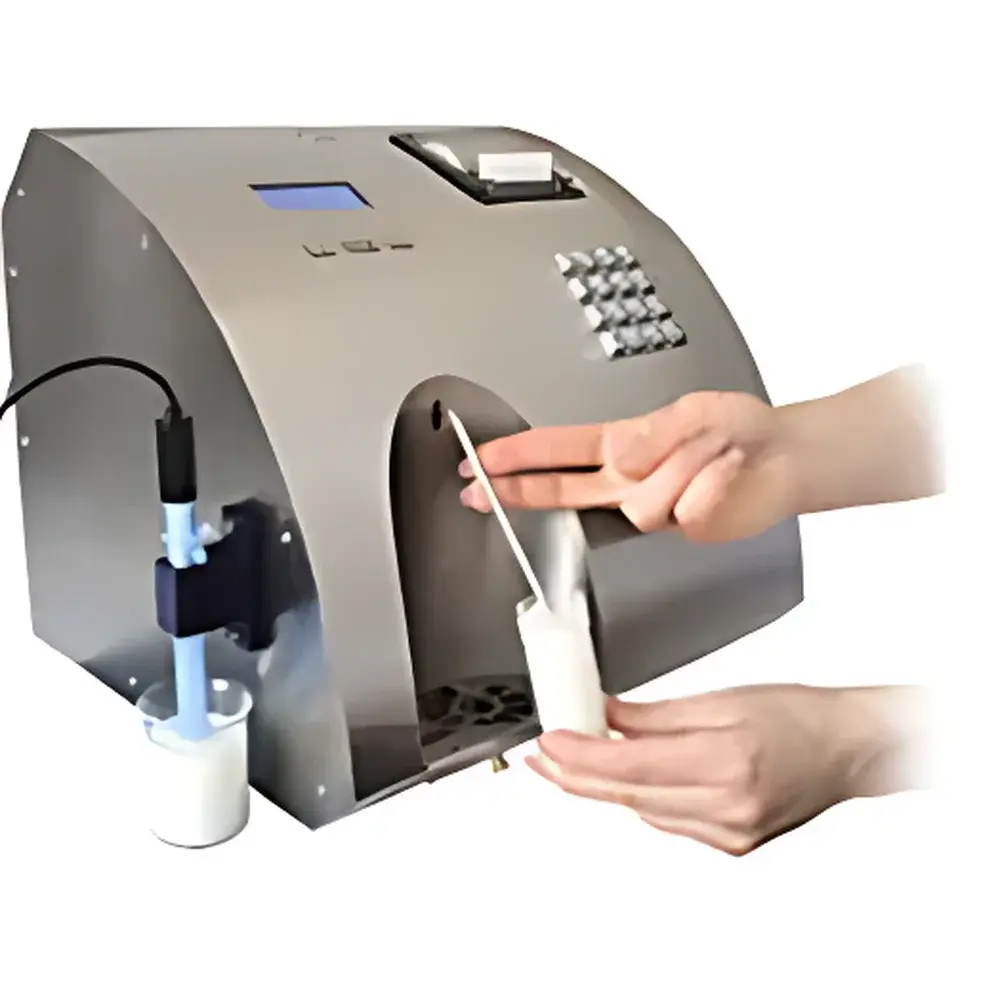
Lactoscan MCC Milk Analyzer by MilkoScan (Bulgarian Origin)
| Origin | Bulgaria |
|---|---|
| Manufacturer Type | Authorized Distributor |
| Origin Category | Imported |
| Model | Lactoscan MCC |
| Detection Parameters | Fat, Protein, Lactose, Non-Fat Solids, Density, Freezing Point, Conductivity, pH, Total Solids, Water Adulteration, Ash |
| Automation Level | Fully Automatic |
| Analysis Time | ≤ 60 seconds per sample |
| Measurement Range | Fat 0.01–45 %, Protein 2–15 %, Lactose 0.01–20 %, Non-Fat Solids 3–40 %, Total Solids 0–50 %, Density 1000–1160 kg/m³, Freezing Point −0.4 to −0.7 °C, Conductivity 2–14 mS/cm, pH 0–14, Ash 0.4–4 %, Water Adulteration 0–70 % |
| Repeatability | ±0.15 % (typical for protein & non-fat solids) |
| Accuracy | ±0.06 % (fat), ±0.15 % (protein, non-fat solids), ±0.005 °C (freezing point), ±0.05 units (pH, conductivity, ash) |
| Sample Volume Required | < 3 mL |
| Throughput | ≥120 samples/hour |
| Interface | RS-232 serial port |
| Power Consumption | Low-power design |
Overview
The Lactoscan MCC Milk Analyzer is a fully automatic, benchtop-to-mobile near-infrared (NIR) and physicochemical multi-parameter analyzer engineered for rapid, non-destructive compositional analysis of raw milk and liquid dairy products. Designed in accordance with ISO 9622:2013 (Milk — Determination of fat, protein, lactose, total solids and urea content — Guidance on the use of mid-infrared spectrometry) and aligned with AOAC Official Method 972.16, the instrument employs a hybrid measurement architecture combining NIR spectroscopy for organic component quantification (fat, protein, lactose) with integrated physical sensors for density, freezing point depression, electrical conductivity, and pH. This dual-mode approach ensures traceable, matrix-robust results across diverse milk types—including bovine, ovine, caprine, and buffalo—without chemical reagents or sample preparation. Its compact footprint (280 × 220 × 240 mm) and low power draw (<15 W) support deployment in mobile labs, collection centers, farm gates, and quality control environments where regulatory-grade data integrity is mandatory.
Key Features
- Fully automated analysis cycle: peristaltic pumping, flow-path rinsing, dual-sample self-calibration, and thermal printout—all executed without operator intervention.
- Minimal sample requirement: validated performance with ≤2.8 mL of unchilled, homogenized raw milk per test.
- High-throughput capability: completes full multi-parameter analysis in ≤60 seconds, supporting ≥120 samples per hour under continuous operation.
- Robust mechanical architecture: sealed optical path, temperature-stabilized sensor array, and vibration-damped housing compliant with IEC 60529 IP20 for laboratory and field use.
- Integrated thermal printer: provides immediate hard-copy documentation with timestamp, sample ID, operator code, and all measured parameters—including uncertainty estimates per parameter.
- RS-232 serial interface: enables direct integration with LIMS, ERP, or farm management software; supports ASCII-based data export with configurable delimiter and header formats.
- Energy-efficient operation: operates on standard 100–240 V AC input; no consumables, solvents, or hazardous waste generation.
Sample Compatibility & Compliance
The Lactoscan MCC is validated for raw milk, pasteurized whole milk, standardized milk, and reconstituted skim milk. It accommodates samples at ambient temperature (10–30 °C) and tolerates moderate somatic cell counts (<1,000,000/mL) and bacterial loads (<500,000 CFU/mL) without signal interference. All measurement algorithms are traceable to NIST-certified reference materials and undergo annual verification against ISO/IEC 17025-accredited calibration standards. The system meets EU Regulation (EC) No 853/2004 hygiene requirements for dairy testing equipment and supports audit-ready documentation for GLP and GMP environments. Freezing point measurement complies with IDF Standard 119A:2016 and is calibrated using certified glycol/water standards traceable to CIPM MRA.
Software & Data Management
Embedded firmware (v4.2+) includes secure user authentication (3-tier access: operator, supervisor, administrator), electronic signature support, and full audit trail logging per FDA 21 CFR Part 11 Annex 11 requirements. All measurements are timestamped, digitally signed, and stored locally with 10,000-sample capacity. Data export supports CSV, TXT, and XML formats with optional encryption (AES-128). Optional PC-based LactoSoft Suite (Windows 10/11) enables advanced trend analysis, SPC charting (X-bar/R, CUSUM), batch reconciliation, and automated report generation compliant with ISO/IEC 17025 clause 7.8.2.
Applications
- Raw milk payment grading at collection hubs based on fat, protein, and total solids content.
- Real-time adulteration screening (water dilution, whey addition, neutralizer use) via freezing point depression and conductivity deviation analysis.
- In-process QC during pasteurization and standardization—monitoring compositional drift before and after thermal treatment.
- Regulatory compliance testing for national food safety authorities (e.g., China’s GB 19301-2010, India’s FSSAI standards, USDA AMS Grade A requirements).
- Research applications in dairy science: correlation studies between NIR spectral features and rheological behavior, heat stability, or rennet coagulation time.
FAQ
What calibration standards are required for daily operation?
No external standards are needed for routine use—the instrument performs dual-sample self-calibration using built-in reference fluid cells prior to each analytical run.
Is the freezing point module independently validated?
Yes—the thermistor-based freezing point sensor is factory-calibrated against NIST-traceable ethylene glycol standards and verified annually per ISO 5725-2 precision protocols.
Can the Lactoscan MCC be used for goat or sheep milk?
Yes—its multivariate NIR models include species-specific chemometric libraries validated for caprine and ovine milk matrices per IDF Bulletin 473:2021.
Does the system support remote diagnostics or firmware updates?
Firmware updates are performed via USB flash drive; remote diagnostic access is not supported to maintain data security and regulatory compliance in controlled environments.
How is measurement uncertainty reported per parameter?
Uncertainty values (k=2, 95% confidence) are embedded in every result set and conform to ISO/IEC Guide 98-3 (GUM); full uncertainty budgets are available upon request for accredited laboratories.






