
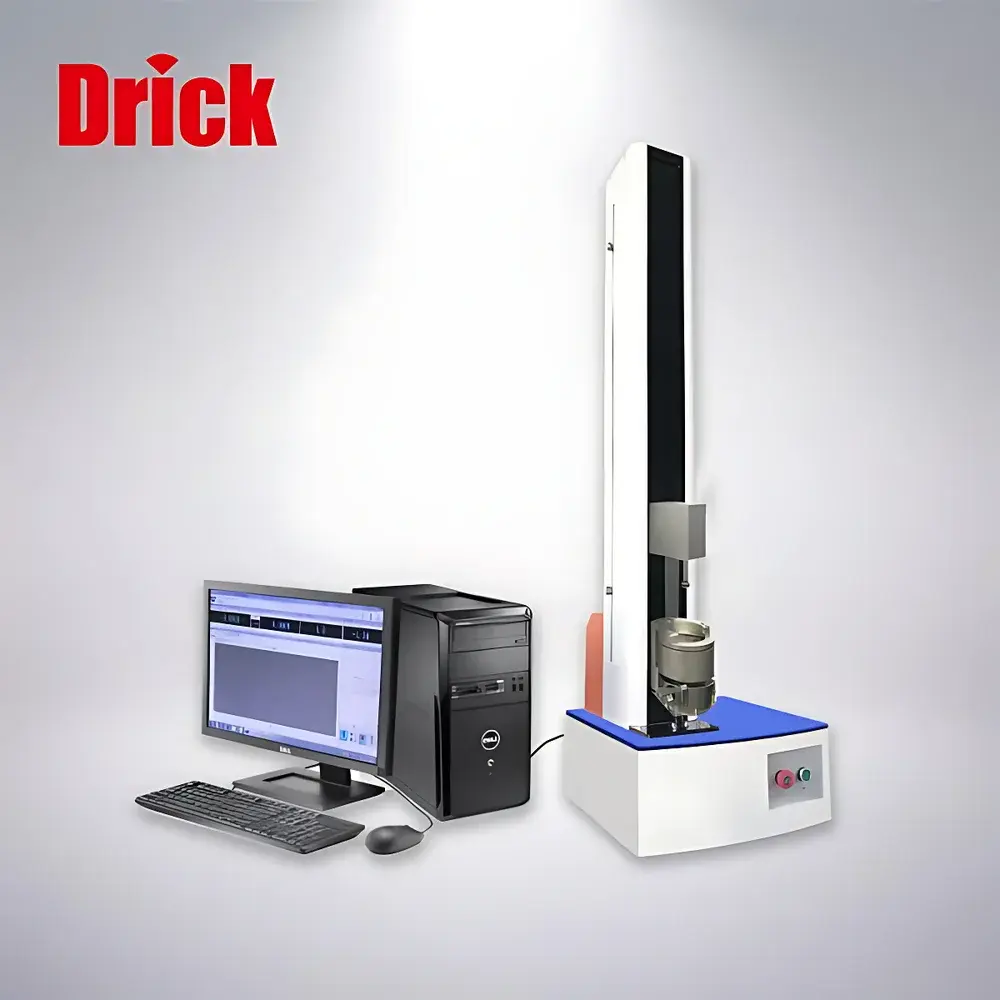
Drick DRK101 Spherical Bursting Strength Tester for Tissue Paper
| Brand | Drick |
|---|---|
| Origin | Shandong, China |
| Manufacturer Type | Direct Manufacturer |
| Model | DRK101 |
| Power Supply | AC 220 V ±10%, 50 Hz, 5 A |
| Measurement Range | 0–30 N |
| Test Accuracy | ±0.01 N |
| Resolution | 0.01 N |
| Ball Diameter | φ16 mm |
| Inner Ring Diameter | φ50 mm (optional φ89 mm) |
| Clamp Width | ≥12.5 mm |
| Penetration Depth | 25 mm |
| Standard Test Speed | 125 ±5 mm/min |
| Adjustable Speed Range | 1–400 mm/min |
| Display | Color TFT Touchscreen LCD |
| Interface | RS232 Serial Port |
| Compliance | ISO/FDIS 12625-9:2015, GB/T 24328.7, GB/T 20810-2018 |
Overview
The Drick DRK101 Spherical Bursting Strength Tester is a dedicated mechanical testing instrument engineered for the quantitative evaluation of spherical bursting strength and burst index in tissue paper products—including facial tissues, toilet paper, kitchen towels, and industrial wiping papers. It operates on the principle of controlled spherical penetration: a standardized steel ball (φ16 mm) is driven vertically at a defined constant speed through a circular clamped specimen supported by an inner ring (φ50 mm or optional φ89 mm), while force displacement data are captured in real time. The maximum applied force prior to specimen rupture—recorded in newtons (N)—constitutes the spherical bursting strength value. This method directly reflects resistance to localized mechanical puncture under dynamic loading, a critical performance indicator for consumer handling, dispensing reliability, and functional integrity in moist or dry conditions. Designed in strict alignment with international standard test protocols, the DRK101 ensures metrological traceability and inter-laboratory comparability for QC/QA labs, R&D centers, and third-party certification bodies serving the global tissue and hygiene product supply chain.
Key Features
- Servo-motor-driven actuation system ensures low acoustic noise, high positional repeatability, and precise velocity control across the full 1–400 mm/min range—with default compliance at 125 ±5 mm/min per ISO 12625-9.
- High-resolution color TFT touchscreen interface displays live force-time curves, peak load, burst index (kPa·g/m²), mean value, standard deviation, and coefficient of variation—calculated automatically from up to 10 sequential tests.
- Force transducer calibrated to ±0.01 N accuracy with 0.01 N resolution over the 0–30 N measurement span, enabling detection of subtle differences in low-strength tissue grades.
- Integrated safety logic provides automatic reset after each test cycle and hardware-based overload protection to safeguard both operator and sensor integrity.
- Standard manual clamping fixture included; optional pneumatic clamping system available for improved operator ergonomics and reduced inter-operator variability in high-throughput environments.
- RS232 serial interface enables bidirectional communication with external LIMS or custom statistical analysis software for automated report generation and audit-ready data export.
Sample Compatibility & Compliance
The DRK101 accommodates standard tissue paper specimens measuring ≥125 mm × 125 mm, secured within the inner ring aperture (φ50 mm nominal, compliant with ISO 12625-9 and GB/T 24328.7). An alternative φ89 mm inner ring is available for thicker multi-ply or structured tissue products requiring expanded support geometry. All mechanical and procedural parameters—including ball geometry (φ16 mm hardened steel), penetration depth (25 mm), and clamp width (≥12.5 mm)—are fully traceable to ISO/FDIS 12625-9:2015, GB/T 24328.7–2020, and GB/T 20810–2018. The instrument’s design supports GLP-compliant operation when paired with validated software workflows and documented calibration records. While not inherently 21 CFR Part 11–compliant, its RS232 output permits integration into validated data acquisition systems meeting FDA regulatory expectations for electronic records.
Software & Data Management
The embedded firmware performs real-time signal filtering, peak detection, and statistical aggregation without external PC dependency. Raw force vs. time datasets are timestamped and stored internally (up to 100 test records), with export capability via RS232 to spreadsheet-compatible ASCII or CSV formats. For enterprise-level deployment, the DRK101 interfaces seamlessly with laboratory information management systems (LIMS) and statistical process control (SPC) platforms using standard MODBUS RTU or custom ASCII command sets. Audit trails—including operator ID, test date/time, sample ID, and calibration status—are programmatically embeddable into exported files to support ISO/IEC 17025 accreditation requirements.
Applications
- Quality control of virgin and recycled fiber-based tissue grades during production line release testing.
- Comparative evaluation of wet/dry strength retention in emollient- or lotion-enhanced tissues.
- R&D screening of novel fiber blends, creping patterns, and resin treatments affecting localized puncture resistance.
- Supplier qualification and incoming material verification against contractual burst strength specifications.
- Regulatory submission support for CE marking, FDA registration dossiers, or APAC market access documentation.
FAQ
What standards does the DRK101 comply with?
It is fully aligned with ISO/FDIS 12625-9:2015, GB/T 24328.7–2020, and GB/T 20810–2018 for spherical bursting strength determination in tissue paper.
Can the instrument calculate burst index automatically?
Yes—the firmware computes burst index (kPa·g/m²) using measured burst force, specimen grammage (entered manually or imported), and standardized geometric constants.
Is pneumatic clamping available as a factory option?
Yes—pneumatic clamping is offered as an optional upgrade to reduce manual handling variability and improve throughput consistency.
Does the DRK101 support GLP or GMP environments?
While the base unit lacks built-in electronic signature or audit trail features, its deterministic behavior, RS232 data export, and stable calibration history enable integration into validated GLP/GMP workflows when coupled with compliant host software.
What maintenance is required for long-term accuracy?
Annual transducer recalibration against NIST-traceable deadweight standards is recommended; routine verification using certified reference load cells should be performed quarterly per ISO/IEC 17025 guidance.



