
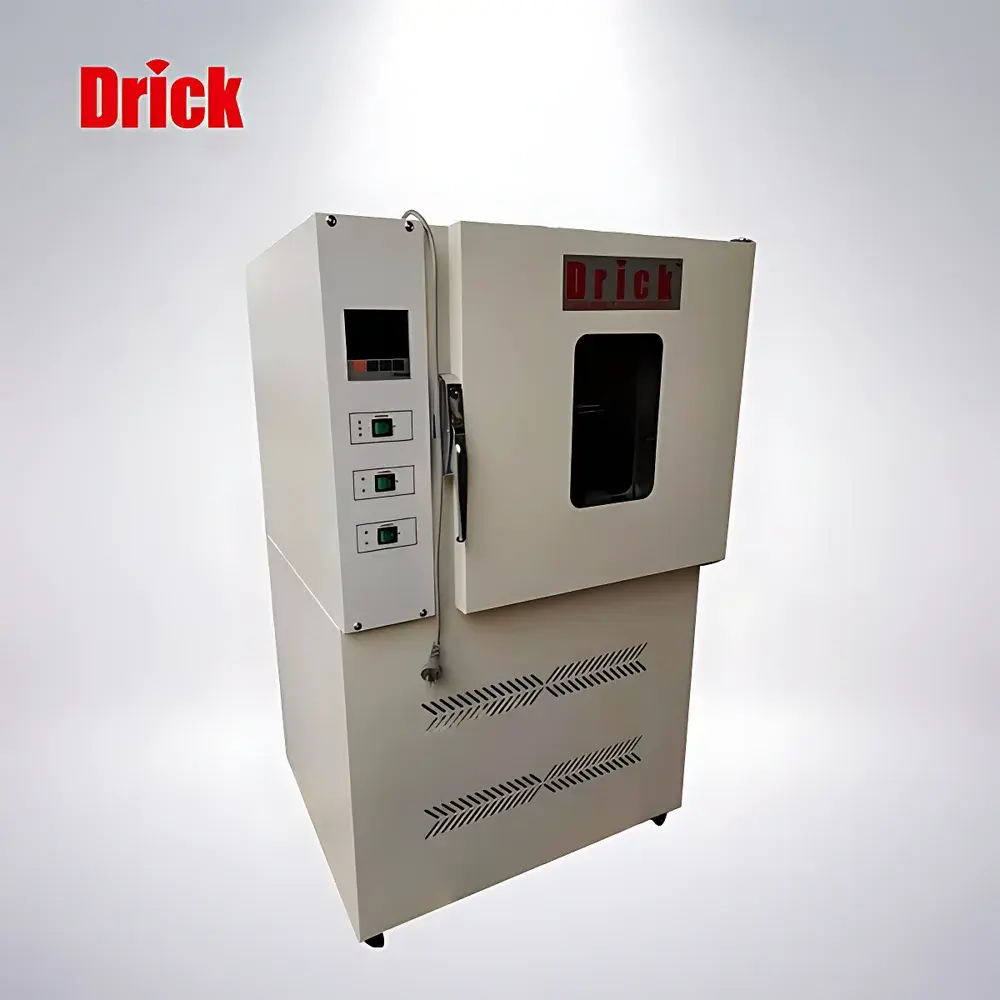
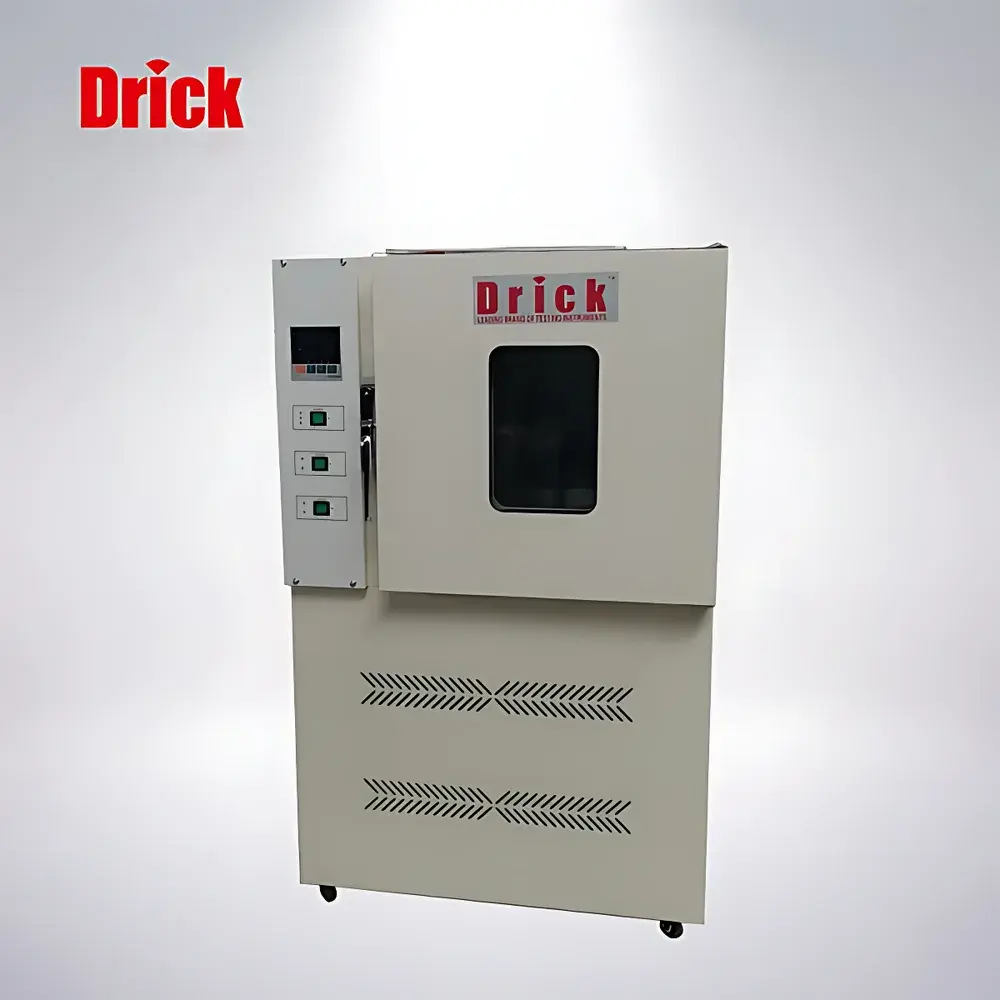
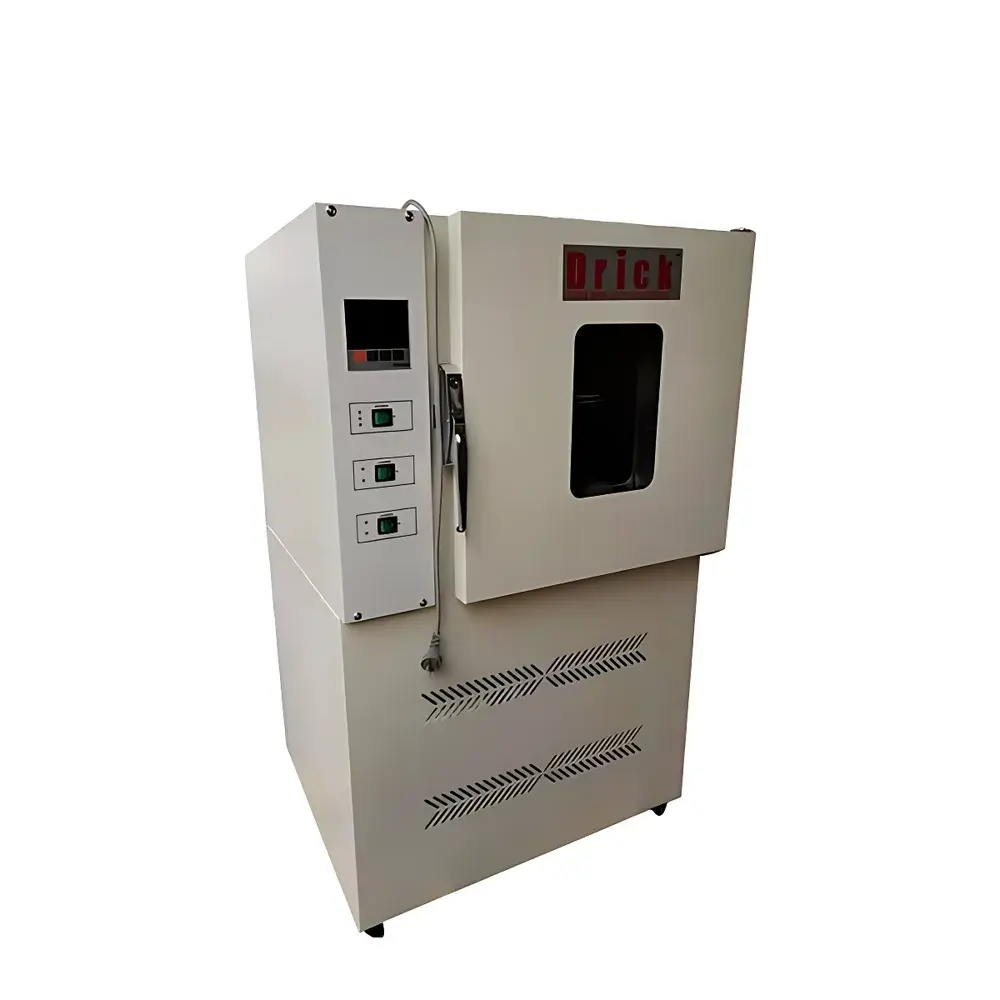
Drick 401A Series Hot Air Aging Test Chamber for Electrical Insulation Materials
| Brand | Drick |
|---|---|
| Origin | Shandong, China |
| Manufacturer Type | Direct Manufacturer |
| Origin Category | Domestic (China) |
| Model | 401A Series |
| Max Operating Temperature | 200°C or 300°C (configurable) |
| Temperature Uniformity | ±1% (forced-air convection) |
| Temperature Control Accuracy | ±1°C |
| Air Exchange Rate | 0–100 cycles/hour |
| Air Velocity | <0.5 m/s |
| Power Supply | AC 220 V, 50 Hz |
| Internal Chamber Dimensions (W×H×D) | 450 × 450 × 450 mm |
| Construction | Cold-rolled steel exterior with high-temp silver paint interior coating and glass fiber insulation |
Overview
The Drick 401A Series Hot Air Aging Test Chamber is an engineered environmental test system designed specifically for accelerated thermal oxidation aging of electrical insulation materials, elastomers, plastics, and polymer-based components under controlled atmospheric conditions. It operates on the principle of forced-convection hot air circulation—where heated ambient air is uniformly distributed throughout the chamber via a precision-balanced axial fan and optimized baffle system—to simulate long-term exposure to elevated temperatures in service environments. This methodology aligns with standardized accelerated aging protocols defined in GB/T 3512 (Rubber – Accelerated ageing test in hot air), ASTM D573, ISO 188, and IEC 60811-2-1 for evaluation of thermal degradation, embrittlement, tensile strength loss, and dielectric property shifts. The chamber’s architecture supports both static and dynamic aging studies, enabling users to assess material lifetime predictions, formulation stability, and compliance with industrial qualification requirements for wire & cable, transformer insulation, automotive harnesses, and aerospace sealing compounds.
Key Features
- Configurable maximum operating temperature options: 200°C or 300°C, selected at time of order to match application-specific thermal stress profiles.
- Forced-air convection system delivering ±1% temperature uniformity across the full working volume—validated per IEC 60068-3-5 and ASTM E2293.
- Precision digital PID temperature controller with ±1°C control accuracy and dual-stage overtemperature protection (mechanical + electronic).
- Robust chamber construction: cold-rolled steel outer casing, high-temperature silver-paint-coated stainless steel inner walls, and 80 mm thick glass fiber insulation for minimized thermal leakage and enhanced energy efficiency.
- Adjustable air exchange rate (0–100 cycles/hour) via calibrated inlet/outlet dampers, supporting both sealed and ventilated aging modes per ISO 188 Clause 7.2.
- Low-turbulence airflow design (<0.5 m/s average velocity) to prevent mechanical disturbance of delicate specimens while ensuring convective heat transfer consistency.
- Compliance-ready design: meets structural and operational prerequisites for GLP-compliant aging validation protocols and supports traceable calibration documentation per ISO/IEC 17025.
Sample Compatibility & Compliance
The 401A Series accommodates standard test specimens—including dumbbell-shaped tensile strips (ISO 37), disc-shaped dielectric samples (IEC 60243), and wrapped coil assemblies—within its 450 × 450 × 450 mm internal workspace. Specimen racks are supplied with non-reactive stainless steel trays and adjustable spacing to ensure unobstructed airflow around all surfaces. All materials in contact with the test environment—including gasketing, fasteners, and internal coatings—are selected for thermal stability up to 300°C and chemical inertness toward oxidizing byproducts. The chamber satisfies the “test apparatus” requirements specified in GB/T 3512, ASTM D573-22, ISO 188:2018, and UL 1581 Section 1000 for thermal aging validation. Optional accessories include calibrated thermocouple probe ports, specimen weight monitoring hooks, and exhaust gas condensation traps for volatile decomposition product capture.
Software & Data Management
While the base model features a standalone digital PID controller with real-time temperature display and setpoint programming, optional RS485/Modbus RTU interface enables integration into centralized laboratory data acquisition systems. When paired with Drick’s optional LogView Pro software (v3.2+), users gain access to time-stamped temperature logging, alarm event history, calibration certificate generation, and audit trail functionality compliant with FDA 21 CFR Part 11 Annex 11 requirements. All temperature records include metadata such as operator ID, chamber ID, test method reference, and environmental timestamp—supporting full traceability for quality assurance audits and regulatory submissions.
Applications
- Evaluation of thermal oxidative stability in cross-linked polyethylene (XLPE), ethylene propylene diene monomer (EPDM), silicone rubber, and fluoropolymers used in high-voltage insulation systems.
- Accelerated life testing of motor winding varnishes, transformer paper-oil composites, and busbar coating systems per IEEE Std 98 and IEC 60505.
- Formulation screening for antioxidant package efficacy in automotive under-hood plastics and elastomeric seals.
- Qualification testing of aerospace-grade adhesives, potting compounds, and flexible printed circuit substrates per MIL-STD-883 Method 1008 and SAE AS5623.
- Supporting R&D and QC workflows in ISO 9001-certified manufacturing facilities producing medical device housings, battery pack enclosures, and photovoltaic junction box materials.
FAQ
What standards does the 401A Series comply with for thermal aging testing?
It meets the apparatus specifications of GB/T 3512, ASTM D573, ISO 188, IEC 60811-2-1, and UL 1581—covering chamber geometry, airflow characteristics, temperature uniformity, and control accuracy.
Can the chamber operate continuously at 300°C?
Yes—when configured for 300°C operation, it is rated for uninterrupted duty cycles up to 1,000 hours, provided routine maintenance (seal inspection, fan lubrication, sensor verification) is performed per the maintenance schedule.
Is external ventilation required for safe operation?
Ventilation is recommended when conducting tests above 200°C or when evaluating materials known to emit volatile organic compounds (VOCs); optional exhaust ducting kits are available with flow-rate monitoring.
How is temperature uniformity validated across the chamber volume?
Uniformity is verified using a 9-point sensor mapping procedure per IEC 60068-3-5, with results documented in the factory acceptance test (FAT) report supplied with each unit.
Does the system support GLP or GMP-compliant recordkeeping?
With the optional LogView Pro software and hardware timestamp module, full electronic records—including operator actions, deviations, and calibration logs—meet ALCOA+ principles and are suitable for FDA, EMA, and NMPA audit readiness.
Related Products



