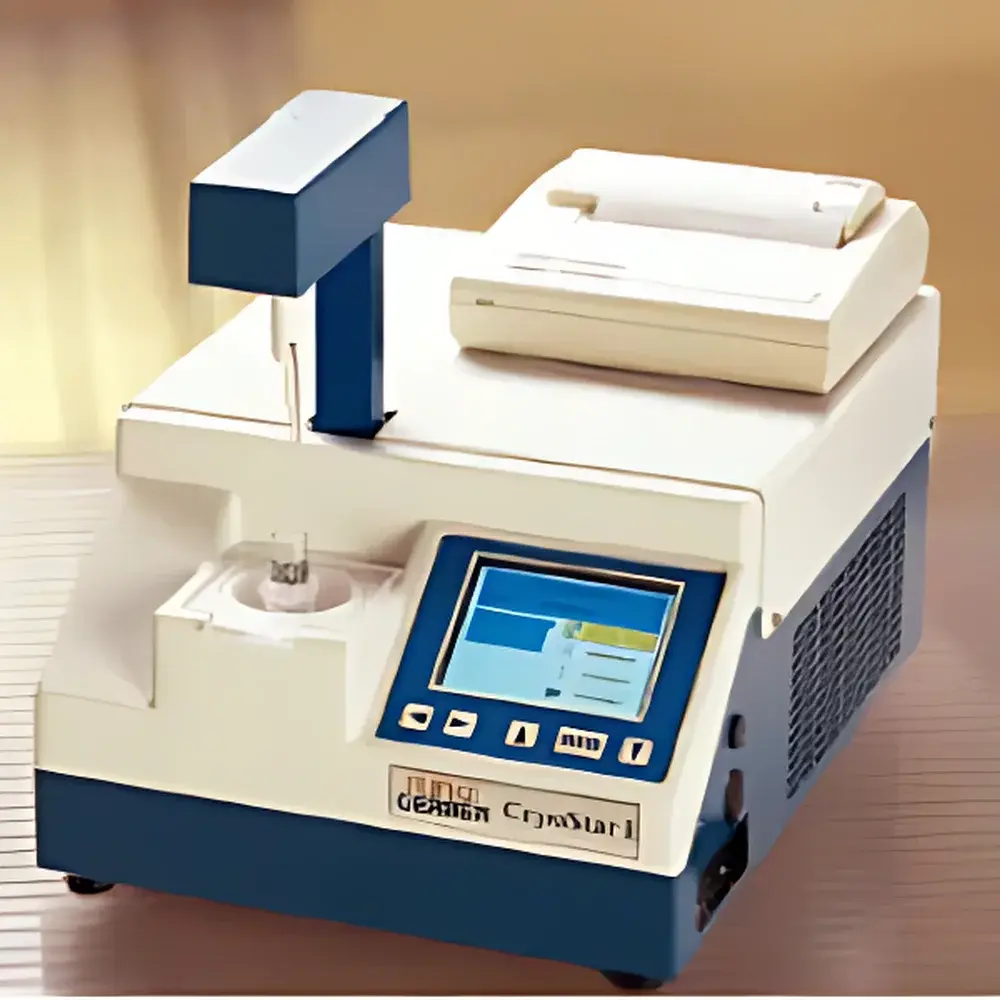
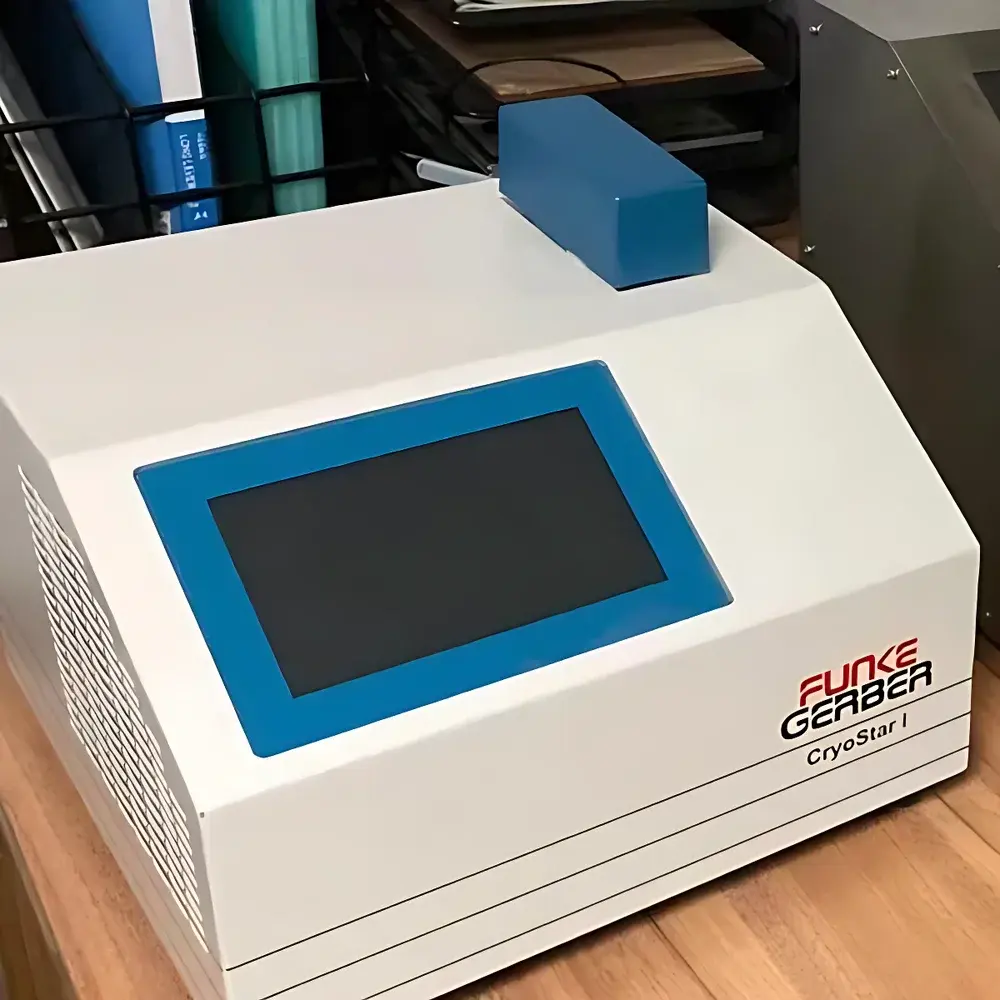
Gerber CryoStar I Milk Cryoscope
| Brand | Gerber |
|---|---|
| Origin | Germany |
| Model | CryoStar I |
| Detection Speed | 40 samples/hour |
| Measurement Range | 0.000 °C to −1.500 °C |
| Sample Volume | 2.2 mL (2.0–2.5 mL) |
| Accuracy | ±0.0001 °C |
| Repeatability | ±0.002 °C |
| Interface | RS-232 port (1), 6 V printer port |
| Power Supply | 230 V / 115 V AC, 50–60 Hz, 180 W |
| Dimensions (W×H×D) | 29 cm × 19 cm × 38 cm |
| Weight | 12 kg |
Overview
The Gerber CryoStar I Milk Cryoscope is a precision laboratory instrument engineered for the accurate determination of the freezing point depression of raw and processed bovine milk—a critical parameter directly correlated with total dissolved solute concentration. Based on the colligative property principle—wherein the freezing point of an aqueous solution decreases linearly with increasing molal concentration of solutes—the CryoStar I quantifies subtle deviations from the natural freezing point of authentic milk (−0.533 °C to −0.516 °C) to detect adulteration, primarily water addition. This method is recognized as the definitive reference technique for milk quality control and is fully compliant with ISO 5764 / IDF 108:2009, “Milk — Determination of freezing point — Thermistor method (Reference method).” The instrument employs a high-stability thermistor sensor array embedded in a Peltier-cooled sample chamber, enabling rapid thermal equilibration and precise phase-transition detection during controlled crystallization.
Key Features
- Thermistor-based measurement system certified to ISO 5764 / IDF 108:2009 for traceable, reference-grade accuracy
- Measurement resolution of 0.0001 °C and repeatability of ±0.002 °C—sufficient to resolve sub-0.01% water dilution
- Throughput of up to 40 samples per hour, optimized for routine dairy laboratory workflows
- Dual-voltage power supply (115 V / 230 V AC) supporting global deployment without external transformers
- Integrated Peltier cooling module with passive heat dissipation—no external coolant circulation or cryogenic gases required
- Onboard thermal calibration verification using two certified reference standards (0.000 °C and −0.557 °C)
- Compact footprint (29 × 19 × 38 cm) and low mass (12 kg) facilitate benchtop integration in QC labs with space constraints
Sample Compatibility & Compliance
The CryoStar I is validated exclusively for bovine milk and milk-based liquid products with low particulate load and minimal fat globule aggregation. It accepts standard 2.2 mL glass capillary tubes (supplied in packs of 50), ensuring consistent sample geometry and thermal mass across analyses. The instrument meets the metrological requirements of ISO/IEC 17025-accredited laboratories when operated under documented procedures, including daily calibration verification and environmental temperature monitoring (recommended operating range: 15–25 °C, <70% RH). Its measurement protocol satisfies regulatory expectations for dairy authenticity testing under EU Regulation (EC) No 853/2004 and national food safety frameworks requiring freezing point analysis for milk standardization and fraud detection.
Software & Data Management
While the CryoStar I operates as a standalone instrument with an intuitive front-panel interface, it supports bidirectional data exchange via its RS-232 serial port for integration into LIMS or QA documentation systems. All measurements are timestamped and include instrument ID, operator code (manually entered), and calibration status flag. Raw thermistor resistance vs. time profiles are not stored internally but may be captured externally using compatible terminal emulation software. For audit readiness, laboratories routinely configure the optional thermal printer (6 V output) to generate hard-copy reports containing sample ID, measured freezing point, deviation from reference range (−0.533 to −0.516 °C), pass/fail indication, and calibration verification result. The system supports 21 CFR Part 11-compliant data handling when paired with validated third-party data acquisition software featuring electronic signatures and audit trails.
Applications
- Detection of water adulteration in raw milk at collection points and processing plants
- Verification of milk composition consistency prior to pasteurization and standardization
- Supporting ISO 8587 sensory evaluation protocols where freezing point serves as a pre-screening criterion
- Compliance testing for dairy export certifications (e.g., USDA-FSIS, China Customs CIQ, Saudi SASO)
- Research applications in dairy science involving osmolality profiling of modified milks (e.g., ultrafiltered, fortified, or fermented variants)
- Calibration reference for secondary methods such as cryoscopic osmometers or refractometric estimators
FAQ
What is the primary regulatory standard governing CryoStar I operation?
ISO 5764 / IDF 108:2009 defines the thermistor-based reference method for milk freezing point determination; the CryoStar I is designed and verified to meet all procedural and performance criteria specified therein.
Can the CryoStar I analyze non-bovine milk (e.g., goat, sheep, or buffalo)?
No. The instrument’s calibration and interpretation algorithms are specific to bovine milk’s characteristic solute profile and freezing behavior. Use with other species requires independent validation and is not supported by Gerber.
How often must calibration standards be replaced?
Certified calibration liquids A (0.000 °C) and B (−0.557 °C) are stable for 12 months unopened; after opening, they must be used within 30 days and stored at 2–8 °C in sealed containers to prevent evaporation or contamination.
Is maintenance limited to user-performed tasks?
Yes. Routine maintenance consists of cleaning the thermistor probe with ethanol after each batch, verifying ambient temperature stability, and performing daily calibration checks. No field-serviceable internal components require periodic replacement under normal use conditions.