
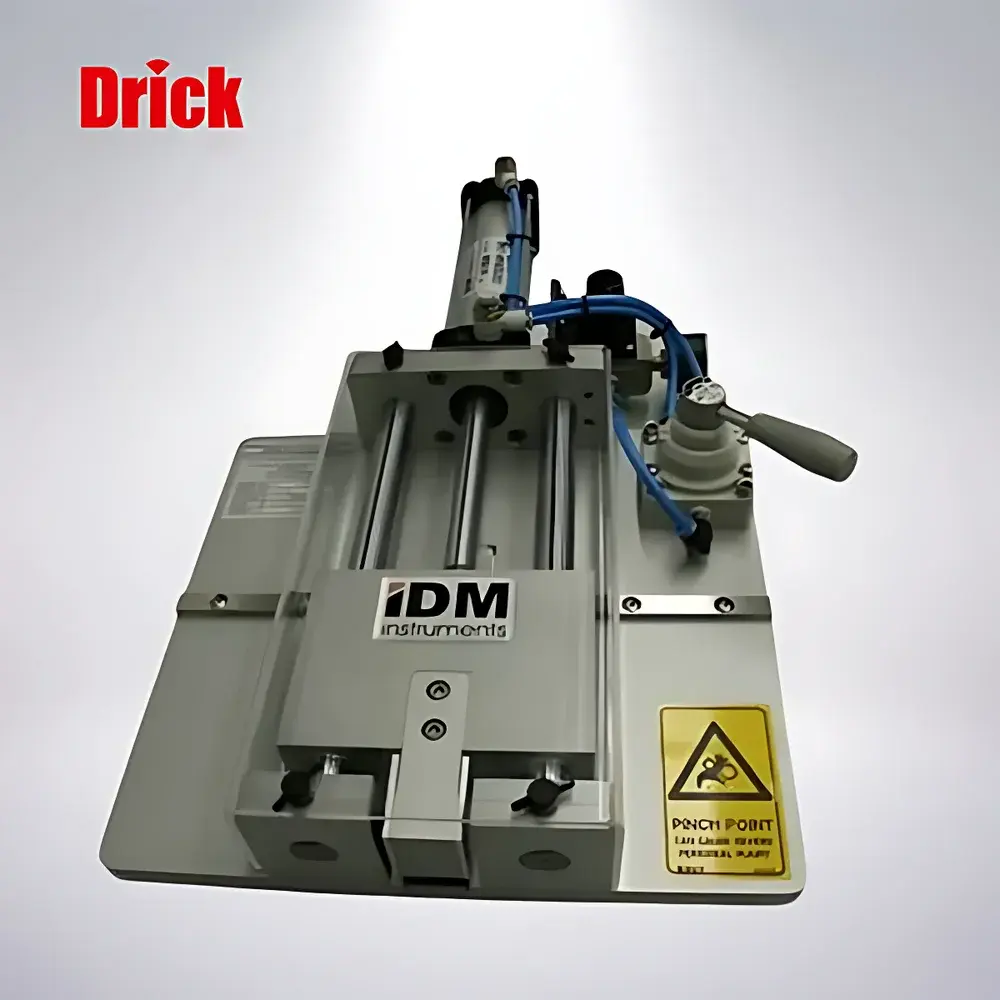
IDM E0001 Pneumatic Edge Crush Test (ECT) Sampler
| Brand | IDM |
|---|---|
| Origin | Shandong, China |
| Manufacturer Type | Authorized Distributor |
| Country of Origin | China |
| Model | E0001 |
| Price | USD 28,000 (FOB Qingdao) |
| Sampling Tool Compatibility | E0002 Cutting Die |
| Max Sample Thickness | 9 mm |
| Operating Pressure | 80 psi (5.5 bar) |
| Compliance Standards | AS/NZS 1301.444s, DIN 53149, ISO 3037, TAPPI T811 |
| E0001 Dimensions (H×W×D) | 20 × 100 × 20 mm |
| E0001 Weight | 1.0 kg |
| E0002 Dimensions (H×W×D) | 100 × 320 × 500 mm |
| E0002 Weight | 10.0 kg |
Overview
The IDM E0001 Pneumatic Edge Crush Test (ECT) Sampler is a precision-engineered sampling device designed exclusively for the preparation of standardized test specimens used in edge crush testing of corrugated fiberboard. It operates on a controlled pneumatic actuation principle—applying consistent 80 psi (5.5 bar) pressure to drive the E0002 cutting die through corrugated board samples, ensuring repeatable specimen geometry and minimal edge deformation. Unlike manual or hydraulic samplers, the E0001 delivers high reproducibility in specimen width (typically 15 mm or 25 mm per standard requirements), critical for minimizing measurement variance in downstream ECT testing per ISO 3037 and TAPPI T811. Its compact, modular architecture integrates seamlessly into QC laboratories and production-line testing stations where space efficiency and operator safety are prioritized. The system does not perform crush testing itself; rather, it fulfills the prerequisite specimen conditioning step mandated by international packaging standards before evaluation on dedicated ECT testers (e.g., Mullen or digital edge crush testers).
Key Features
- Pneumatically actuated cutting mechanism ensures uniform force application across all sample types—eliminating human-induced variability from hand-operated tools.
- Interchangeable hardened steel cutting blades (E0002 die set) support rapid maintenance and long-term dimensional stability under repeated use on multi-layered boards including single-, double-, and triple-wall corrugated media.
- Designed for specimens up to 9 mm thickness—covering the full operational range of commercial corrugated board, including wax-coated, clay-coated, and recycled-content substrates.
- Compact footprint (20 × 100 × 20 mm) enables benchtop deployment adjacent to edge crush testers without requiring dedicated floor space or structural anchoring.
- Compliance-ready construction: All mechanical tolerances and die alignment protocols conform to the dimensional verification clauses specified in ISO 3037 Annex A and TAPPI T811 Section 6.2 for specimen preparation equipment.
- Integrated pressure regulation interface compatible with standard industrial air supply lines (¼” NPT inlet), with optional inline filter-regulator-lubricator (FRL) unit recommended for sustained performance.
Sample Compatibility & Compliance
The E0001 sampler accommodates a broad spectrum of corrugated board configurations: single-face, single-wall, double-wall, triple-wall, and specialty laminates such as wax-impregnated boards (commonly referenced as “wax board” in North American packaging specifications). It maintains dimensional fidelity when processing printed vs. unprinted zones—enabling comparative analysis of print-induced fiber compression effects on edge strength, a key requirement in ASTM D642-based root-cause investigations. All prepared specimens meet the strict width tolerance limits (±0.2 mm) and edge squareness criteria defined in AS/NZS 1301.444s and DIN 53149. Validation documentation—including calibration certificates traceable to NIM (China National Institute of Metrology) and conformity statements referencing ISO/IEC 17025:2017—can be provided upon request for GLP/GMP-regulated environments.
Software & Data Management
As a mechanical sampling tool, the E0001 does not incorporate embedded firmware, onboard data logging, or connectivity interfaces. Its operation is fully manual and deterministic—requiring no software installation, driver configuration, or cybersecurity validation. This design aligns with ISO/IEC 17025 Clause 6.4.10 and FDA 21 CFR Part 11 Annex A guidance for non-computerized instrumentation: all output is physical (cut specimens), and measurement uncertainty originates solely from upstream metrological control of the cutting die and downstream ECT instrumentation—not from algorithmic interpretation or digital signal processing. Laboratories maintaining electronic records may log specimen IDs, batch numbers, and operator initials via LIMS-integrated barcode scanning of pre-labeled sample carriers—consistent with audit-ready workflows in certified packaging testing facilities.
Applications
- Preparation of standardized specimens for Edge Crush Test (ECT) in accordance with ISO 3037, TAPPI T811, and ASTM D642.
- Comparative assessment of edge strength degradation across printed/unprinted zones to quantify ink film or coating impact on board structural integrity.
- Quality gate testing at converting facilities prior to box erection—supporting real-time process adjustments in corrugator line speed or adhesive application parameters.
- Supplier qualification testing where specimen repeatability directly affects pass/fail decisions under contractual ECT thresholds (e.g., ≥6.0 kN/m for Class 30 shipping containers).
- R&D validation of new flute profiles (e.g., micro-flute B/C combinations) and recycled fiber blends where precise specimen geometry is essential for isolating material variables.
FAQ
Does the E0001 include an integrated edge crush tester?
No. The E0001 is a dedicated sampling device only. Edge crush measurement requires a separate ECT tester compliant with ISO 3037 or TAPPI T811.
Can the E0001 cut specimens from triple-wall corrugated board?
Yes—provided total board thickness does not exceed 9 mm and compressive resistance remains within the 80 psi pneumatic actuation capacity. Double- and triple-wall boards up to 8.5 mm have been validated in routine use.
Is calibration required before first use?
The E0001 is factory-aligned to nominal die clearance tolerances. Users should verify blade protrusion and parallelism annually using optical alignment gauges per ISO 9001:2015 Clause 7.1.5.
What maintenance is recommended for long-term accuracy?
Replace E0002 cutting blades after 5,000 cuts or upon visible edge rounding; clean air intake filters quarterly; inspect O-rings for pneumatic seal integrity every six months.
Does IDM provide traceable calibration documentation?
Yes—NIM-traceable dimensional verification reports and pressure regulator calibration certificates are available as optional deliverables under QA addendum contracts.




