
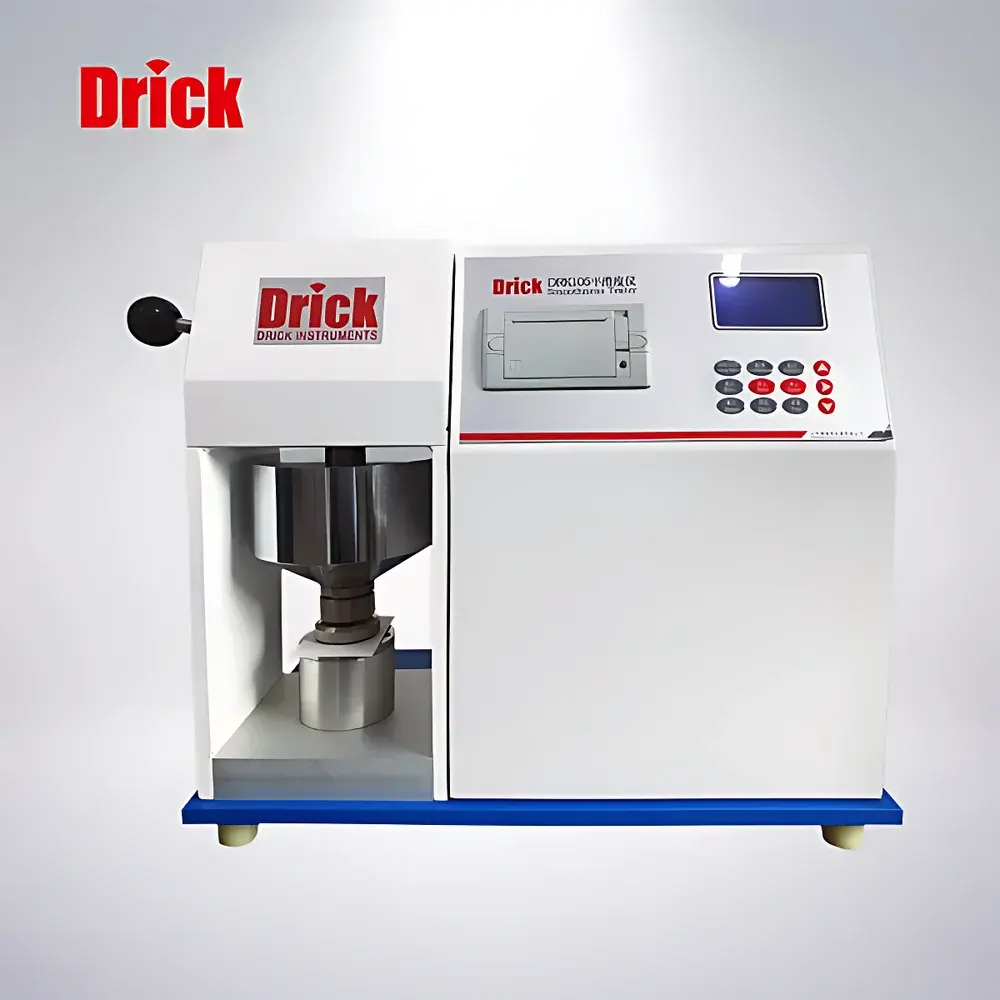
Drick DRK105 Bekk-Type Paper and Paperboard Smoothness Tester
| Brand | Drick |
|---|---|
| Origin | Shandong, China |
| Manufacturer Type | Direct Manufacturer |
| Country of Origin | China |
| Model | DRK 105 |
| Power Supply | AC 220 V ±5%, 50 Hz |
| Timing Accuracy | ±1 s at 1000 s |
| Measurement Range | 0–9999 s (three ranges: 1–15 s, 15–300 s, 300–9999 s) |
| Test Area | 10.00 ±0.05 cm² |
| Vacuum Chamber Volumes | Large chamber: 380 ±1 mL |
| Small chamber | 38 ±1 mL |
| Vacuum Setpoints | Range I & II: 50.66–48.00 kPa |
| Range III | 50.66–29.33 kPa |
| Air Ingress Volume | 10.00 ±0.20 mL (large chamber), 1.00 ±0.05 mL (small chamber) at pressure drop from 50.66 to 48.00 kPa |
| Applied Pressure | 100 ±2 kPa |
| Operating Environment | 5–35 °C, ≤85% RH |
| Dimensions (W×D×H) | 318 × 362 × 518 mm |
| Weight | 47 kg |
Overview
The Drick DRK105 Bekk-Type Paper and Paperboard Smoothness Tester is a precision instrument engineered for the quantitative determination of surface smoothness in high-gloss and low-porosity paper and paperboard substrates, in strict accordance with the fundamental principles of the Bekk air-leak method. This technique relies on measuring the time required for a defined volume of air to pass through the interface between a standardized test specimen and a polished glass anvil under controlled vacuum and applied pressure conditions. The resulting Bekk smoothness value—expressed in seconds—is inversely proportional to surface roughness and directly correlated with critical end-use performance attributes such as ink transfer uniformity, print gloss retention, coating adhesion, and calendering response. Designed exclusively for materials with thickness ≤0.5 mm and low air permeance (e.g., coated offset papers, cast-coated boards, and laminated packaging grades), the DRK105 excludes porous or thick substrates where uncontrolled air leakage would compromise measurement validity and repeatability.
Key Features
- Oil-free vacuum system: Integrates a high-reliability vacuum pump sourced from South Korea, eliminating lubricant contamination risks and ensuring clean, maintenance-light operation compliant with ISO 5627 environmental requirements.
- Dual-volume vacuum chambers: Offers selectable large (380 mL) and small (38 mL) chambers—enabling rapid measurement cycles (up to 10× faster with the small chamber) without sacrificing metrological integrity across the full 0–9999 s range.
- Precise vacuum control: Three programmable vacuum setpoint ranges support method-specific calibration: Ranges I and II maintain differential pressure stability (50.66–48.00 kPa) for standard Bekk testing; Range III extends down to 29.33 kPa for specialized low-smoothness evaluation protocols.
- High-fidelity sealing architecture: Utilizes imported vacuum-grade elastomeric gaskets and optimized clamping force distribution to achieve leak rates below 0.1 mL/min—meeting the sealing performance criteria specified in ISO 5627 Annex B and GB/T 456 Clause 6.2.
- Configurable pre-compression: Supports optional 60-second pre-load application prior to vacuum initiation, enhancing interfacial contact consistency for compressible or textured specimens.
- Modular thermal/impact printing: Integrated printer module accepts either thermal or dot-matrix printheads, enabling direct hardcopy output of individual test records, batch statistics, and operator-annotated metadata.
Sample Compatibility & Compliance
The DRK105 is validated for use with planar, non-perforated paper and paperboard specimens meeting ISO 5627 sample preparation guidelines: conditioned at 23 ±1 °C and 50 ±2% RH per ISO 187, cut to ≥50 mm × 50 mm, and free of folds, creases, or surface contaminants. It is explicitly unsuitable for materials exceeding 0.5 mm thickness or exhibiting air permeance >1 µm/(Pa·s) (as measured per ISO 5636-3), due to non-linear flow behavior violating Bekk method assumptions. Instrument compliance includes full alignment with ISO 5627:2021 and GB/T 456–2002, with documented traceability to national pressure and time standards. Calibration verification procedures follow ISO/IEC 17025–compliant internal protocols, including periodic validation using certified reference specimens with NIST-traceable smoothness values.
Software & Data Management
While the DRK105 operates as a standalone benchtop instrument with embedded firmware, its data architecture supports GLP-aligned recordkeeping. All measurements are timestamped, stored in non-volatile memory with operator ID tagging (via keypad input), and include chamber selection, vacuum range, pre-load status, and raw timing values. Export capability via RS-232 interface enables integration with laboratory information management systems (LIMS) or custom QA databases. Audit trails retain calibration history, firmware version logs, and parameter modification timestamps—supporting regulatory readiness for ISO 9001, ISO 13485, or FDA 21 CFR Part 11 environments when paired with appropriate electronic signature controls.
Applications
- Quality assurance of premium printing papers (e.g., LWC, SC, and coated freesheet grades) prior to pressroom release.
- Process monitoring during paper machine reel-up and calender stack optimization.
- R&D evaluation of surface sizing formulations, pigment dispersion efficiency, and nano-coating efficacy.
- Supplier qualification testing for folding carton board, label facestock, and metallized packaging substrates.
- Conformance verification against customer technical specifications referencing Bekk smoothness limits (e.g., “Bekk ≥1000 s @ 50 kPa” per TAPPI T 538).
FAQ
What is the maximum allowable specimen thickness for valid Bekk testing?
The DRK105 is validated only for specimens ≤0.5 mm thick. Thicker materials induce excessive deformation under 100 kPa pressure, invalidating the laminar flow assumption central to the Bekk method.
Why does the instrument offer two vacuum chamber volumes?
The small chamber (38 mL) reduces air volume displacement, shortening measurement duration by approximately 90% for specimens with Bekk values <300 s—enhancing throughput while maintaining ASTM D5262 repeatability thresholds.
Is operator training required to achieve ISO 5627 compliance?
Yes. Proper specimen conditioning, anvil cleaning frequency, gasket inspection intervals, and vacuum decay verification must be performed per Section 7 of ISO 5627. Drick provides a certified technician-led installation qualification (IQ) protocol.
Can the DRK105 be used for ISO 8791-2 (Parker Print-Surf) testing?
No. The Parker Print-Surf method employs distinct geometry, pressure differentials, and flow calculation algorithms. The DRK105 is designed solely for Bekk-type measurement per ISO 5627 and GB/T 456.
How often should the vacuum pump oil filter be replaced?
The oil-free design eliminates routine oil changes. However, the inlet particulate filter requires replacement every 6 months under continuous operation or after 500 test cycles—whichever occurs first.





