
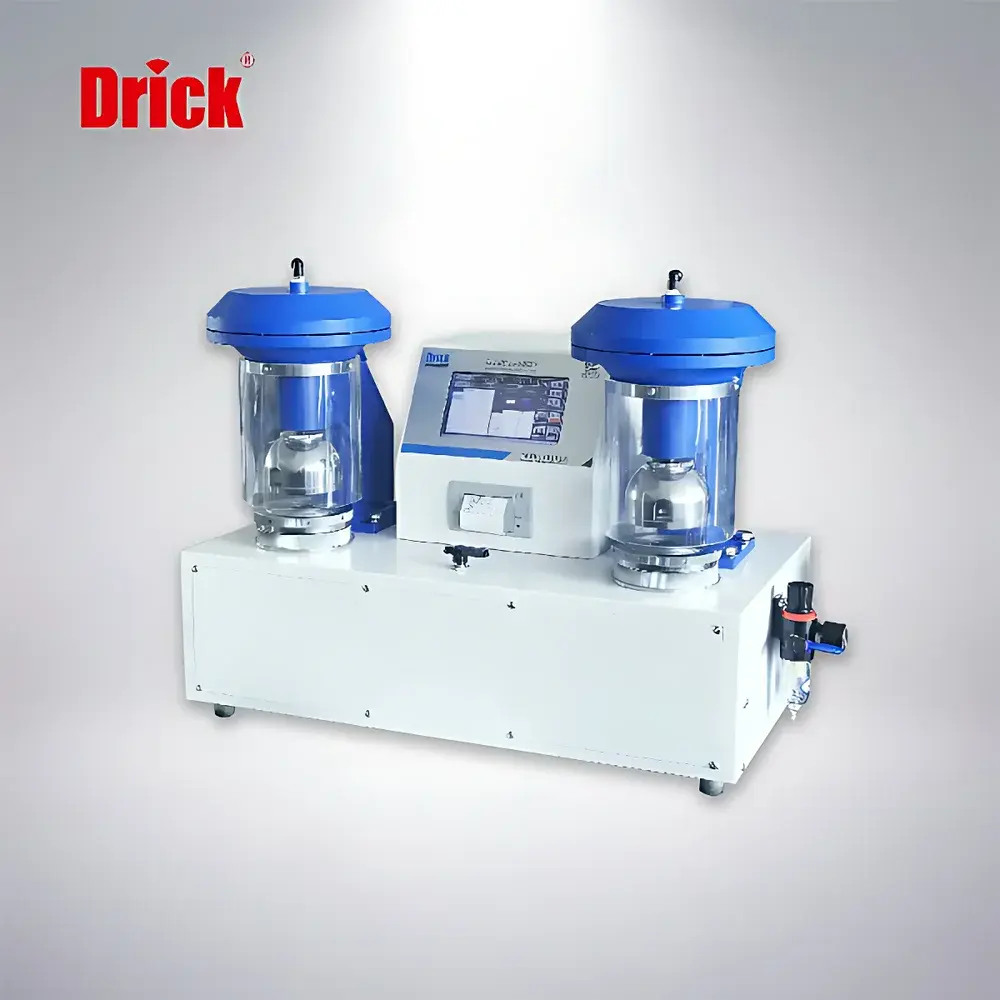
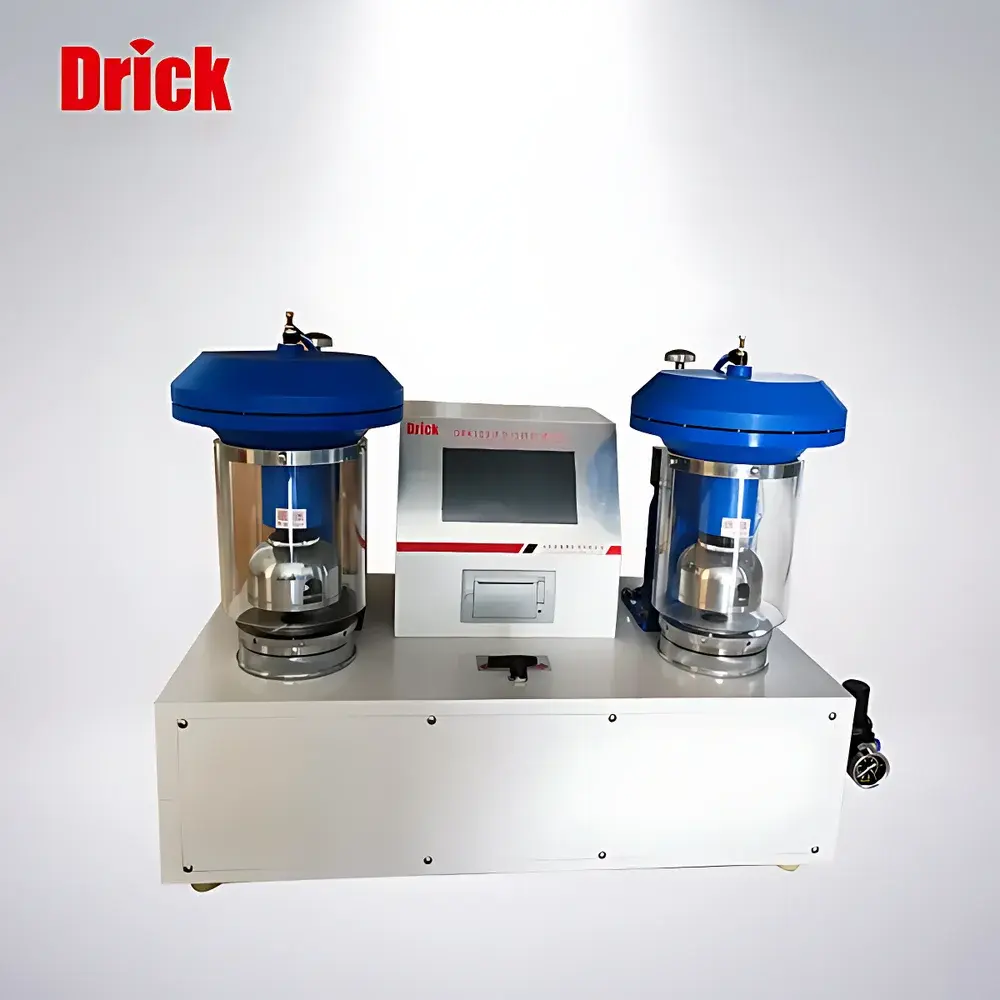
Drick DRK109ST Dual-Head Pneumatic Bursting Strength Tester for Paper and Paperboard
| Brand | Drick |
|---|---|
| Origin | Shandong, China |
| Manufacturer Type | Direct Manufacturer |
| Country of Origin | China |
| Model | DRK109ST |
| Measuring Range (Paper) | 50–2000 kPa |
| Measuring Range (Paperboard) | 250–6000 kPa |
| Clamp Force (Upper/Lower Platen) | >430 kPa / >690 kPa |
| Diaphragm Resistance (at 10 mm Bulge) | 20–40 kPa (Paper) / 170–220 kPa (Paperboard) |
| Temperature Range | 25°C ± 10°C |
| Ambient Humidity | 40–80% RH (non-condensing) |
| Accuracy | ±0.5% F.S. |
| Resolution | 0.1 kPa |
| Pressure Source | 0.7 MPa compressed air (external supply required) |
| Hydraulic System Leak Rate | <10% Pmax over 1 min at upper limit |
| Clamp Ring Dimensions | Upper φ30.5 ± 0.05 mm / Lower φ33.5 ± 0.05 mm (Paper) |
| Motor Power | 90 W |
| Dimensions (W×D×H) | 700 × 400 × 550 mm |
| Power Supply | AC 220 V ± 5%, 50 Hz |
| Compliance | ISO 2759, GB/T 454, GB/T 6545, GB 1539, QB/T 1057 |
Overview
The Drick DRK109ST Dual-Head Pneumatic Bursting Strength Tester is a precision-engineered instrument designed to determine the bursting strength of paper, corrugated fiberboard, and other flexible sheet materials according to internationally recognized mechanical testing principles. It operates on the hydraulic–pneumatic diaphragm bulge method: a standardized rubber diaphragm is hydraulically pressurized beneath a clamped specimen until rupture occurs; the peak pressure recorded—expressed in kilopascals (kPa)—represents the material’s resistance to perpendicular force. This principle aligns with the fundamental mechanics described in ISO 2759 and ASTM D774, where bursting strength serves as a critical proxy for internal bond integrity, surface cohesion, and structural resilience under localized stress. Unlike single-head testers, the DRK109ST integrates two independent test heads—one optimized for thin, high-compliance papers (50–2000 kPa), the other calibrated for rigid board substrates (250–6000 kPa)—enabling seamless transition between laboratory-grade paper evaluation and industrial-grade packaging validation without recalibration or mechanical reconfiguration.
Key Features
- Dual-head architecture with dedicated pneumatic–hydraulic actuation systems for paper and paperboard modes, eliminating cross-range interpolation errors
- Touchscreen HMI interface with embedded real-time control logic, supporting intuitive parameter selection, test initiation, and immediate result visualization
- Self-contained hydraulic circuit with verified seal integrity: pressure decay ≤10% of maximum test pressure within 60 seconds at full scale, ensuring measurement stability per ISO 2759 Annex B requirements
- High-precision load cell and digital signal conditioning delivering 0.1 kPa resolution and ±0.5% full-scale accuracy, traceable to national metrological standards
- Automated clamp actuation with programmable platen force (>430 kPa for paper, >690 kPa for board) to ensure consistent specimen confinement and eliminate edge slippage artifacts
- Integrated thermal-stabilized diaphragm module with defined bulge height (10 mm) and controlled resistance profiles (20–40 kPa for paper; 170–220 kPa for board), compliant with GB/T 454 and GB/T 6545 specifications
- Onboard data logging with timestamped storage, CSV export capability, and GLP-compliant audit trail generation for regulatory review
Sample Compatibility & Compliance
The DRK109ST accommodates standard circular specimens (φ30.5 ± 0.05 mm upper clamp, φ33.5 ± 0.05 mm lower clamp for paper; φ31.5 ± 0.05 mm for board) cut per ISO 186 and TAPPI T403. It supports not only virgin and recycled papers (e.g., copy paper, newsprint, kraft liner), but also corrugated medium, solid fiberboard, honeycomb cores, and non-woven textiles such as silk and cotton fabric—provided tensile modulus and thickness fall within validated operational envelopes. All mechanical and procedural parameters adhere strictly to ISO 2759 (paperboard), ISO 2758 (paper), GB/T 454, GB/T 6545, GB 1539, and QB/T 1057. The system meets functional equivalence to ASTM D774 and TAPPI T810 for comparative benchmarking in global supply chain QA/QC workflows.
Software & Data Management
The proprietary DrickTest v3.2 software provides full instrument control, automated statistical analysis (mean, SD, CV%, max/min), and configurable report templates aligned with ISO/IEC 17025 documentation requirements. Raw pressure–time curves are stored with metadata including operator ID, environmental conditions (ambient temperature/humidity), calibration certificate ID, and firmware version. Export formats include PDF (with digital signature support), Excel (.xlsx), and XML for LIMS integration. Audit trails record all user actions—including parameter edits, calibration events, and result deletions—with immutable timestamps and role-based access control, satisfying FDA 21 CFR Part 11 and EU Annex 11 electronic record retention mandates.
Applications
- Quality assurance of linerboard and corrugated shipping containers in packaging manufacturing facilities
- R&D evaluation of pulp refining efficiency, filler dispersion, and sizing agent performance in paper mills
- Supplier qualification testing for sustainable packaging materials (e.g., molded fiber trays, bamboo-based boards)
- Regulatory conformance verification for medical device packaging per ISO 11607-1 mechanical integrity clauses
- Failure mode analysis of printed cartons subjected to warehouse stacking loads or transit vibration
- Validation of recycled content impact on burst resistance across multi-layer composite structures
FAQ
What standards does the DRK109ST comply with?
ISO 2759, ISO 2758, GB/T 454, GB/T 6545, GB 1539, QB/T 1057, and technical equivalency to ASTM D774 and TAPPI T810.
Is external compressed air required?
Yes—a clean, dry, oil-free air supply at 0.7 MPa is mandatory; optional integrated air dryer and regulator kits are available upon request.
Can test data be exported to a corporate LIMS?
Yes—via USB or Ethernet, using structured CSV or XML output with customizable field mapping and ISO/IEC 17025-compliant metadata tagging.
Does the system support GLP/GMP audit trails?
Yes—full electronic record history with user authentication, timestamped event logs, and tamper-evident archiving enabled by default.
What maintenance intervals are recommended?
Diaphragm replacement every 10,000 cycles or annually (whichever occurs first); hydraulic fluid inspection quarterly; annual metrological recalibration traceable to CNAS-accredited labs.





