
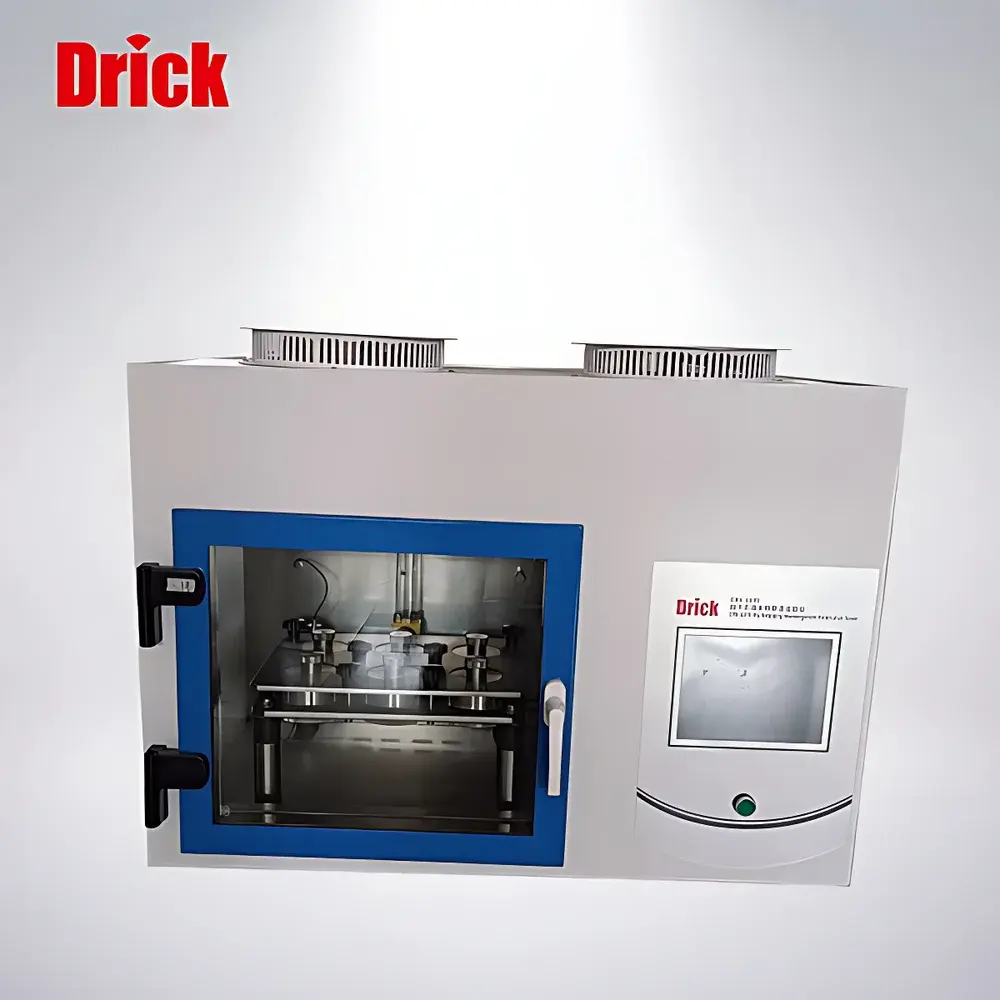
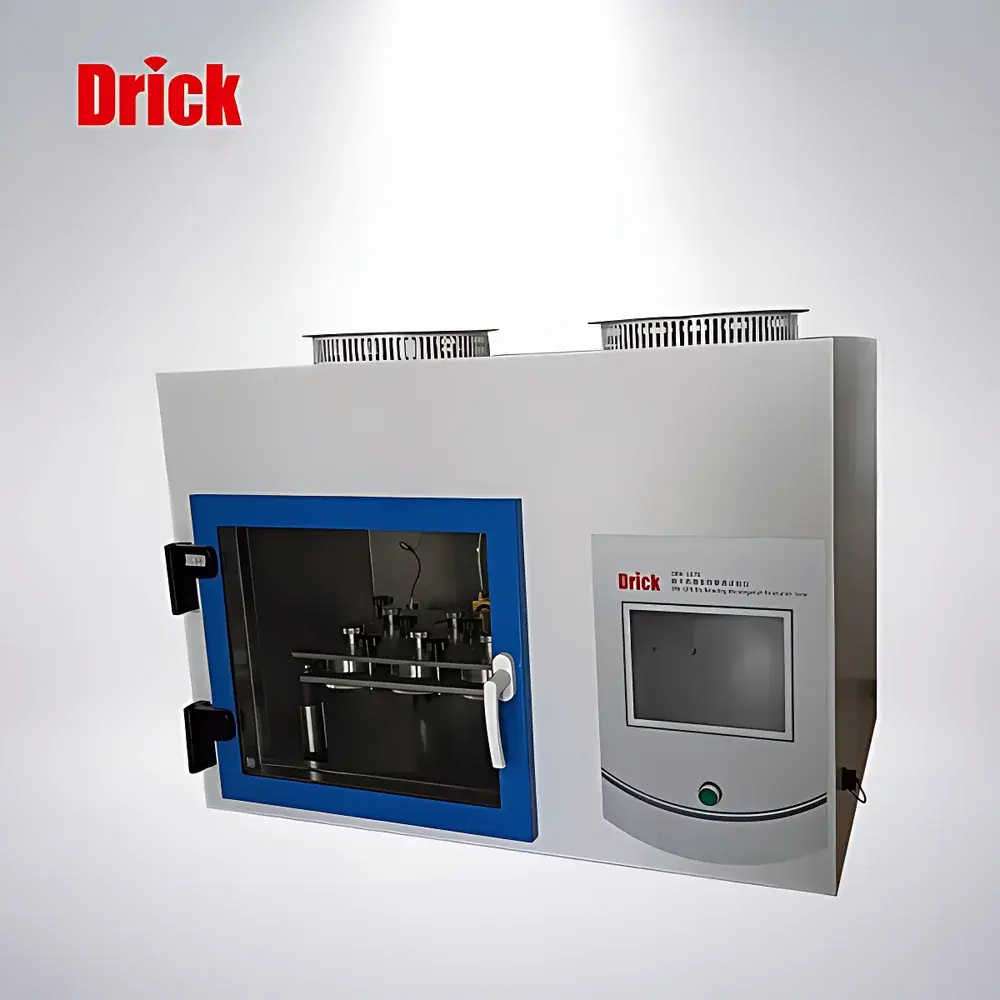
Drick DRK1070 Dry-State Microbial Penetration Tester
| Brand | Drick |
|---|---|
| Origin | Shandong, China |
| Manufacturer Type | Original Equipment Manufacturer (OEM) |
| Regional Classification | Domestic (China) |
| Model | DRK1070-1 |
| Power Supply | AC 220 V, 50 Hz |
| Max. Power Consumption | < 2000 W |
| Vibration Mechanism | Pneumatic Spherical Oscillator |
| Vibration Frequency | 20,800 cycles/min (347 Hz) |
| Dynamic Force Output | 650 N |
| Test Chamber Negative Pressure Range | −50 to −200 Pa |
| Cabinet Airflow Rate | ≥ 5 m³/min |
| HEPA Filtration Efficiency | > 99.99% (at 0.3 µm) |
| Stainless Steel Test Vessels | 6 units, each with piston seal and Petri dish slot |
| Work Surface | 400 mm × 400 mm × 10 mm marble plate |
| Data Storage Capacity | 5000 test records |
| Dimensions (W×D×H) | 1000 × 680 × 670 mm |
| Net Weight | ≈ 130 kg |
Overview
The Drick DRK1070 Dry-State Microbial Penetration Tester is a purpose-built, ISO- and YY/T-compliant instrumentation system engineered to evaluate the resistance of medical barrier materials—including surgical gowns, drapes, cleanroom garments, and instrument covers—to dry-state microbial penetration under controlled mechanical stress. Unlike liquid or aerosol challenge methods, this system simulates real-world dry particulate transmission pathways by applying high-frequency, high-force pneumatic oscillation to test specimens mounted over sterile agar-filled Petri dishes. The core principle follows the standardized dry-state challenge protocol defined in EN ISO 22612:2005 and YY/T 0506.5–2009, where microorganisms (typically Bacillus subtilis spores or Staphylococcus aureus) are introduced as dried particulates onto the outer surface of the material; mechanical vibration then induces micro-fracture propagation and particle migration across the fabric matrix. The absence of colony growth on underlying agar after incubation indicates effective barrier performance.
Key Features
- Integrated negative-pressure containment cabinet with dual-stage HEPA filtration (≥99.99% @ 0.3 µm), ensuring operator biosafety and environmental isolation during testing.
- Pneumatic spherical oscillator delivering precise, repeatable vibration at 20,800 cycles per minute (347 Hz) with calibrated dynamic force output of 650 N—fully compliant with ISO 22612 mechanical stimulus requirements.
- Six parallel stainless-steel test vessels with precision-machined piston seals and bottom-mounted Petri dish slots, enabling simultaneous multi-sample evaluation under identical conditions.
- Industrial-grade 7-inch color touchscreen HMI with password-protected user access levels, real-time parameter monitoring, and automatic fault detection with safety interlock shutdown.
- Onboard data logging system storing up to 5,000 complete test records—including timestamp, pressure setpoint, vibration duration, and operator ID—with USB export capability for audit-ready traceability.
- Robust cabinet construction: inner chamber formed from seamless 304 stainless steel; outer shell fabricated from powder-coated cold-rolled steel; thermal and flame-retardant insulation layer between panels.
- Integrated LED task lighting, earth-leakage circuit breaker, and adjustable rubber leveling feet for stable operation on standard laboratory flooring.
Sample Compatibility & Compliance
The DRK1070 accommodates flat, non-stretch barrier materials up to 150 mm × 150 mm in dimension and ≤5 mm in thickness. Compatible substrates include woven/nonwoven polypropylene, SMS laminates, spunbond-meltblown composites, coated polyester, and Tyvek® derivatives. All test configurations conform strictly to the specimen mounting, orientation, and environmental preconditioning stipulated in EN ISO 22612:2005 and YY/T 0506.5–2009. The system supports GLP-aligned workflows through configurable audit trails, electronic signature support (via optional software module), and full compliance with FDA 21 CFR Part 11 requirements when deployed with validated firmware and networked data management protocols.
Software & Data Management
The embedded control software provides intuitive workflow navigation, parameter calibration wizards, and real-time graphical feedback of cabinet pressure stability and vibration amplitude consistency. Each test record includes metadata fields for test standard reference, microbiological strain identifier, operator credentials, ambient temperature/humidity logs (when integrated with external sensors), and pass/fail determination based on preconfigured colony count thresholds. Data exports generate CSV files compatible with LIMS integration and statistical process control (SPC) platforms. Optional software modules enable remote diagnostics, automated report generation (PDF/Excel), and secure cloud-based backup aligned with ISO/IEC 27001 data governance frameworks.
Applications
- Quality assurance testing of surgical drapes and gowns prior to sterilization and distribution.
- Comparative evaluation of new barrier material formulations during R&D.
- Validation of cleanroom garment integrity for pharmaceutical aseptic processing environments.
- Regulatory submission support for CE marking (Class I/IIa), NMPA registration, and FDA 510(k) clearance pathways.
- Internal compliance audits against ISO 13485 quality management system requirements.
- Root-cause analysis of barrier failure incidents in clinical or manufacturing settings.
FAQ
What microbial strains are recommended for use with the DRK1070?
Bacillus subtilis var. niger (ATCC 9372) spores are the primary challenge organism specified in EN ISO 22612; alternative strains such as Staphylococcus aureus (ATCC 6538) may be used per internal validation protocols.
Is compressed air supply included with the instrument?
No—the DRK1070 requires an external oil-free compressed air source delivering 0.6–0.8 MPa at ≥10 L/min flow rate; optional air storage tank kits are available as accessories.
Can the system be integrated into a laboratory network for centralized data collection?
Yes—Ethernet connectivity is standard; optional OPC UA or REST API interfaces support integration with enterprise LIMS, MES, or QMS platforms.
Does the instrument meet electromagnetic compatibility (EMC) requirements for clinical environments?
Yes—the DRK1070 complies with IEC 61326-1:2013 Class B emission and immunity standards for laboratory equipment.
What maintenance intervals are recommended for HEPA filters and vibration actuators?
HEPA filters require replacement every 12 months or after 2,000 operating hours; pneumatic oscillators undergo biannual calibration verification using certified force transducers and frequency analyzers.





