
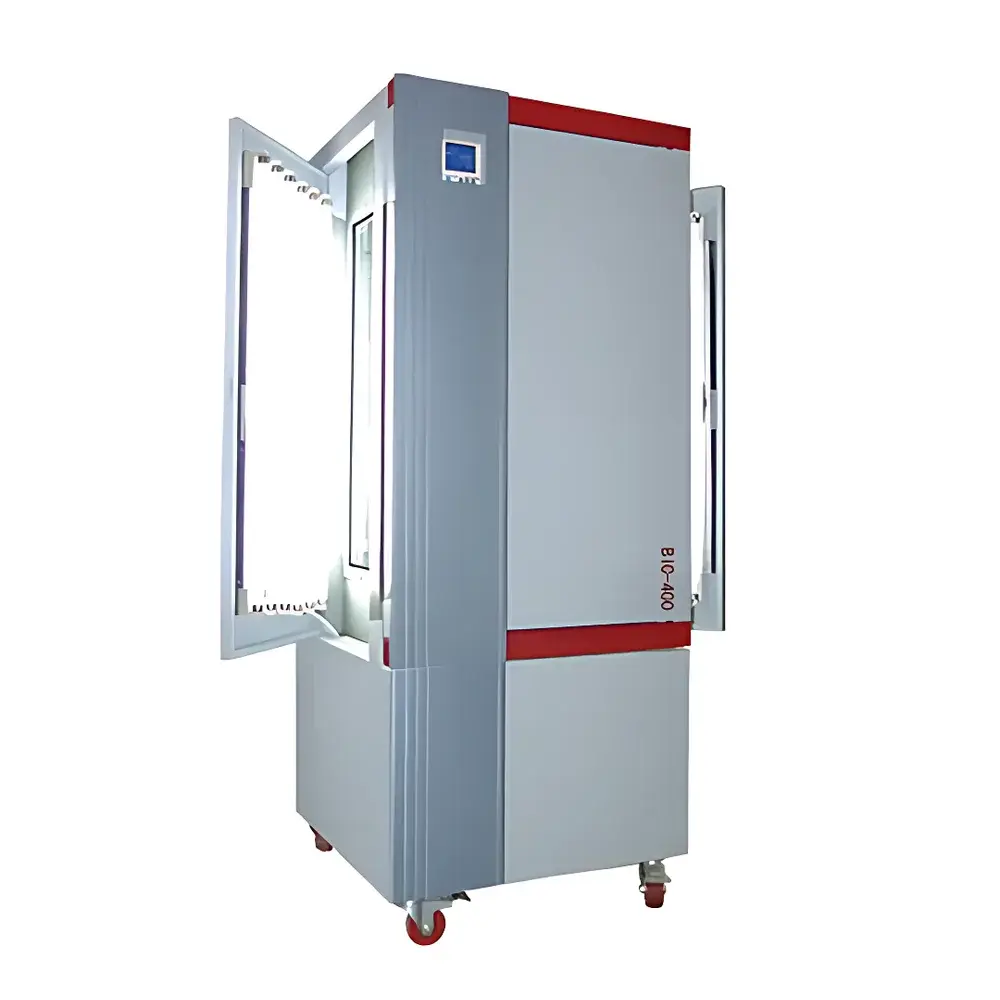
Brookfield BIC-250 Pharmaceutical Stability Testing Chamber
| Brand | Jihepu |
|---|---|
| Origin | Shandong, China |
| Model | BIC-250 |
| Temperature Control Range (dark) | 0–60 °C |
| (with light) | 10–60 °C |
| Temperature Resolution | 0.1 °C |
| Temperature Uniformity | ±1 °C |
| Temperature Fluctuation | ±0.5 °C |
| Humidity Range | 60–90 %RH |
| Humidity Fluctuation | ±5 %RH |
| Illumination Intensity | 0–15,000 lx (6-level adjustable) |
| Power Input | 1600 W |
| Timer Range | 0–9999 min |
| Interior Dimensions (W×D×H) | 480×480×1100 mm |
| Exterior Dimensions (W×D×H) | 710×775×1770 mm |
| Shelving | 4 adjustable stainless steel shelves |
| Refrigeration | Eco-friendly R134a-free compressor system with integrated frost-free defrost |
| Control Interface | LCD with microprocessor-based PID control |
| Communication | RS-485 port for external data logging or PC integration |
| Compliance | Designed to support ICH Q1–Q5 guidelines for stability testing under GLP/GMP-aligned operational conditions |
Overview
The Brookfield BIC-250 Pharmaceutical Stability Testing Chamber is an engineered environmental simulation system designed specifically for long-term, controlled-condition drug stability studies in compliance with International Council for Harmonisation (ICH) Q1A(R3), Q5C, and related regulatory expectations. It operates on a dual-mode principle—precise thermohygrometric regulation combined with programmable photometric exposure—to replicate real-world storage environments including accelerated, intermediate, and long-term stability test conditions defined in ICH Q1. The chamber employs a high-efficiency, non-ozone-depleting refrigeration architecture with an integrated, energy-neutral defrost cycle that eliminates thermal disturbance during extended unattended operation. Its robust construction—cold-rolled steel exterior with electrostatic powder coating and mirror-finish 304 stainless steel interior—ensures corrosion resistance, cleanability, and compatibility with routine disinfection protocols required in GxP laboratories.
Key Features
- Microprocessor-based PID temperature and humidity control with real-time digital display of setpoints, actual values, and elapsed time
- Independent six-level illumination control (0–15,000 lx) using three-dimensional LED array configuration to ensure spatial uniformity across all shelf levels
- Advanced air circulation design featuring laminar airflow distribution and vertical convection enhancement for ±1 °C temperature uniformity and ±5 %RH humidity consistency throughout the 250 L working volume
- Frost-free defrost system utilizing patented passive heat exchange—no power consumption or temperature offset during defrost cycles
- Configurable 30-segment, 99-cycle programmable profile scheduler supporting complex ICH-compliant ramp-hold sequences (e.g., 40 °C/75 %RH for 6 months, followed by 25 °C/60 %RH for 12 months)
- RS-485 serial interface compliant with Modbus RTU protocol for integration into centralized environmental monitoring systems (EMS) and electronic lab notebooks (ELN)
- Power-fail recovery function with non-volatile memory retention of all active parameters and runtime logs
- Dual-sensor redundancy architecture: capacitive humidity sensor (imported) + PT100 temperature probe, both calibrated traceable to NIST standards
Sample Compatibility & Compliance
The BIC-250 accommodates standard pharmaceutical packaging formats—including blister packs, HDPE bottles, glass vials, and secondary cartons—across four independently adjustable stainless steel shelves (load capacity: ≤15 kg per shelf). Its internal geometry (480 × 480 × 1100 mm) permits simultaneous placement of multiple ICH reference batches without cross-contamination risk. The chamber meets essential design criteria referenced in USP , ISO 14644-1 Class 8 background environment suitability, and supports audit readiness for FDA 21 CFR Part 11-compliant data integrity when paired with validated third-party data acquisition software. Optional GPRS alarm modules provide remote notification of out-of-specification excursions, while optional thermal printer output enables hard-copy generation of trend curves aligned with ALCOA+ principles.
Software & Data Management
While the BIC-250 operates autonomously via its embedded controller, its RS-485 interface enables bidirectional communication with industry-standard environmental monitoring platforms such as DeltaTrak Vision, Vaisala viewLinc, or custom SCADA implementations. All logged data—including timestamped temperature, humidity, illumination intensity, and alarm events—are structured in CSV-compatible format with UTC synchronization capability. Audit trail functionality (when used with compliant host software) records user actions, parameter changes, and system events with immutable timestamps—fulfilling requirements for GLP documentation and FDA inspection preparedness. Firmware updates are delivered via secure USB dongle, ensuring version control and traceability.
Applications
- ICH Q1A(R3) real-time and accelerated stability testing of APIs and finished dosage forms
- Photostability assessment per ICH Q5C under Option 1 (optionally configured with UV-filtered lamps)
- Excipient compatibility screening under variable hygrothermal stress
- Reference standard storage under controlled ambient conditions (25 °C/60 %RH)
- Microbial growth inhibition validation at elevated humidity endpoints
- Stability-indicating method development support through forced degradation condition simulation
FAQ
Does the BIC-250 meet ICH Q1 requirements for temperature and humidity tolerances?
Yes—the chamber maintains ±0.5 °C temperature fluctuation and ±5 %RH humidity deviation over its specified operating range, satisfying ICH Q1A(R3) instrumentation performance thresholds for Zone IVb climatic zones.
Can the unit be qualified per GxP standards?
Yes—its design supports IQ/OQ/PQ execution using vendor-provided qualification protocols. Calibration certificates for temperature and humidity sensors are available upon request with NIST-traceable documentation.
Is remote monitoring supported out of the box?
Standard RS-485 connectivity enables integration with existing EMS infrastructure. Optional GPRS module adds cellular-based SMS alerts for critical deviations without requiring local network access.
What maintenance intervals are recommended?
Compressor oil and refrigerant integrity checks every 24 months; humidity sensor recalibration annually; condensate tray cleaning weekly; air filter replacement quarterly—per documented maintenance log templates supplied with the system.





