
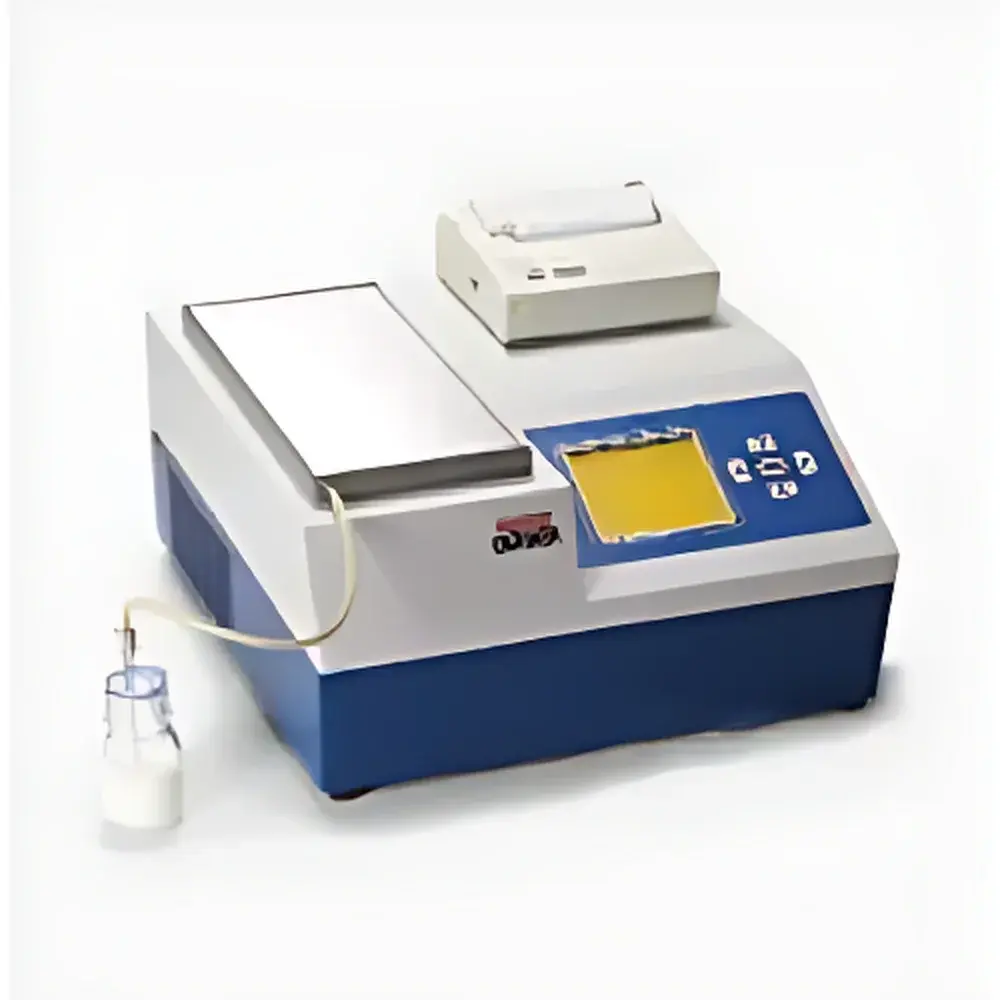
Gerber LactoStar1 Dairy Analyzer
| Brand | Funke |
|---|---|
| Origin | Germany |
| Manufacturer Type | Authorized Distributor |
| Country of Origin | Imported |
| Model | LactoStar1 |
| Price | Upon Request |
Overview
The Gerber LactoStar1 Dairy Analyzer is a benchtop, near-infrared (NIR) and thermometric optical instrument engineered for rapid, non-destructive quantification of key compositional parameters in raw and processed milk matrices. Based on dual-mode measurement—integrating multi-wavelength photometric absorption (blue module) and precision freezing point depression thermometry (red module)—the system delivers traceable, reproducible results compliant with internationally recognized dairy testing protocols including ISO 9622:2013 (Milk — Determination of fat, protein and lactose content — Guidance on the use of mid-infrared spectrometry) and IDF Standard 141:2015. Designed for routine quality control in dairy collection centers, processing plants, and regulatory laboratories, the LactoStar1 operates without chemical reagents or sample derivatization, minimizing operator intervention while maintaining analytical integrity across heterogeneous milk types—including bovine, caprine, ovine, and human breast milk.
Key Features
- Multi-matrix calibration library: Stores up to 20 independent calibration sets, enabling seamless switching between raw milk, whole milk, skim milk, cream, and specialty milks without recalibration.
- Automated maintenance cycle: Integrated rinse pump and sample pump execute zero-point calibration, channel flushing, and scheduled cleaning—triggered automatically after >5 minutes of idle time or manually via the “Clean” menu.
- Dual-sensor architecture: Optical measurement unit (blue module) performs simultaneous NIR-based quantification of fat, protein, lactose, SNF, and minerals; thermometric module (red module) measures freezing point depression with ±0.002 °C repeatability for adulteration screening.
- Integrated data handling: Built-in thermal printer provides immediate hard-copy output; RS232 serial interface supports bidirectional communication with laboratory information management systems (LIMS) or custom PC-based software for audit-trail-enabled data export.
- Compact benchtop design: 44 cm × 44 cm × 20 cm footprint; 15.5 kg mass; compatible with standard 230/180 V AC (50–60 Hz) or 12 V DC power sources for mobile or off-grid deployment.
Sample Compatibility & Compliance
The LactoStar1 accepts liquid milk samples ranging from 12–20 mL per analysis—optimized for homogenized, unfiltered, and temperature-equilibrated specimens at 20–25 °C. It demonstrates validated performance across species-specific milks (bovine, caprine, ovine, human), supporting compositional profiling in maternal nutrition studies and infant formula R&D. All reported measurement ranges and repeatability values comply with ISO/IEC 17025:2017 general requirements for competence of testing and calibration laboratories. Instrument firmware includes configurable user access levels and timestamped operation logs—facilitating GLP/GMP-aligned workflows and readiness for FDA 21 CFR Part 11-compliant electronic record review where paired with validated third-party software.
Software & Data Management
Data acquisition and reporting are managed through the embedded LCD interface (three-button navigation) and external serial communication. Raw measurement values—including fat (0.01–35.00 %), protein (0.01–10.00 %), lactose (0.01–10.00 %), SNF (0.01–15.00 %), minerals (0.01–5.00 %), and freezing point (−0.500 to −0.001 °C)—are stored with full metadata (date/time, calibration ID, operator code). Exported ASCII files contain tab-delimited fields suitable for statistical process control (SPC) integration or Excel-based trending. Audit trails capture all critical events: calibration changes, cleaning cycles, measurement triggers, and parameter edits—ensuring traceability required under ISO 17025 Clause 7.7 and EU Regulation (EC) No 852/2004.
Applications
- On-farm and collection center milk payment testing based on fat/protein benchmarks
- Adulteration detection via freezing point deviation (e.g., water dilution, urea addition)
- QC release testing for pasteurized, UHT, and powdered dairy products
- Clinical and nutritional research on human milk composition dynamics during lactation
- Formulation validation in infant formula and medical nutrition manufacturing
- Regulatory compliance verification against national standards (e.g., Codex Alimentarius STAN 206-1999, US Grade A Pasteurized Milk Ordinance)
FAQ
What sample volume is required for a single analysis?
12–20 mL of homogenized, room-temperature milk is sufficient; 30 mL is not required—the stated 30 mL reflects conservative operational guidance in certain field conditions.
Does the instrument require daily recalibration?
No. The LactoStar1 maintains calibration stability across shifts when operated within specified environmental conditions (15–30 °C ambient, <70 % RH); periodic verification using certified reference materials is recommended per ISO 9622 Annex B.
Can it analyze frozen or refrigerated milk directly?
Samples must be equilibrated to 20–25 °C prior to loading; cold-induced fat globule aggregation compromises optical path consistency and thermometric response accuracy.
Is the freezing point module traceable to NIST standards?
Yes—the thermometric sensor is factory-calibrated against certified freezing point standards traceable to PTB (Physikalisch-Technische Bundesanstalt), Germany’s national metrology institute.
How is data security ensured during RS232 transmission?
RS232 communication is unencrypted by default; secure data transfer requires implementation of application-layer encryption or network isolation per organizational IT policy—consistent with ISO/IEC 27001 Annex A.8.2.3.



