
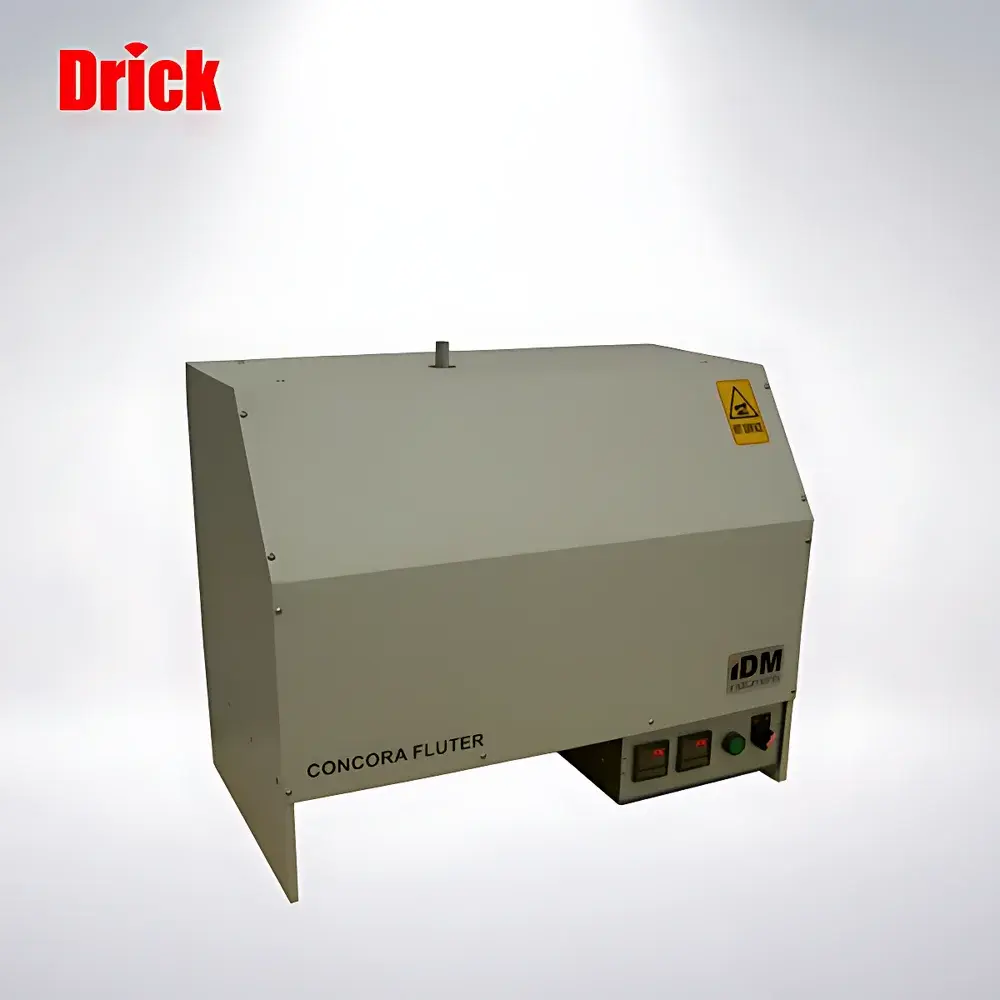
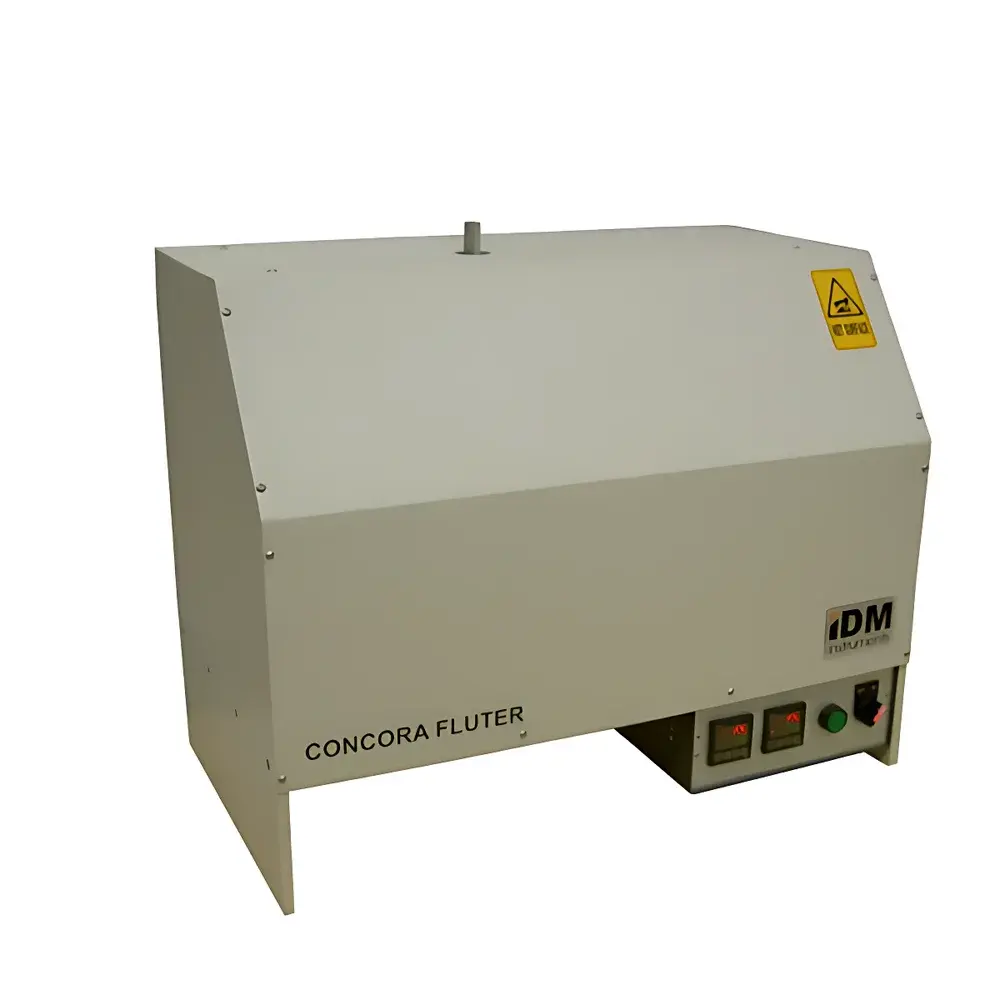
IDM C0013 Corrugator Tester for Flute Formation and Flat Crush Resistance Testing
| Brand | IDM |
|---|---|
| Origin | Shandong, China |
| Manufacturer Type | Authorized Distributor |
| Country of Origin | China |
| Model | C0013 |
| Price | USD 7,000 (FOB) |
| Heating Roll Temperature Range | Ambient to 200 °C |
| Temperature Accuracy | ±2 °C |
| Load Capacity | 98 N (±4 N accuracy) |
| Compliance Standards | AS/NZS 1301.434, CPPA D24, DIN 53143, SCAN P27, ISO 7263, TAPPI T 809, TAPPI T 824 |
| Power Supply | 220–240 VAC @ 50 Hz or 110 VAC @ 60 Hz (customizable) |
| Dimensions (H×W×D) | 400 × 745 × 427 mm |
| Weight | 60 kg |
Overview
The IDM C0013 Corrugator Tester is a precision-engineered laboratory instrument designed to simulate the industrial fluting process and quantitatively evaluate the mechanical integrity of corrugated medium (linerboard and fluting medium) prior to full-scale board lamination. It operates on the principle of controlled thermal-mechanical deformation: two heated rolls—typically one fixed and one adjustable—apply calibrated pressure and temperature to form standardized flute profiles (e.g., A-, B-, C-, or E-flute geometry) in single-ply corrugating medium. Following fluting, the instrument performs flat crush resistance (FCR) testing per ISO 7263 and TAPPI T 809, measuring peak load (in newtons) required to compress the fluted sample perpendicular to its flute direction. This dual-function capability—flute formation followed by immediate FCR assessment—enables R&D labs and QC departments to isolate the contribution of raw paper properties (fibre morphology, moisture content, starch compatibility, and pre-compression resilience) to final board performance, particularly under downstream converting stresses such as die-cutting, creasing, and high-speed printing.
Key Features
- Integrated dual-stage operation: precise flute formation followed by in-situ flat crush resistance measurement—eliminating sample transfer errors and environmental exposure.
- Heated roll system with PID-controlled temperature regulation; setpoint range 30–200 °C, stability ±2 °C over full operating cycle.
- Dedicated emergency stop circuit and independent overtemperature alarm (audible + visual) compliant with IEC 61000-6-2 EMC and EN 60204-1 safety directives.
- Auto-calibrating temperature controller with real-time thermocouple feedback and user-accessible calibration offset adjustment.
- Load cell with 98 N full-scale capacity and ±4 N linearity tolerance, traceable to NIST-equivalent national standards.
- Modular sample carriage with quick-release clamping mechanism supporting standard test specimens (152 mm × 152 mm per TAPPI T 809).
Sample Compatibility & Compliance
The C0013 accommodates uncoated and lightly coated kraft linerboards, test liners, and fluting mediums with basis weights from 80 to 220 g/m² and moisture contents between 5.5% and 9.5%. Specimen width is limited to ≤180 mm to ensure uniform heat transfer and mechanical engagement across the flute profile. All test protocols align with internationally recognized packaging material standards—including ISO 7263 (corrugated fibreboard — determination of flat crush resistance), TAPPI T 809 (flat crush resistance of corrugating medium), TAPPI T 824 (edge crush test of corrugated fibreboard), and SCAN P27 (flat crush of fluting medium). The instrument’s mechanical design and procedural documentation support GLP-compliant data generation, and optional audit-trail-enabled firmware upgrades facilitate alignment with FDA 21 CFR Part 11 requirements for electronic records in regulated manufacturing environments.
Software & Data Management
The C0013 operates via embedded microcontroller-based firmware with local LCD interface (no PC dependency for basic operation). Optional USB-connected PC software (Windows 10/11 compatible) provides real-time load vs. displacement curve visualization, automated pass/fail flagging against user-defined specification limits, and export to CSV or PDF formats. All test logs include timestamp, operator ID, ambient RH/T, specimen ID, temperature setpoint, actual roll surface temperature, peak load, and deformation at 10% compression. Data files are digitally signed and append a SHA-256 hash for integrity verification—supporting traceability in ISO/IEC 17025-accredited laboratories.
Applications
- Raw material qualification: screening incoming fluting medium batches for consistency in flute-forming behavior and post-fluting crush resistance.
- Process optimization: evaluating impact of starch formulation, pre-humidification, and roll gap settings on flute geometry fidelity and structural resilience.
- Product development: correlating fibre furnish changes (e.g., hardwood/softwood ratio, recycled content) with flat crush retention after simulated hot-press conditions.
- Quality assurance: routine monitoring of production-line medium to detect early degradation due to storage humidity fluctuations or aging.
- Standards compliance testing: generating certified reports for customer audits requiring ISO 7263, TAPPI T 809, or CPPA D24 conformance evidence.
FAQ
Does the C0013 generate ASTM-certified test reports?
No—ASTM does not publish a dedicated standard for fluting or flat crush of medium; however, the instrument implements test methodologies fully aligned with ISO 7263 and TAPPI T 809, which are referenced in ASTM D7251 (Standard Guide for Corrugated Fiberboard Performance Testing).
Can the heating rolls be replaced with chilled rolls for low-temperature fluting studies?
Not natively—the C0013 is engineered exclusively for thermal fluting. Custom roll assemblies with Peltier cooling modules are available under OEM engineering agreement, subject to lead time and validation protocol development.
Is third-party calibration certification included with purchase?
A factory-issued calibration certificate (traceable to CNAS-accredited metrology lab) is provided. Full ISO/IEC 17025 calibration with uncertainty budget requires separate service contract.
What maintenance intervals are recommended for the load cell and temperature sensors?
Annual verification of load cell linearity and thermocouple drift is advised. Daily visual inspection of roll surfaces and weekly cleaning of debris channels using non-abrasive tools is required per maintenance log.
Does the instrument support multi-language UI beyond English?
Firmware supports English and simplified Chinese UIs. Additional languages (Spanish, Portuguese, German) are available upon request with minimum order quantity of five units.






