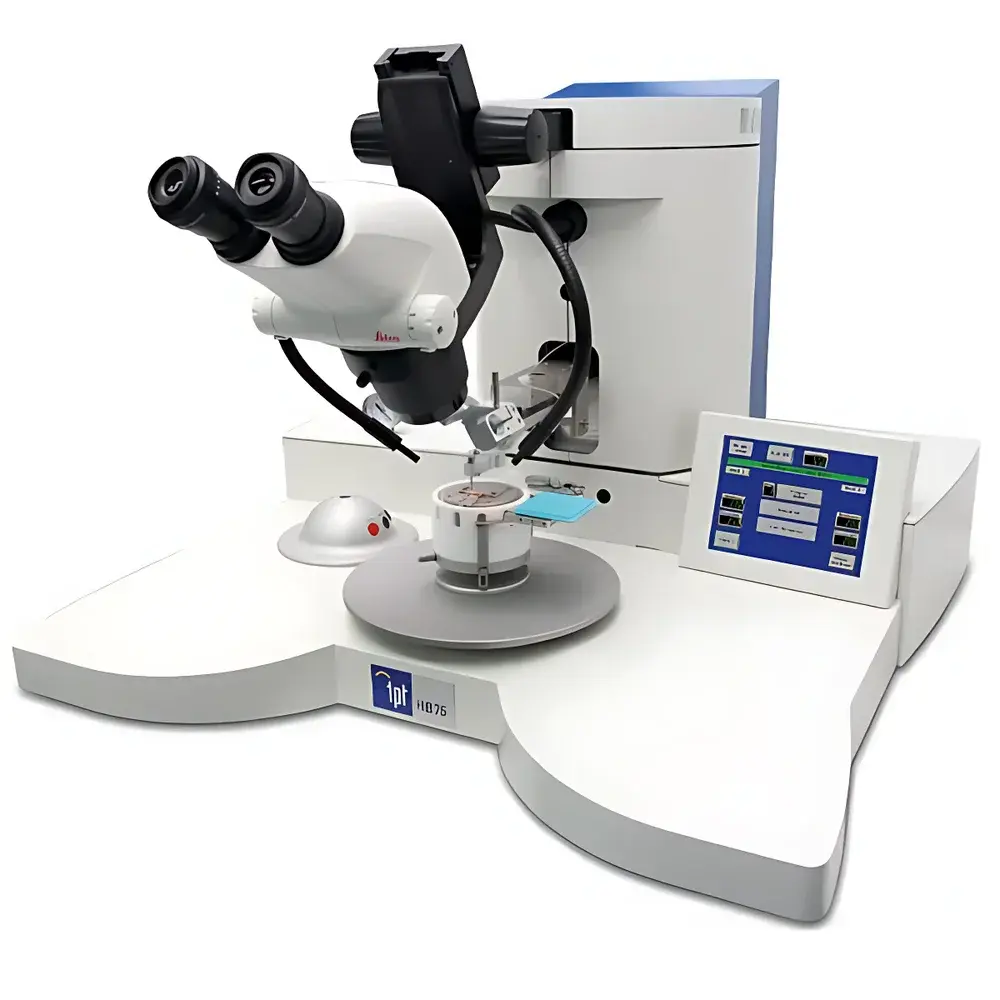
TPT HB75 Manual/Semi-Automatic Pick-and-Place Machine
| Brand | TPT |
|---|---|
| Origin | Germany |
| Model | TPT HB75 |
| Mounting Type | Desktop |
| Control Interface | 6.5" TFT Touchscreen |
| Z-Axis Drive | Motorized |
| Z-Travel | 17 mm |
| Placement Head Arm Length | 165 mm |
| X-Y Manipulator Range | 10 mm |
| Mechanical Lever Ratio | 6:1 |
| Chip Size Range | 100 µm × 100 µm to 10 mm × 10 mm |
| Placement Time | 1–10,000 ms (optional up to 20,000 ms) |
| Placement Force | 10–150 cN·m (optional up to 350 cN·m) |
| Vacuum Source | Integrated Pump |
| Nozzle Diameter | Ø1.58 mm, L=19 mm |
| Dispensing Capability | Optional Dot Dispensing & Standard Pick-and-Dip Adhesive Function |
| Temperature Control | Up to 250 °C ±1 °C |
| Power Supply | 100–240 V AC, ±10%, 50/60 Hz, max. 10 A |
| Dimensions (W×D×H) | 680 × 640 × 490 mm |
| Net Weight | 42 kg |
Overview
The TPT HB75 Manual/Semi-Automatic Pick-and-Place Machine is a precision-engineered desktop platform designed for high-accuracy die placement in low-volume, high-mix semiconductor assembly environments. Built on a rigid orthogonal motion architecture with motorized Z-axis actuation and mechanical lever-amplified X-Y fine positioning (6:1 ratio), the HB75 delivers repeatable sub-100 µm placement accuracy under manual or semi-automated operation. Its core functionality centers on controlled pick-and-place, pick-and-dip adhesive application, and optional micro-dispensing—enabling reliable handling of fragile, heterogeneous components ranging from MEMS dies and optical subassemblies to medical micro-sensors and MOEMS devices. The system operates without external vacuum or pneumatic infrastructure, integrating a dedicated vacuum pump and thermally regulated stage (up to 250 °C ±1 °C) to support flux-activated bonding, epoxy curing, and low-temperature solder preform reflow protocols. As a CE-compliant instrument manufactured in Germany and distributed globally through authorized technical channels, the HB75 meets foundational requirements for lab-based process development, NPI prototyping, and GLP-aligned qualification studies.
Key Features
- Motor-driven Z-axis with 17 mm travel and programmable force control (10–150 cN·m standard; 350 cN·m optional) for compliant die placement and bond-line thickness management
- Orthogonal X-Y manipulator with 10 mm range and 6:1 mechanical leverage for tactile, high-resolution manual positioning
- Rotatable nozzle turret enabling rapid interchange of standardized Ø1.58 mm × 19 mm vacuum nozzles—compatible with industry-standard ISO 80000-4 compliant tooling
- Integrated vacuum generation system eliminating dependency on facility-supplied vacuum lines
- 6.5-inch industrial-grade TFT touchscreen HMI with intuitive parameter navigation, real-time status feedback, and direct access to all operational settings
- Rotating substrate platform supporting angular alignment of non-rectangular dies and asymmetric optical elements
- Onboard memory for up to 100 user-defined placement programs, each configurable for dwell time (1–10,000 ms), Z-speed profile, vacuum threshold, and thermal setpoint
- Dual-mode operation: fully manual (lever-controlled) and semi-automatic (program-triggered placement with manual X-Y/Z override)
Sample Compatibility & Compliance
The HB75 accommodates substrates and dies spanning 100 µm × 100 µm to 10 mm × 10 mm, including silicon, glass, ceramic, and polymer-based components. It supports standard wafer frames (up to 6″), custom PCB carriers, and bare-die trays. Adhesive compatibility includes UV-curable epoxies, anisotropic conductive films (ACF), isotropic silver-filled pastes, and low-viscosity fluxes. The system conforms to IEC 61000-6-2 (immunity) and IEC 61000-6-4 (emission) standards. While not certified for Class 100 cleanroom use out-of-the-box, it is routinely deployed in ISO Class 5–7 environments when operated with laminar flow hoods. Its thermal module complies with EN 60519-1 for electrical safety in heating equipment.
Software & Data Management
The HB75 operates via embedded firmware with no PC dependency. All programs are stored locally in non-volatile memory with timestamped versioning. Parameter logs—including actual placement force, Z-position trajectory, vacuum onset time, and thermal ramp rate—are recorded per cycle and exportable via USB to CSV format. Audit trail functionality meets basic GLP documentation requirements, capturing operator ID (via optional RFID badge reader integration), program revision, and start/stop timestamps. While not FDA 21 CFR Part 11 compliant by default, the system supports third-party validation packages for regulated medical device assembly workflows.
Applications
- MEMS and MOEMS packaging R&D, including inertial sensor die attach and optical MEMS mirror alignment
- Hybrid optoelectronic assembly: VCSELs, photodiodes, and micro-lens arrays onto silicon photonics interposers
- Medical micro-device fabrication: piezoelectric transducer placement for ultrasound catheters and implantable pressure sensors
- Advanced packaging prototyping: chip-to-wafer and chip-to-substrate bonding with thermocompression or adhesive cure
- Academic and government lab use for failure analysis sample preparation, cross-section mounting, and TEM grid loading
- Low-volume production of specialty RF modules, quantum sensing platforms, and aerospace-grade hybrid circuits
FAQ
Does the HB75 require external vacuum or compressed air?
No—the system includes an integrated oil-free vacuum pump rated for continuous duty at ≤80 kPa suction pressure.
Can the HB75 handle wafers larger than 6 inches?
No—maximum supported carrier size is 6-inch wafer frame or equivalent footprint (≤150 mm × 150 mm).
Is thermal profiling logged during placement cycles?
Yes—stage temperature, ramp rate, soak duration, and final setpoint are captured per program execution and exported with placement metadata.
What level of maintenance does the motorized Z-axis require?
The brushless DC motor and lead-screw assembly are sealed and lubricated for life; recommended inspection interval is 12 months or 2,000 operating hours.
Are custom nozzle geometries supported?
Yes—TPT provides OEM nozzle design services; third-party nozzles must comply with ISO 80000-4 dimensional tolerances and vacuum port interface specifications.