
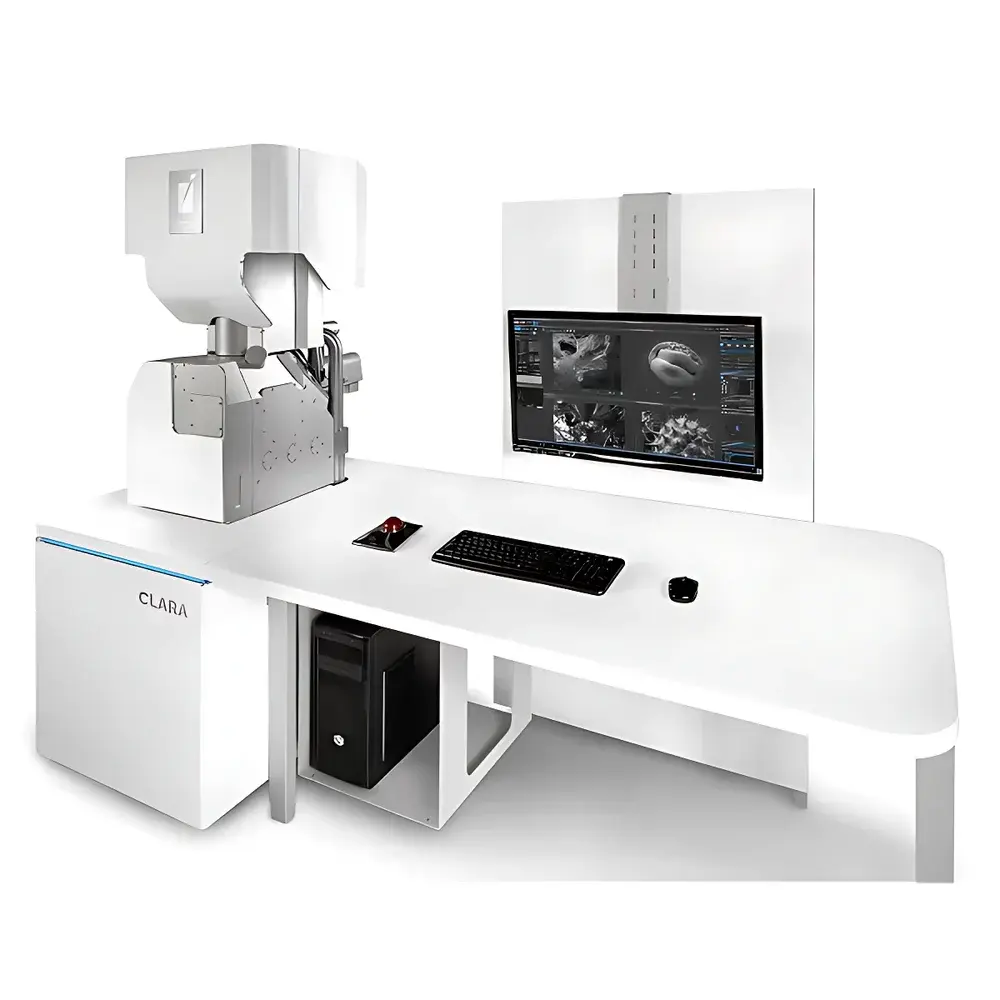
TESCAN CLARA Field Emission Scanning Electron Microscope
| Brand | TESCAN |
|---|---|
| Origin | Czech Republic |
| Model | TESCAN CLARA |
| Instrument Type | Floor-standing SEM |
| Electron Gun | Thermal Field Emission (TFE) |
| Secondary Electron (SE) Resolution | 0.9 nm @ 15 kV |
| Backscattered Electron (BSE) Resolution | 2.0 nm @ 30 kV (Low Vacuum Mode) |
| Accelerating Voltage | 50 V – 30 kV |
| Magnification Range | 2× – 2,000,000× |
Overview
The TESCAN CLARA Field Emission Scanning Electron Microscope (FE-SEM) is an advanced, floor-standing analytical platform engineered for high-resolution imaging, compositional contrast analysis, and multi-modal characterization of diverse solid-state materials. Built upon the proven architecture of the S8000 series, the CLARA integrates next-generation electron optics—including BrightBeam™ aberration-optimized lens design and EquiPower™ thermal management—to deliver sub-nanometer resolution across a wide accelerating voltage range (50 V to 30 kV). Its thermal field emission (TFE) electron source ensures exceptional beam stability, brightness, and long-term emission reproducibility—critical for quantitative EDS mapping, EBSD pattern acquisition, and low-voltage surface-sensitive imaging. Unlike conventional SEMs reliant on deceleration lenses or charge compensation stages, the CLARA achieves landing energies as low as 50 eV directly at the sample surface without beam retardation, minimizing charging artifacts on insulators and preserving structural integrity of beam-sensitive specimens such as polymers, biological tissues, and organic thin films.
Key Features
- BrightBeam™ Ultra-High-Resolution Lens System: A non-magnetic, aberration-corrected objective lens with zero magnetic leakage enables distortion-free imaging of ferromagnetic materials and eliminates interference with in-lens detectors or external sensors.
- Wide Field Optics™ Technology: Dual-objective configuration supports seamless transition between ultra-low magnification (2×) and ultra-high magnification (2,000,000×), enabling rapid area navigation and precise region-of-interest targeting without auxiliary optical cameras.
- Integrated In-Chamber BSE Detection Architecture: Axial BSE detector captures near-axis backscattered electrons for pure atomic-number (Z)-contrast imaging; Multidetector BSE system acquires mid-angle signals with optional energy filtering to simultaneously resolve topographic and compositional features.
- Real-Time Beam Optimization: EquiPower™ lens cooling combined with automated beam alignment and stigmation routines ensures consistent probe performance across all beam currents—essential for reproducible EDS quantification and EBSD indexing.
- Collision-Aware 3D Navigation: Real-time predictive collision modeling prevents mechanical interference during stage movement, safeguarding both sample integrity and column alignment—particularly critical during automated tilt-series or large-area mosaic acquisitions.
Sample Compatibility & Compliance
The CLARA accommodates a broad spectrum of specimen types—including non-conductive ceramics, hydrated biological sections, beam-sensitive pharmaceuticals, and magnetic alloys—without mandatory sputter coating or conductive mounting. Its low-voltage imaging capability (down to 50 V landing energy) mitigates surface charging and radiation damage, supporting compliant workflows under ISO/IEC 17025-accredited laboratories. The system meets electromagnetic compatibility (EMC) standards per EN 61326-1 and conforms to IEC 61000-6-3 for industrial environments. Optional vacuum modes (high vacuum, low vacuum, and variable pressure) facilitate direct observation of partially hydrated or outgassing samples—aligning with ASTM E2487 and ISO 16700 guidelines for SEM-based particle analysis and failure investigation.
Software & Data Management
TESCAN Essence™ is a modular, role-based software platform designed for GLP/GMP-aligned operations. It supports audit-trail logging per FDA 21 CFR Part 11 requirements, including user authentication, electronic signatures, and immutable record retention for all imaging, acquisition, and analysis parameters. Predefined workflows—such as “Quick Start,” “EDS Mapping,” or “EBSD Orientation Analysis”—can be saved, shared, and version-controlled across multi-user installations. All image metadata (accelerating voltage, working distance, dwell time, detector settings, stage coordinates) are embedded in TIFF/DM3 formats and exportable to LIMS or ELN systems via standardized APIs. Batch processing tools enable automated stitching, particle sizing (per ISO 13322-1), and statistical reporting without manual intervention.
Applications
- Materials Science: Grain boundary analysis in superalloys, porosity quantification in additively manufactured metals, phase identification in multiphase ceramics, and interfacial characterization of polymer composites.
- Life Sciences: Subcellular ultrastructure imaging of cryo-fractured tissues, correlative light-electron microscopy (CLEM) registration, and nanoscale drug delivery vehicle morphology assessment.
- Geosciences & Environmental Research: Mineralogical mapping of shale matrix components, microplastic identification in wastewater sludge, and diagenetic feature analysis in carbonate reservoir rocks.
- Industrial Quality Control: Defect root-cause analysis in semiconductor packaging, coating thickness verification on medical implants, and wear debris classification in lubricant monitoring programs.
FAQ
What vacuum modes does the TESCAN CLARA support?
The CLARA operates in high vacuum (HV), low vacuum (LV), and variable pressure (VP) modes—enabling imaging of conductive, semi-conductive, and partially hydrated specimens without metal coating.
Can the CLARA perform automated EDS elemental mapping?
Yes—integrated Bruker QUANTAX EDS hardware and ESPRIT software enable fully automated, drift-corrected mapping with live spectrum visualization and standardless quantification traceable to NIST SRM reference materials.
Is the system compatible with third-party EBSD detectors?
The CLARA features standardized flanges and synchronized trigger interfaces compliant with Oxford Instruments, EDAX, and Bruker EBSD systems—supporting full integration with pattern indexing, phase identification, and crystallographic orientation reconstruction.
How is user training and method transfer supported?
Essence™ includes method templates, remote desktop collaboration tools, and cloud-synced parameter libraries—allowing standardized operating procedures to be deployed across global laboratory networks while maintaining local calibration records.
Does the CLARA meet regulatory requirements for pharmaceutical QC labs?
With optional 21 CFR Part 11 compliance packages—including electronic signature validation, change control logs, and secure audit trails—the CLARA supports validated workflows in GMP-compliant pharmaceutical development and release testing environments.





