
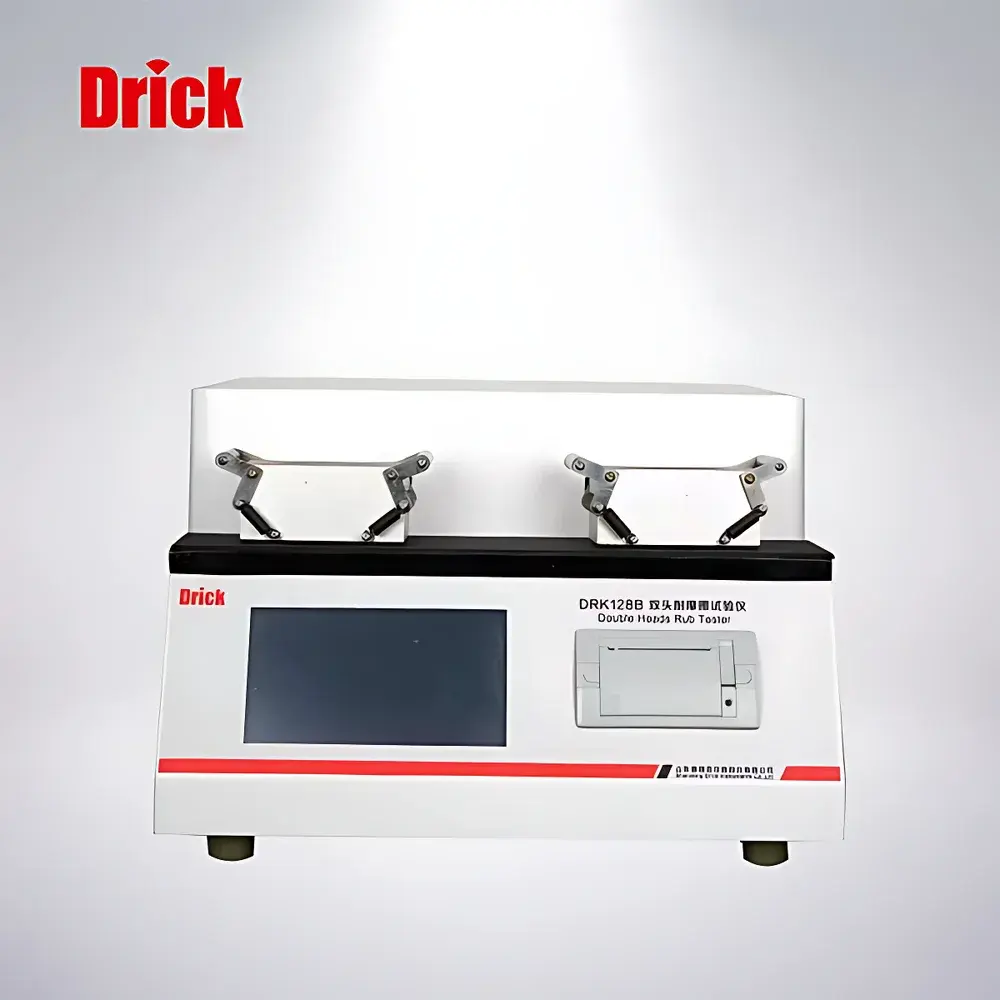
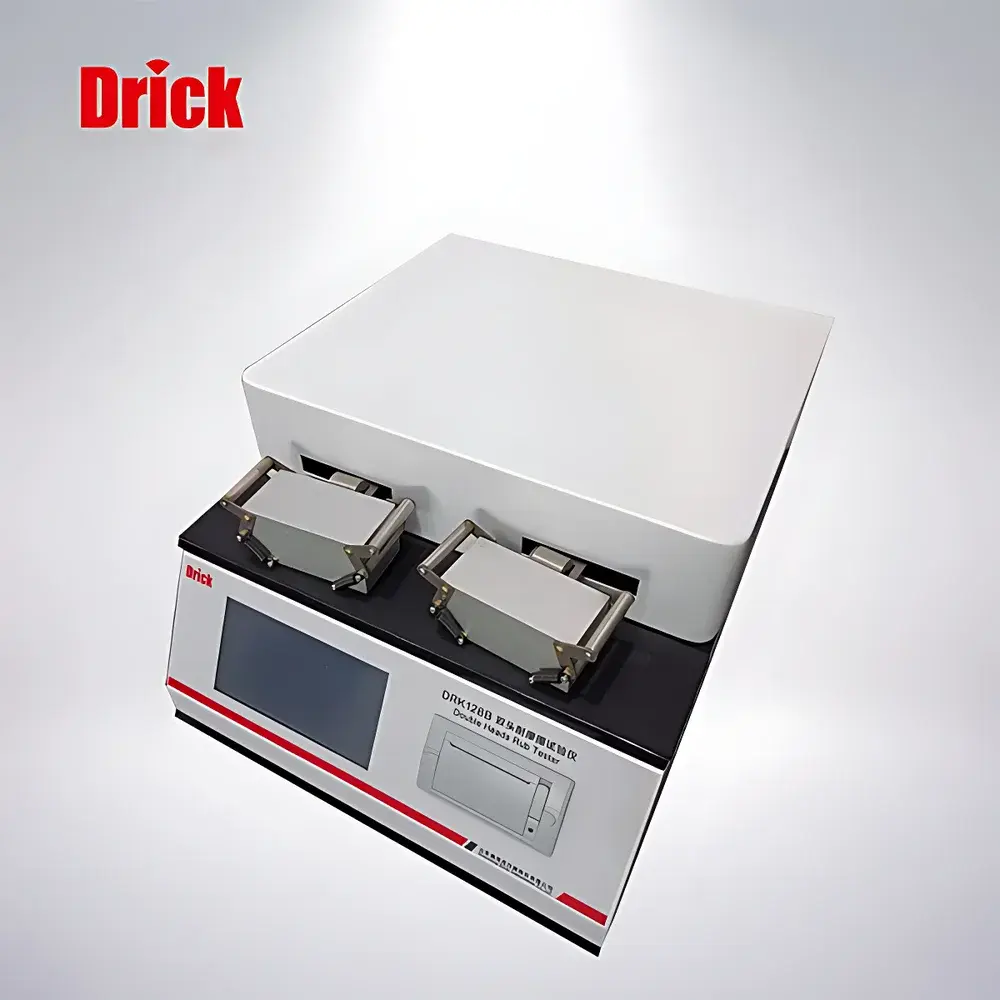
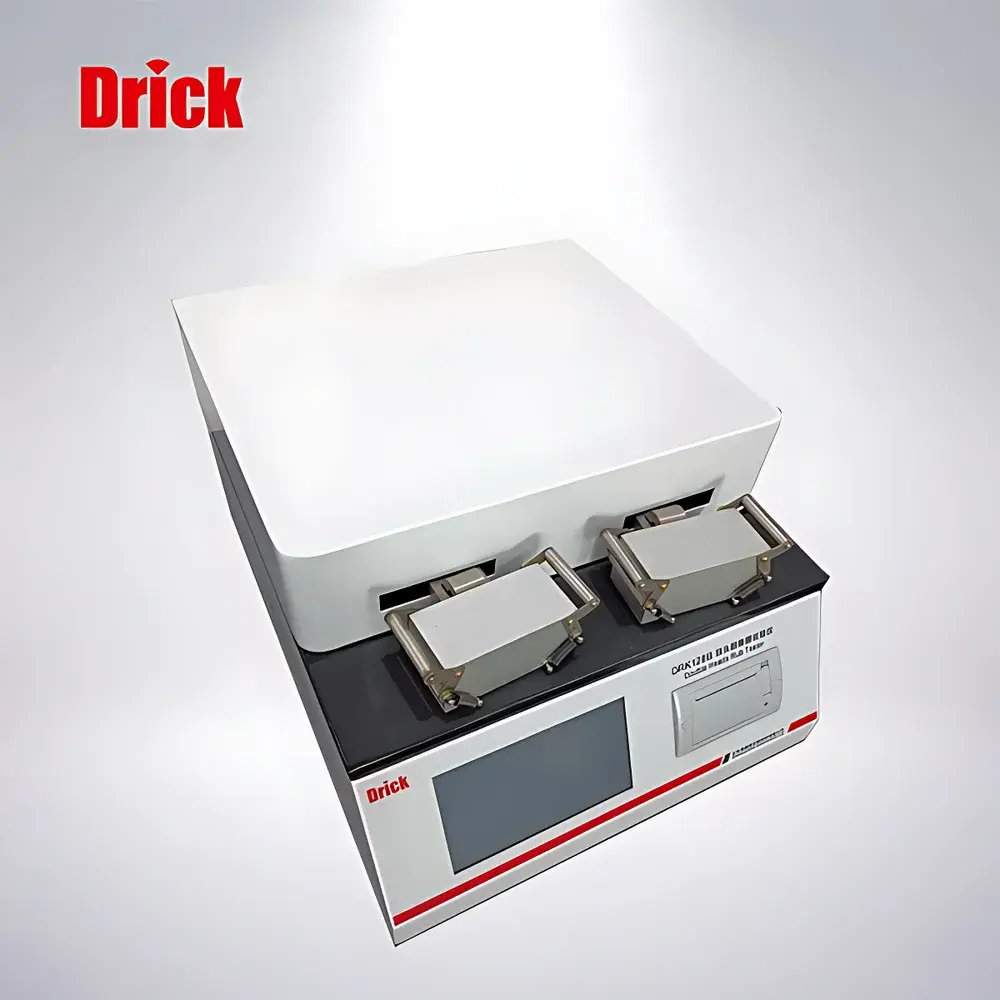
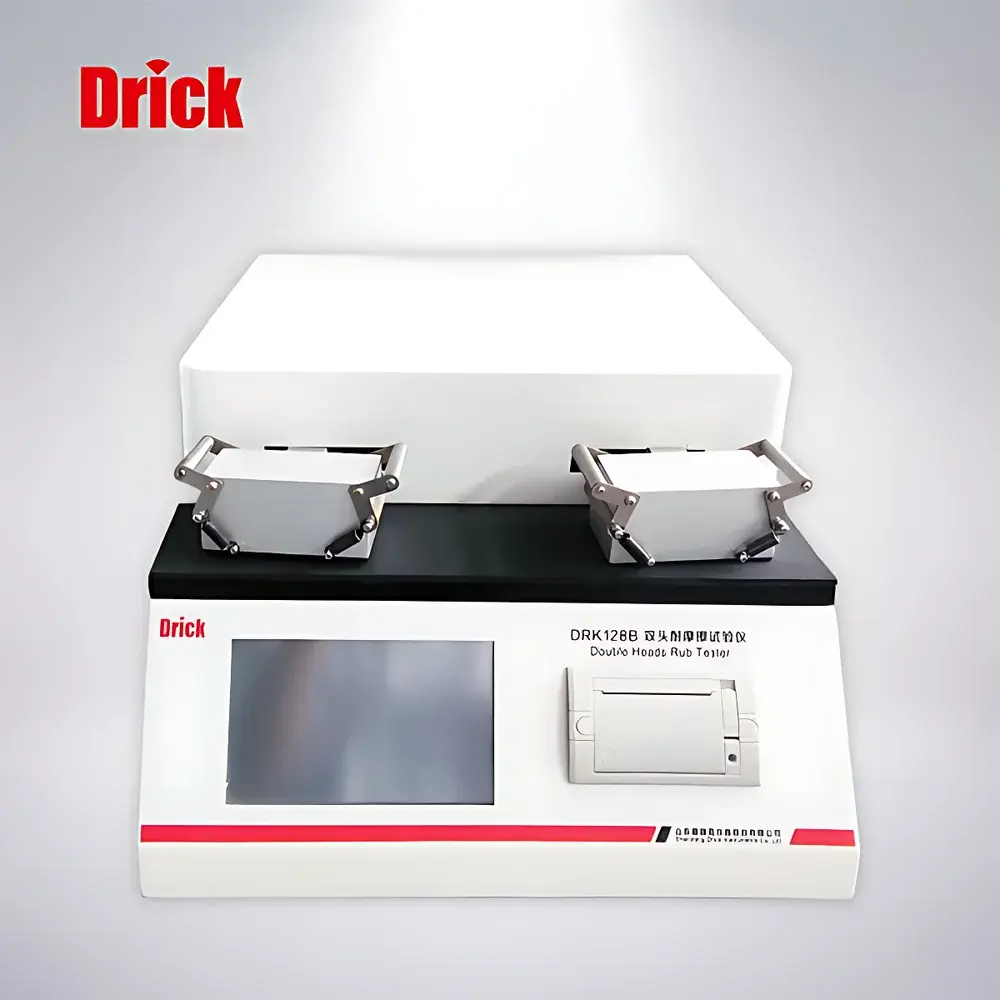
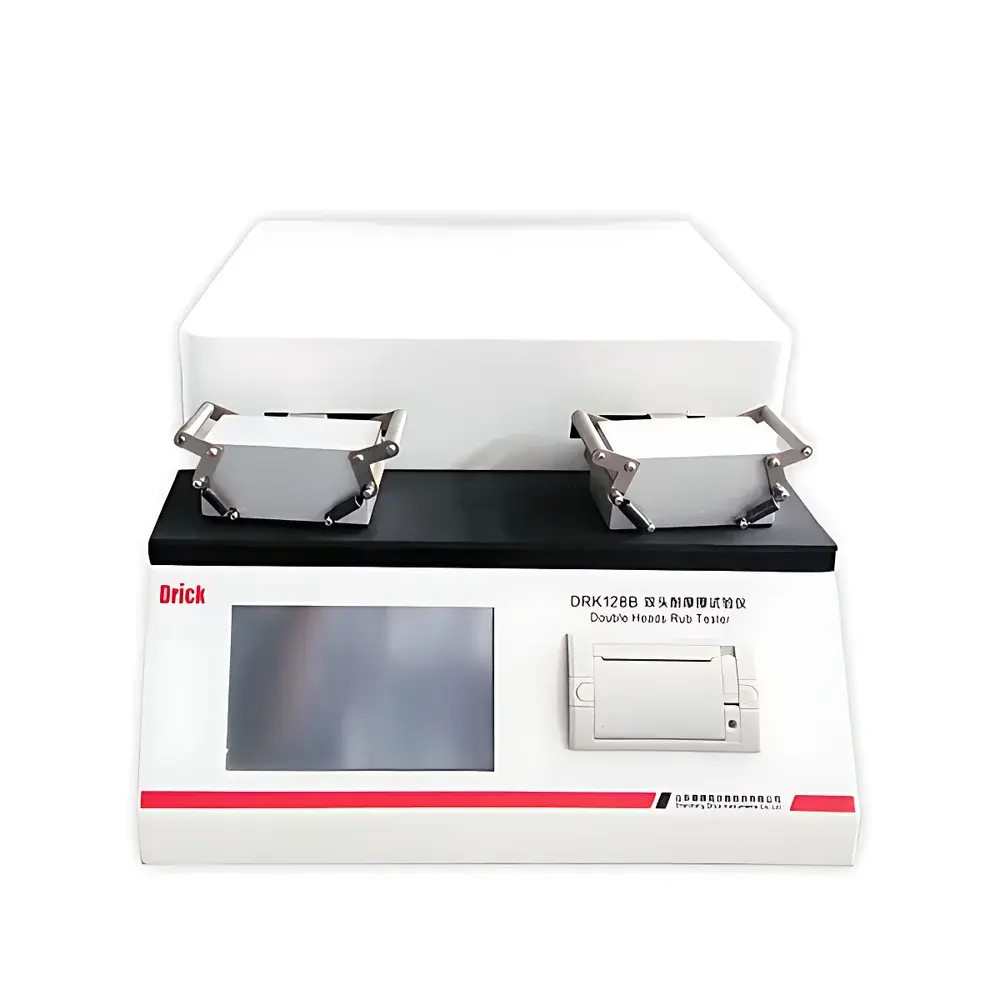
Drick DRK128B Key-Actuated Abrasion Tester for Printed Ink Layers
| Brand | Drick |
|---|---|
| Origin | Shandong, China |
| Manufacturer Type | Direct Manufacturer |
| Model | DRK128B |
| Applied Standards | GB/T 7706, ASTM D5264, JIS K5701, TAPPI T476 |
| Normal Force | 20 ± 0.2 N |
| Oscillation Frequency | 43 cycles per minute (cpm) |
| Contact Area | 155 mm (L) × 50 mm (B) |
| Test Cycles Range | 1–9999 |
| Specimen Size | 230 mm (L) × 50 mm (B) |
| Power Supply | AC 220 V, 50 Hz |
| Dimensions (W×D×H) | 260 mm × 245 mm × 340 mm |
| Net Weight | 17 kg |
Overview
The Drick DRK128B Key-Actuated Abrasion Tester is a precision-engineered instrument designed for quantitative evaluation of surface coating durability—specifically targeting printed ink layers, photosensitive emulsions on PS plates, and other functional thin-film coatings applied to paper, film, or board substrates. It operates on the principle of controlled reciprocating linear abrasion under defined normal force and fixed stroke geometry, simulating real-world mechanical wear conditions such as handling, stacking, transport, and press contact. Unlike rotary or rotary-oscillatory abrasion testers, the DRK128B employs a unidirectional oscillating motion with a rigid, embedded friction platform, ensuring repeatable contact pressure distribution and minimizing lateral shear artifacts. Its design complies with internationally recognized test methodologies for surface integrity assessment, including ISO/IEC 17025-aligned validation practices for laboratory instrumentation.
Key Features
- Calibrated normal force delivery system maintaining 20 ± 0.2 N across full cycle range—traceable to national metrological standards;
- Embedded friction stage with precisely machined 155 mm × 50 mm contact zone, guaranteeing uniform load distribution and eliminating edge-effect variability;
- Key-actuated start/stop interface with tactile feedback—designed for operator safety and procedural consistency in regulated environments;
- Non-volatile cycle memory: automatically retains setpoint and accumulated count during power interruption, supporting GLP-compliant workflow continuity;
- Acoustically damped drive mechanism enabling silent operation (<45 dB(A))—critical for shared lab spaces and long-duration endurance testing;
- Adjustable stroke counter with programmable upper limit (1–9999 cycles), facilitating both pass/fail threshold testing and degradation curve analysis.
Sample Compatibility & Compliance
The DRK128B accommodates flat, rigid specimens up to 230 mm × 50 mm, making it suitable for sheet-fed offset prints, flexographic labels, gravure foils, lithographic PS plates, and coated packaging substrates. It supports dry abrasion, wet abrasion (using standardized solvent-dampened cloths per ASTM D5264 Annex A), rub-fastness evaluation via grayscale or spectrophotometric ΔE measurement, and edge-blur assessment per ISO 12042. The instrument meets mechanical and performance requirements specified in GB/T 7706 (Chinese standard for gravure ink abrasion resistance), ASTM D5264 (standard practice for evaluating print rub resistance), JIS K5701 (Japanese standard for printing ink durability), and TAPPI T476 (rub resistance of printed surfaces). All calibration procedures align with ISO/IEC 17025 clause 6.5 for measurement traceability.
Software & Data Management
While the DRK128B operates as a standalone hardware unit with physical key controls, its test parameters—including applied force, cycle count, and elapsed time—are fully documentable within laboratory information management systems (LIMS) or electronic lab notebooks (ELN). The device’s deterministic mechanical behavior ensures high inter-laboratory reproducibility (CV < 2.3% across 10 replicate runs per ISO 5725-2), enabling audit-ready reporting. When integrated into GMP or GLP workflows, users may apply 21 CFR Part 11-compliant digital loggers to capture timestamped cycle data, operator ID, and environmental ambient logs (temperature/humidity)—all essential for regulatory submissions and internal quality audits.
Applications
- Quantitative assessment of ink adhesion strength in commercial printing QC labs;
- Evaluation of PS plate photosensitive layer wear resistance prior to press installation;
- Comparative testing of varnish, lacquer, and UV-curable topcoats on folding cartons and flexible packaging;
- Root-cause analysis of print marring, scuffing, or pigment transfer in post-conversion processes;
- Validation of substrate-coating compatibility during new material qualification (e.g., bio-based films, metallized PET);
- Supporting R&D efforts in developing abrasion-resistant ink formulations compliant with ISO 2836 or ISO 2846-1.
FAQ
What standards does the DRK128B directly support?
It is mechanically and functionally compliant with GB/T 7706, ASTM D5264, JIS K5701, and TAPPI T476. Calibration certificates include traceability statements aligned with ISO/IEC 17025.
Can the tester be used for wet abrasion testing?
Yes—by placing a standardized cotton cloth moistened with water or ethanol (per ASTM D5264 Section 7.3) on the friction pad, users can perform controlled wet-rub testing.
Is force calibration required before each test series?
No—its spring-loaded loading mechanism maintains stable 20 ± 0.2 N output over 10,000+ cycles; however, annual verification against certified deadweight standards is recommended per ISO/IEC 17025 clause 6.5.2.
Does the instrument generate digital output or connect to a PC?
It operates as an electromechanical standalone unit; cycle data must be manually recorded or captured via external time-lapse imaging or digital counter integration.
What maintenance intervals are recommended for long-term reliability?
Lubrication of the linear guide rails every 6 months and inspection of the friction pad surface for wear or debris accumulation after every 500 test cycles ensure consistent performance and measurement fidelity.





