
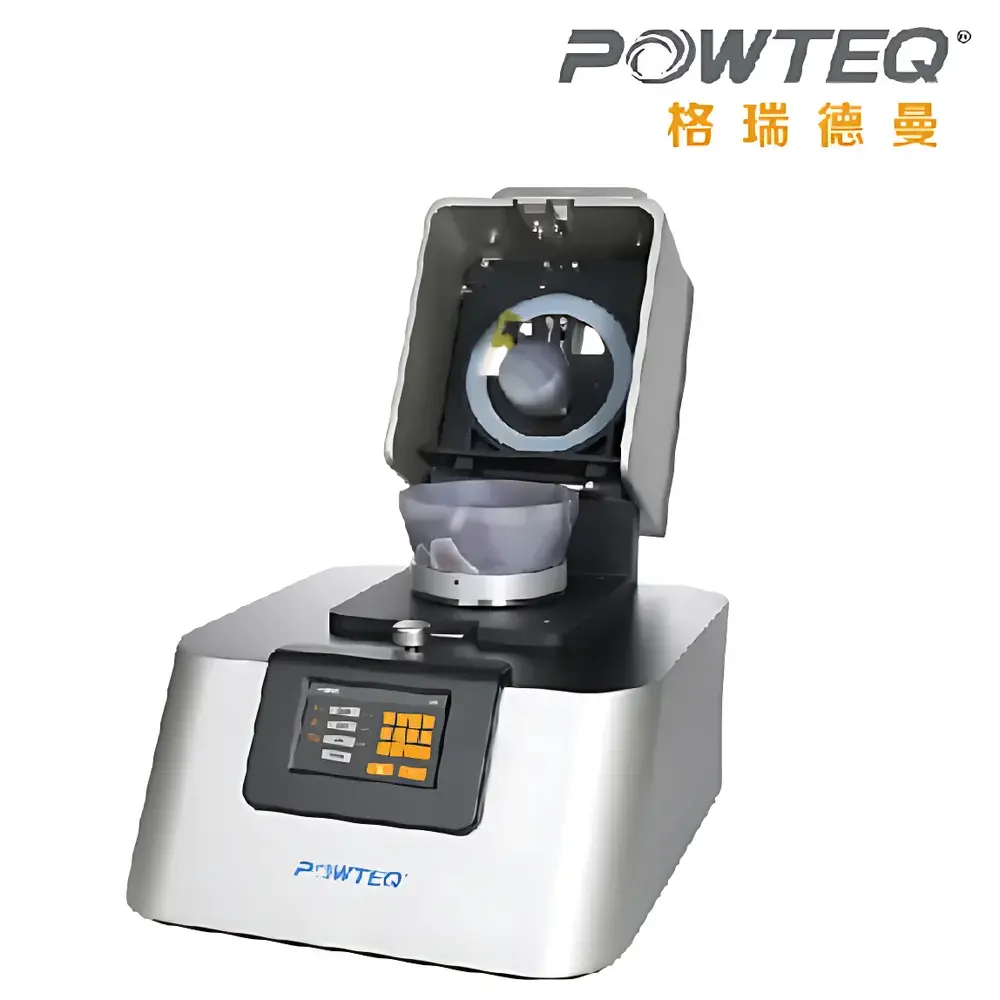
Grindemann MG200 Mortar Grinder
| Brand | Grindemann |
|---|---|
| Origin | Beijing, China |
| Manufacturer Type | Direct Manufacturer |
| Product Category | Domestic |
| Model | MG200 |
| Instrument Type | Mortar Grinder |
| Sample Suitability | Hard, Brittle, Soft & Paste-like Materials (Mohs Hardness ≤ 9) |
| Feed Size | ≤ 10 mm |
| Final Particle Size | < 5 µm (sample-dependent) |
| Batch Capacity | 10–200 mL |
| Speed Range | 50–130 rpm (digital display, continuously adjustable) |
| Rated Power | 200 W |
| Voltage | 220 V, 50/60 Hz |
| Display | 5-inch LED touchscreen |
| Safety Features | Interlocked lid switch, real-time motor load monitoring, automatic LED illumination upon lid opening |
| Adjustable Components | Vertical position of mortar pestle and scraper blade |
Overview
The Grindemann MG200 Mortar Grinder is a precision-engineered laboratory grinding system designed for reproducible, high-energy comminution of heterogeneous solid samples. Based on the classical mortar-and-pestle principle—enhanced by controlled rotational impact and shear forces—the MG200 delivers consistent particle size reduction across diverse material classes without thermal degradation or cross-contamination. Its mechanical architecture employs a vertically actuated, motor-driven pestle rotating inside a fixed ceramic or hardened steel mortar chamber, generating compressive, shearing, and abrasive forces ideal for brittle fracture and plastic deformation mechanisms. Unlike planetary ball mills or rotor-stator homogenizers, the MG200 operates at relatively low rotational speeds (50–130 rpm), minimizing sample heating while maintaining sufficient energy input for sub-5 µm final particle sizes. This makes it particularly suitable for applications requiring structural preservation (e.g., crystallinity analysis), volatile compound retention (e.g., essential oil extraction prep), or avoidance of metal contamination (e.g., geochemical reference materials). The device complies with fundamental mechanical safety standards for laboratory equipment (IEC 61010-1) and supports GLP-aligned workflows through traceable parameter logging and hardware interlocks.
Key Features
- 5-inch full-color LED touchscreen interface with intuitive icon-based navigation and real-time parameter visualization—including instantaneous motor load, rotational speed, and elapsed grinding time
- Interlocked safety lid switch: motor halts immediately upon lid opening; integrated LED illumination activates automatically to enable visual inspection during operation
- Vertically adjustable pestle and independently positionable scraper blade ensure optimal contact geometry for uniform force distribution and complete sample evacuation
- Multi-mode grinding capability: dry grinding, wet grinding (with solvent compatibility up to IPA, ethanol, and aqueous buffers), and cryogenic grinding (compatible with liquid nitrogen-cooled mortars)
- Modular mortar and pestle sets available in zirconia, tungsten carbide, stainless steel, and agate—selected per sample chemistry and hardness requirements (Mohs ≤ 9)
- Robust 200 W brushless DC motor with closed-loop speed control ensures stable torque delivery across variable load conditions
Sample Compatibility & Compliance
The MG200 accommodates a broad spectrum of sample types including but not limited to: cocoa beans, roasted coffee, dairy powders, maize kernels, legumes, latex emulsions, clay-rich soils, quartzite and basalt rock fragments, sintered ceramics, Portland cement clinker, metallurgical slags, and pharmaceutical excipients. All grinding protocols adhere to ISO 13320:2020 (particle size analysis — laser diffraction methods) sample preparation guidelines and support ASTM D2493 (standard practice for preparing coal samples for analysis). For regulated environments, the instrument’s parameter lockout function, audit trail-capable software interface (via optional GrindSoft v3.2), and hardware-level safety interlocks facilitate compliance with FDA 21 CFR Part 11 requirements when paired with validated electronic records systems.
Software & Data Management
The embedded firmware enables storage of up to 99 user-defined grinding protocols—each configurable with speed ramp profiles, dwell times, cooling intervals, and endpoint criteria (e.g., time-based or load-threshold termination). Optional GrindSoft v3.2 PC software provides remote monitoring, batch report generation (PDF/CSV), digital signature integration, and export of raw motor current and RPM logs for root-cause analysis of inconsistent results. All data fields are timestamped and user-attributed, supporting ALCOA+ principles (Attributable, Legible, Contemporaneous, Original, Accurate, Complete, Consistent, Enduring, Available) for quality assurance documentation.
Applications
- Preparation of homogenized reference materials for XRF, XRD, and SEM-EDS analysis
- Routine milling of food matrices prior to fat extraction (Soxhlet) or heavy metal digestion (EPA Method 3050B)
- Particle size reduction of catalyst supports and battery electrode precursors for BET surface area measurement
- Cryogenic grinding of polymer blends and thermolabile APIs to prevent thermal degradation prior to dissolution testing (USP <711>)
- Homogenization of heterogeneous environmental samples (sediments, sludges) for TCLP leaching studies (EPA Method 1311)
- Production of ultrafine ceramic slurries for tape casting and additive manufacturing feedstock qualification
FAQ
What materials are compatible with the MG200 mortar and pestle assemblies?
Zirconia, agate, tungsten carbide, and stainless steel options are available—selected based on sample hardness, chemical reactivity, and required purity level.
Can the MG200 be used for cryogenic grinding?
Yes; the mortar chamber is compatible with liquid nitrogen pre-cooling and sustained low-temperature operation when using cryo-rated components.
Is method validation support available for regulated laboratories?
Grindemann provides IQ/OQ documentation templates and can supply third-party calibration certificates traceable to NIST standards upon request.
How is cross-contamination prevented between batches?
The fully disassemblable design—combined with smooth-surface ceramic/metal components and absence of internal crevices—enables rapid manual cleaning or ultrasonic decontamination per SOP.
Does the MG200 meet electrical safety standards for international use?
The unit conforms to IEC 61010-1:2010 for laboratory electrical equipment and includes dual insulation, overcurrent protection, and grounded chassis construction.



