
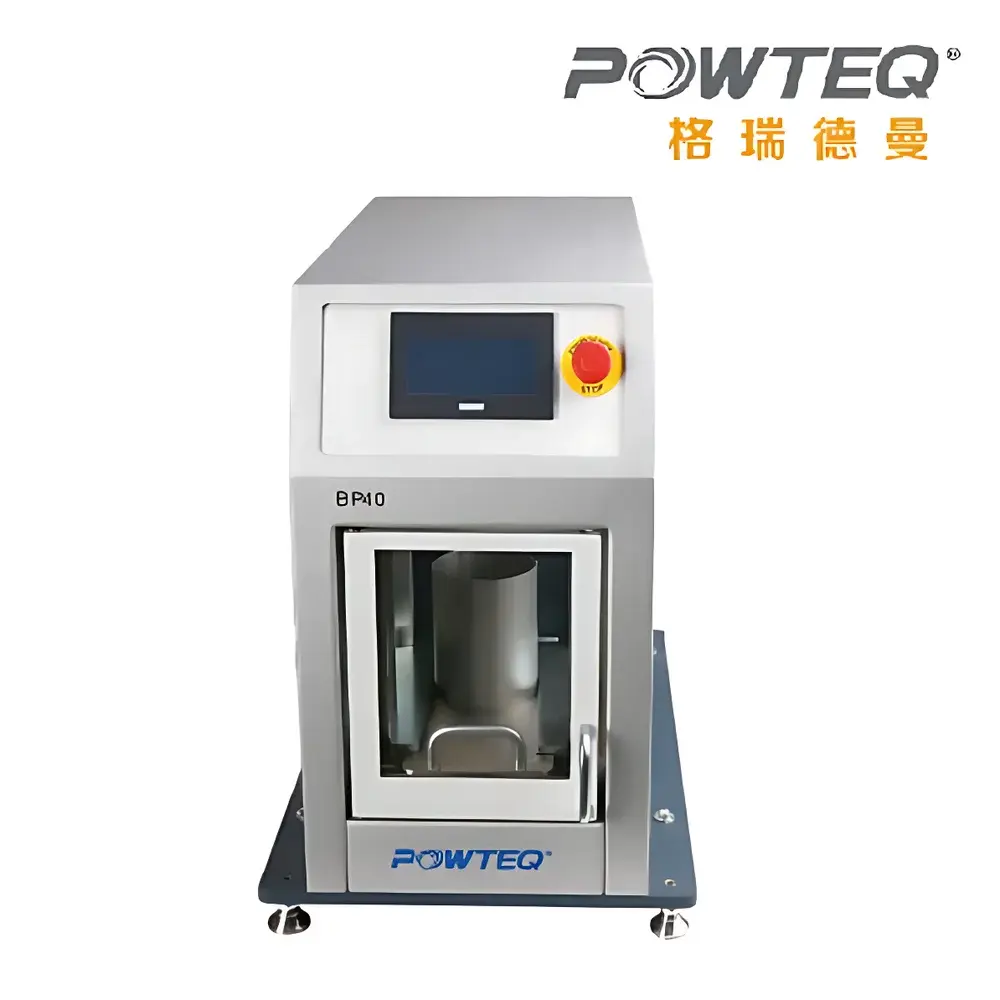
Grindemann BP40 Fully Automatic Benchtop Pellet Press
| Brand | Grindemann |
|---|---|
| Origin | Beijing, China |
| Manufacturer Type | Direct Manufacturer |
| Country of Origin | China |
| Model | BP40 |
| Instrument Type | Fully Automatic Pellet Press |
| Primary Function | Powder Compaction for Analytical Sample Preparation |
| Maximum Pressure | 400 kN (40 metric tons) |
| Control Interface | Touchscreen Display with Digital Readout |
| Programmable Presets | 10 user-defined press cycles |
| Pressure & Timing Control | Adjustable compression pressure, dwell time, and decompression rate |
| Compatible Die Sizes | Internal diameters: 32 mm, 35 mm |
| External diameters | 40 mm, 51.5 mm (stainless steel dies) |
| Footprint | Benchtop, compact structural design |
| Safety Compliance | Integrated mechanical and electronic safety interlocks |
| Application Scope | XRF, NIR, ICP-OES/MS sample preparation |
Overview
The Grindemann BP40 Fully Automatic Benchtop Pellet Press is an engineered solution for reproducible, high-density pellet fabrication from powdered analytical samples. Designed around uniaxial hydraulic compaction principles, the BP40 applies controlled, programmable force to consolidate fine particulates—such as geological, metallurgical, or industrial powders—into mechanically stable, flat-surface pellets suitable for quantitative elemental analysis. Its operation adheres to fundamental powder metallurgy mechanics: under increasing axial load, interparticle friction and plastic deformation reduce void volume, while a defined dwell period at peak pressure promotes particle bonding via cold welding and surface adhesion. This process yields pellets with uniform density distribution, minimal edge chipping, and low porosity—critical prerequisites for minimizing matrix effects in X-ray fluorescence (XRF) spectroscopy, near-infrared (NIR) reflectance measurement, and subsequent digestion for inductively coupled plasma (ICP) analysis.
Key Features
- Hydraulically actuated compaction system delivering up to 400 kN (40 metric tons) maximum force, calibrated and traceable to national standards
- Integrated touchscreen HMI with real-time digital pressure feedback, enabling precise setting and monitoring of compression pressure, dwell duration (0–300 s), and controlled decompression rate
- 10 programmable press protocols stored locally—each configurable with independent pressure setpoints, hold times, and die-specific parameters
- Benchtop form factor (W × D × H: 480 × 420 × 560 mm) optimized for space-constrained laboratories; reinforced steel frame ensures vibration damping and long-term mechanical stability
- Interchangeable stainless-steel die sets supporting standard analytical pellet geometries: 32 mm and 35 mm internal diameter (ID), plus 40 mm and 51.5 mm external diameter (OD) configurations—compatible with ASTM E1792, ISO 12846, and USP <1057> pellet geometry guidelines
- Dual-safety architecture: hardware-based emergency stop circuit combined with software-enforced pressure limit override and automatic column retraction upon cycle completion
Sample Compatibility & Compliance
The BP40 accommodates a broad spectrum of inorganic and composite powders—including crushed ores, cement clinkers, fly ash, slag, glass frits, ceramic precursors, and geological reference materials—with particle size distributions typically < 75 µm (200 mesh). Its high-force capability enables consolidation of inherently low-cohesion or ultra-hard matrices (e.g., quartz-rich silicates, alumina ceramics) without binder addition. All operational parameters comply with GLP and GMP documentation requirements: audit trails record timestamped cycle logs (including pressure curve metadata), user ID, and program version. The system supports 21 CFR Part 11–compliant electronic signatures when integrated with validated LIMS environments.
Software & Data Management
Press cycle execution and parameter logging are managed via embedded firmware—not external PC software—ensuring deterministic timing and eliminating OS-level latency. Each completed cycle generates a structured CSV log containing: start time, selected program ID, applied peak pressure (kN), actual dwell duration (s), final pellet thickness (mm, measured via optional integrated displacement sensor), and operator ID. Logs are exportable via USB port in UTF-8 format; no proprietary file formats or vendor-locked readers are used. Firmware updates are delivered as signed binary packages with SHA-256 checksum verification.
Applications
- XRF quantitative analysis: production of homogeneous, binder-free pellets for major/minor/trace element determination in mining QA/QC, cement raw mix control, and environmental soil screening
- NIR calibration sample preparation: creation of spectrally stable pellets for chemometric model development in agricultural feedstock and pharmaceutical excipient analysis
- ICP pre-digestion standardization: fabrication of certified reference material (CRM) pellets to minimize heterogeneity-induced digestion bias
- Research-scale powder densification studies: parametric investigation of pressure–density–porosity relationships under controlled thermal and atmospheric conditions (when used inside gloveboxes or dry rooms)
- Quality assurance in refractory manufacturing: validation of green-body integrity prior to sintering
FAQ
What is the maximum recommended operating pressure for routine XRF pellet preparation?
For most geological and industrial powders, optimal XRF performance is achieved between 250–350 kN; 400 kN is reserved for exceptionally hard or low-density matrices requiring full consolidation.
Does the BP40 support automated die ejection or require manual removal?
Pellets are manually extracted post-cycle using standard die punches; the system does not include motorized ejection to maintain mechanical simplicity and serviceability.
Can third-party dies be used with the BP40?
Yes—any DIN/ISO-standardized stainless-steel die with compatible outer diameter (40 mm or 51.5 mm) and height ≤ 65 mm may be installed, provided it meets minimum hardness (≥ HRC 50) and surface finish (Ra ≤ 0.8 µm) specifications.
Is calibration certification included with shipment?
Each unit ships with a factory-issued calibration certificate traceable to CNAS-accredited standards, covering pressure transducer linearity (±0.5% FS) and dwell timer accuracy (±0.1 s).
What maintenance intervals are recommended?
Hydraulic oil replacement every 24 months or 2,000 cycles; die cleaning after each use; annual verification of pressure transducer drift and safety interlock response time.



